
Masteries
Arithmoí Book 1
Essential to the undertaking is that mathematics be the means of conveying the topic. The synthesis presented in the book starts by first bringing to light the historical human biases pervasive in mathematics, physics, and metaphysics subject matter. Anthropomorphism, meaning attributing human emotions, traits, and intents to non-human forms, is a deeply rooted inclination in the human psyche. Evidence for this abounds when we consider religion and mythos, where divine entities took human forms, traits, and qualities. How the human sensorium interprets phenomena lends itself to the tendency to overemphasize what is physically perceived while abandoning the concern of understanding the holos. Anthropocentrism, also known as homocentrism, is another closely related belief system that places humans at the center of the Universe. A prime example of this in the past was the geocentric model, which put the Earth at the center of the solar system during a time that preceded any understanding of what galaxies and the Universe were. Some still believe that the observer plays a fundamental role in the observed quantum mechanical system, and this should be considered a form of anthropocentrism.
Get the book
- Read onlineIn the reader: its maths, figures and contents, on a phone or a computerRead online
- The printed bookBuying it supports the work of those who wrote itBuy the book
- Study it as a courseLessons, questions and your progressStudy online
Contents
- Introduction
- Acknowledgments
1.1 Matrix Group Theory
- 1.1.1 Matrix Group Theory
- 1.1.2 Matrix Group Properties
- 1.1.3 General Linear Group
- 1.1.4 Special Linear Group
- 1.1.5 Orthogonal Groups
- 1.1.6 The Linear Transformation
- 1.1.7 Group Exponentiation
- 1.1.8 The Singular Value Decomposition
- 1.1.9 The Matrix Transpose
- 1.1.10 Calculating the SVD
- 1.1.11 The Commutator
- 1.1.12 Complex Powers and Logarithms
- 1.1.13 Matrix Powers and Logarithms
- 1.1.14 Symmetric and Dihedral Groups
- 1.1.15 The Groups
- 1.1.16 The Dihedral Groups
- 1.1.17 The Symmetric/Dihedral Isomorphism
- 1.1.18 The Group
- 1.1.19 The DihedralGroup and Symmetry Transformations
- 1.1.20 The Symmetry Group
- 1.1.21 Polygonal Rotations in
- 1.1.22 Hilbert Spaces
- 1.1.23 Geometric Visualization of the Inner Product
- 1.1.24 The Cartan Subalgebra of U(3)
- 1.1.25 The Anti-Diagonal Symmetry of the Cartan Subalgebra
- 1.1.26 The Symmetric/Dihedral Cone Group
- 1.1.27 Projective Forms
1.2 Tangent Spaces and Differential Forms
- 1.2.1 Tangent Spaces and Differential Forms
- 1.2.2 The Cyclic Trigonometric Functions and their Derivatives
- 1.2.3 The Dihedral Differential Forms
- 1.2.4 The Dihedral Differential Group
- 1.2.5 The Dihedral Cone Differential Group
- 1.2.6 The Lie Algebra and Differential Forms
- 1.2.7 Tangent Spaces
- 1.2.8 Dihedral Group Tangent Spaces
- 1.2.9 Numeri Mirabiles
- 1.2.10 Summary
1.3 Curvature and Light
- 1.3.1 Curvature and Light
- 1.3.2 The Space of Angles
- 1.3.3 Vector Representations in Complex-Angled Space
- 1.3.4 Curvature
- 1.3.5 Circular Curvature and the Wave Equation
- 1.3.6 Hyperbolic Curvature
- 1.3.7 Complex Curvature
- 1.3.8 Geometric Algebra
- 1.3.9 The Asymptotic Light Functions
- 1.3.10 The Curvature of Light
- 1.3.11 Summary
1.4 Matrix Group Conic Sections
- 1.4.1 Matrix Group Conic Sections
- 1.4.2 SU(2) as the Inscribed Sphere of the Light Cone
- 1.4.3 The Tangent Space of the Cone
- 1.4.4 Null Curves and the Cone Group
- 1.4.5 Number Forms, Odd and Even Partition Geometry, and Minimal Elements
- 1.4.6 The Conic Group
- 1.4.7 The Axis Group
- 1.4.8 The Subgroup of the Symmetric Conic Group
- 1.4.9 The SU(2) Subgroup of the Symmetric Conic Group
- 1.4.10 The Pauli Matrices Subgroup of the Symmetric Conic Group
- 1.4.11 Geometric Visualization of Matrix Group Conics
- 1.4.12 Summary
1.5 Tangent Space Angles and Path-Connectedness in the Symmetric Cone Group
- 1.5.1 Tangent Space Angles and Path-Connectedness in the Symmetric Cone Group
- 1.5.2 The Symmetric Cone Group Lie Algebra
- 1.5.3 The Matrix Logarithm
- 1.5.4 The Baker-Campbell-Hausdorff Formula
- 1.5.5 The Matrix-Matrix Exponential
- 1.5.6 The Matrix-Matrix Exponential and Smoothing the Tangent Space
- 1.5.7 Smoothing the Minimal Element Basis
- 1.5.8 The Infinite Symmetry Group and the Subtangent Space
- 1.5.9 Subtangent Vectors
- 1.5.10 Summary
1.6 The Singularity
- 1.6.1 The Singularity
- 1.6.2 Infinite Differentiation and the Matrix Logarithm
- 1.6.3 Matrix-Based Infinite Integration and Differentiation
- 1.6.4 Harmonic Logarithms and the Infinite Subtangent Space
- 1.6.5 Outer Products and Infinities
- 1.6.6 The Alternating Harmonic Series and its Inverse Analog
- 1.6.7 Transformations and Representation Theory
- 1.6.8 Matrix Determinants and the Infinite Symmetry Group
- 1.6.9 The Infinite Sphere of Tangent Spaces
- 1.6.10 Summary
1.7 Prime Numbers and the Geometry of the Minimal Element
- 1.7.1 Prime Numbers and the Geometry of the Minimal Element
- 1.7.2 The Geometric Primes and the Higher-Ordered Forms
- 1.7.3 Prime Number Theory and the Geometry of Groups
- 1.7.4 Primality
- 1.7.5 Discussion and Summary
1.8 The Flowing Point and the Theory of Light
- 1.8.1 The Flowing Point and the Theory of Light
- 1.8.2 The Flowing Point of Axial Light
- 1.8.3 The Quantum Flowing Point
- 1.8.4 Relativistic Mechanics and the Unified Field
- 1.8.5 The Unit Invariant Mass and the Flowing Point Ideals
- 1.8.6 The Theory of Light
- 1.8.7 Summary
- Conclusion
- References
This edition
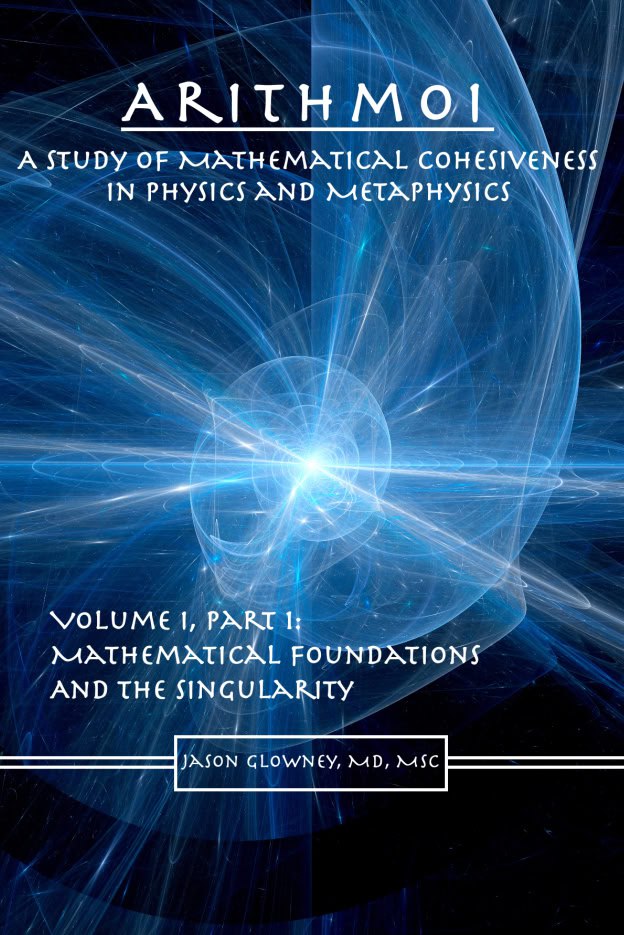
Arithmoí
A Study of Mathematical Cohesiveness in Physics and Metaphysics
Volume I, Part 1:
Mathematical Foundations and the Singularity
Jason Glowney

Athene Noctua Press
Boulder, Colorado USA
2023
This book is dedicated to all of those who have fought, and continue to fight, to bring humanity out of intellectual darkness and into the light.
To my wife Emily and my sons Maximilien and Aidan.
Athene Noctua Press
4745 Arapahoe, Suite 300
Boulder, Colorado, 80303 USA
ISBN- 9798863031958
Copyright, 2023, by
Athene Noctua Press
Boulder, Colorado
All rights reserved. The Arithmoí Series, or parts thereof,
may not be reproduced in any form, or translation, without the
permission in writing from the publishers.