Masteries · Jason GlowneyArithmoí Book 1

Masteries

1.7.4 Primality

The prime num­bers are dis­tin­guished from the non-primes by their common co­or­di­nates at the in­ter­sec­tion of the gpg_{p} and e(2iπn[(n−1)!])e^{\left( \frac{2i\pi}{n}\left\lbrack (n - 1)! \right\rbrack \right)} curves. In­tu­itive­ly, the fac­to­r­i­al func­tion as (n−1)!(n - 1)!rep­re­sents the means to check for even di­vis­i­bil­i­ty for a nat­ur­al number nn. Taking the (n−1)!(n - 1)!fac­to­r­i­al, we can create an (n−1)×(n−1)(n - 1) \times (n - 1) matrix array where each row/column entry (j,k)(j,k) equals

(j,k)=mod(j×k,   n),\begin{array}{r} (j,k) = mod(j \times k,\ \ \ n), \end{array}
(1.7.372)

which is im­ple­ment­ed using the fol­low­ing MATLAB code for a spec­i­fied nat­ur­al number n:n:

NumM= [];

n1=n;

for j=1:(n1-1)

vec= [];

for k=1:(n1-1)

iter=mod(j*k, n1);

vec= [vec, iter];

end

NumM= [NumM; vec];

end

We use this al­go­rithm to eval­u­ate the nat­ur­al num­bers from 55 to 1010, ar­rang­ing these ma­tri­ces in the array

Mn=(M5M6M7M8M9M10).\begin{array}{r} M_{n} = \begin{pmatrix} M_{5} & M_{6} & M_{7} \\ M_{8} & M_{9} & M_{10} \end{pmatrix}. \end{array}
(1.7.373)
1234
2\textcolor[HTML]{0070C0}{2}4\textcolor[HTML]{0070C0}{4}1\textcolor[HTML]{0070C0}{1}3\textcolor[HTML]{0070C0}{3}
3\textcolor[HTML]{0070C0}{3}1\textcolor[HTML]{0070C0}{1}4\textcolor[HTML]{0070C0}{4}2\textcolor[HTML]{0070C0}{2}
4321
12345
2\textcolor[HTML]{0070C0}{2}4\textcolor[HTML]{0070C0}{4}0\textcolor[HTML]{FF0000}{0}2\textcolor[HTML]{0070C0}{2}4\textcolor[HTML]{0070C0}{4}
3\textcolor[HTML]{0070C0}{3}0\textcolor[HTML]{FF0000}{0}3\textcolor[HTML]{0070C0}{3}0\textcolor[HTML]{FF0000}{0}3\textcolor[HTML]{0070C0}{3}
420\textcolor[HTML]{FF0000}{0}42
5\textcolor[HTML]{0070C0}{5}4\textcolor[HTML]{0070C0}{4}3\textcolor[HTML]{0070C0}{3}2\textcolor[HTML]{0070C0}{2}1\textcolor[HTML]{0070C0}{1}
123456
2\textcolor[HTML]{0070C0}{2}4\textcolor[HTML]{0070C0}{4}6\textcolor[HTML]{0070C0}{6}1\textcolor[HTML]{0070C0}{1}3\textcolor[HTML]{0070C0}{3}5\textcolor[HTML]{0070C0}{5}
3\textcolor[HTML]{0070C0}{3}6\textcolor[HTML]{0070C0}{6}2\textcolor[HTML]{0070C0}{2}5\textcolor[HTML]{0070C0}{5}1\textcolor[HTML]{0070C0}{1}4\textcolor[HTML]{0070C0}{4}
415263
5\textcolor[HTML]{0070C0}{5}3\textcolor[HTML]{0070C0}{3}1\textcolor[HTML]{0070C0}{1}6\textcolor[HTML]{0070C0}{6}4\textcolor[HTML]{0070C0}{4}2\textcolor[HTML]{0070C0}{2}
654321
1234567
2\textcolor[HTML]{0070C0}{2}4\textcolor[HTML]{0070C0}{4}6\textcolor[HTML]{0070C0}{6}0\textcolor[HTML]{FF0000}{0}2\textcolor[HTML]{0070C0}{2}4\textcolor[HTML]{0070C0}{4}6\textcolor[HTML]{0070C0}{6}
3\textcolor[HTML]{0070C0}{3}6\textcolor[HTML]{0070C0}{6}1\textcolor[HTML]{0070C0}{1}4\textcolor[HTML]{0070C0}{4}7\textcolor[HTML]{0070C0}{7}2\textcolor[HTML]{0070C0}{2}5\textcolor[HTML]{0070C0}{5}
40\textcolor[HTML]{FF0000}{0}40\textcolor[HTML]{FF0000}{0}40\textcolor[HTML]{FF0000}{0}4
5\textcolor[HTML]{0070C0}{5}2\textcolor[HTML]{0070C0}{2}7\textcolor[HTML]{0070C0}{7}4\textcolor[HTML]{0070C0}{4}1\textcolor[HTML]{0070C0}{1}6\textcolor[HTML]{0070C0}{6}3\textcolor[HTML]{0070C0}{3}
6420\textcolor[HTML]{FF0000}{0}642
7\textcolor[HTML]{0070C0}{7}6\textcolor[HTML]{0070C0}{6}5\textcolor[HTML]{0070C0}{5}4\textcolor[HTML]{0070C0}{4}3\textcolor[HTML]{0070C0}{3}2\textcolor[HTML]{0070C0}{2}1\textcolor[HTML]{0070C0}{1}
12345678
2\textcolor[HTML]{0070C0}{2}4\textcolor[HTML]{0070C0}{4}6\textcolor[HTML]{0070C0}{6}8\textcolor[HTML]{0070C0}{8}1\textcolor[HTML]{0070C0}{1}3\textcolor[HTML]{0070C0}{3}5\textcolor[HTML]{0070C0}{5}7\textcolor[HTML]{0070C0}{7}
3\textcolor[HTML]{0070C0}{3}6\textcolor[HTML]{0070C0}{6}0\textcolor[HTML]{FF0000}{0}3\textcolor[HTML]{0070C0}{3}6\textcolor[HTML]{0070C0}{6}0\textcolor[HTML]{FF0000}{0}3\textcolor[HTML]{0070C0}{3}6\textcolor[HTML]{0070C0}{6}
48372615
5\textcolor[HTML]{0070C0}{5}1\textcolor[HTML]{0070C0}{1}6\textcolor[HTML]{0070C0}{6}2\textcolor[HTML]{0070C0}{2}7\textcolor[HTML]{0070C0}{7}3\textcolor[HTML]{0070C0}{3}8\textcolor[HTML]{0070C0}{8}4\textcolor[HTML]{0070C0}{4}
630\textcolor[HTML]{FF0000}{0}630\textcolor[HTML]{FF0000}{0}63
7\textcolor[HTML]{0070C0}{7}5\textcolor[HTML]{0070C0}{5}3\textcolor[HTML]{0070C0}{3}1\textcolor[HTML]{0070C0}{1}8\textcolor[HTML]{0070C0}{8}6\textcolor[HTML]{0070C0}{6}4\textcolor[HTML]{0070C0}{4}2\textcolor[HTML]{0070C0}{2}
87654321
123456789
2\textcolor[HTML]{0070C0}{2}4\textcolor[HTML]{0070C0}{4}6\textcolor[HTML]{0070C0}{6}8\textcolor[HTML]{0070C0}{8}0\textcolor[HTML]{FF0000}{0}2\textcolor[HTML]{0070C0}{2}4\textcolor[HTML]{0070C0}{4}6\textcolor[HTML]{0070C0}{6}8\textcolor[HTML]{0070C0}{8}
3\textcolor[HTML]{0070C0}{3}6\textcolor[HTML]{0070C0}{6}9\textcolor[HTML]{0070C0}{9}2\textcolor[HTML]{0070C0}{2}5\textcolor[HTML]{0070C0}{5}8\textcolor[HTML]{0070C0}{8}1\textcolor[HTML]{0070C0}{1}4\textcolor[HTML]{0070C0}{4}7\textcolor[HTML]{0070C0}{7}
48260\textcolor[HTML]{FF0000}{0}4826
5\textcolor[HTML]{0070C0}{5}0\textcolor[HTML]{FF0000}{0}5\textcolor[HTML]{0070C0}{5}0\textcolor[HTML]{FF0000}{0}5\textcolor[HTML]{0070C0}{5}0\textcolor[HTML]{FF0000}{0}5\textcolor[HTML]{0070C0}{5}0\textcolor[HTML]{FF0000}{0}5\textcolor[HTML]{0070C0}{5}
62840\textcolor[HTML]{FF0000}{0}6284
7\textcolor[HTML]{0070C0}{7}4\textcolor[HTML]{0070C0}{4}1\textcolor[HTML]{0070C0}{1}8\textcolor[HTML]{0070C0}{8}5\textcolor[HTML]{0070C0}{5}2\textcolor[HTML]{0070C0}{2}9\textcolor[HTML]{0070C0}{9}6\textcolor[HTML]{0070C0}{6}3\textcolor[HTML]{0070C0}{3}
86420\textcolor[HTML]{FF0000}{0}8642
987654321
Table 1.7.4. – The nat­ur­al number ma­tri­ces n=[5,10]n = \lbrack 5,10\rbrack arranged in an array form. The zeros in the ma­tri­ces rep­re­sent com­pos­ite number even di­vis­i­bil­i­ty (M6,M8,M9,M10)\left( M_{6},M_{8},M_{9},M_{10} \right). Prime num­bers are the zero-less ma­tri­ces (M5,M7)\left( M_{5},M_{7} \right).

The MnM_{n} ma­tri­ces are dis­played in Table 1.7.4, which are sym­met­ric, and each equals its own matrix trans­pose. The in­ter­pre­ta­tion of the po­si­tion of the zeros in the com­pos­ite num­bers is the row/column num­bers rep­re­sent the spe­cif­ic evenly di­vis­i­ble prod­uct(s). For ex­am­ple, in the M9M_{9} matrix, the zeros co­in­cide with prod­ucts gen­er­at­ed by (3,3),(3,6),(6,3),(6,6)(3,3),(3,6),(6,3),(6,6), re­call­ing this is con­gru­ent modulo 9. In each of the MnM_{n} ma­tri­ces sub­ma­tri­ces are high­light­ed in grey and light blue, with the orange cross­es rep­re­sent­ing shared rows/columns in the sub­ma­tri­ces for even-valued nn. We draw at­ten­tion to the odd-valued ma­tri­ces in par­tic­u­lar and the di­ag­o­nal and anti-di­ag­o­nal of these sub­ma­tri­ces, which we eval­u­ate con­gru­ent modulo nn the prod­uct of the el­e­ments in M5,M7,M9M_{5},M_{7},M_{9}

M5:{mod(4,5)=4mod(1,5)=1},\begin{array}{r} M_{5}:\begin{Bmatrix} mod(4,5) = 4 \\ mod(1,5) = 1 \end{Bmatrix}, \end{array}
(1.7.374)
M7:{mod(4∙2,7)=1mod(6∙6,7)=1mod(1∙1,7)=1mod(4∙2,7)=1},\begin{array}{r} M_{7}:\begin{Bmatrix} mod(4 \bullet 2,7) = 1 & mod(6 \bullet 6,7) = 1 \\ mod(1 \bullet 1,7) = 1 & mod(4 \bullet 2,7) = 1 \end{Bmatrix}, \end{array}
(1.7.375)
M9:{mod(4∙0∙7, 9)=0mod(8∙0∙8, 9)=0mod(1∙0∙1, 9)=0mod(5∙0∙2, 9)=0}.\begin{array}{r} M_{9}:\begin{Bmatrix} mod(4 \bullet 0 \bullet 7,\ 9) = 0 & mod(8 \bullet 0 \bullet 8,\ 9) = 0 \\ mod(1 \bullet 0 \bullet 1,\ 9) = 0 & mod(5 \bullet 0 \bullet 2,\ 9) = 0 \end{Bmatrix}. \end{array}
(1.7.376)

These con­gru­ent modulo di­ag­o­nal/anti-di­ag­o­nal el­e­ment prod­ucts yield values con­sis­tent with the pri­ma­ry gen­er­a­tors ori­ent­ed coun­ter­clock­wise and clock­wise from the iden­ti­ty for the prime num­bers.

By the in­her­ent com­plex geom­e­try, pri­mal­i­ty test­ing can be achieved by en­sur­ing each el­e­ment ∈Gn\in G_{n} trans­forms by a power to equal one of the two guar­an­teed gen­er­a­tors. Using the ex­po­nents in the Geo­met­ric Num­bers, a matrix array can be cre­at­ed as fol­lows for G7G_{7}

exp⁡(2iπ7(1234560246135036251404152630531642065432100000000)),\begin{array}{r} \exp\left( \frac{2i\pi}{7}\begin{pmatrix} 1 & 2 & 3 & 4 & 5 & 6 & 0 \\ 2 & 4 & 6 & 1 & 3 & 5 & 0 \\ 3 & 6 & 2 & 5 & 1 & 4 & 0 \\ 4 & 1 & 5 & 2 & 6 & 3 & 0 \\ 5 & 3 & 1 & 6 & 4 & 2 & 0 \\ 6 & 5 & 4 & 3 & 2 & 1 & 0 \\ 0 & 0 & 0 & 0 & 0 & 0 & 0 \end{pmatrix} \right), \end{array}
(1.7.377)

where each el­e­ment in the matrix por­tion above rep­re­sents each vertex el­e­ment from the 77-gon raised to the powers 11 through 7 mod(7).7\ mod(7).The guar­an­teed gen­er­a­tors ∈G7\in G_{7} are e2iπ(17)e^{2i\pi\left( \frac{1}{7} \right)} and e2iπ(67)e^{2i\pi\left( \frac{6}{7} \right)}, which by powers, will form the entire group

⟨e2iπ(17)⟩,⟨e2iπ(67)⟩=G7.\begin{array}{r} \left\langle e^{2i\pi\left( \frac{1}{7} \right)} \right\rangle,\left\langle e^{2i\pi\left( \frac{6}{7} \right)} \right\rangle = G_{7}. \end{array}
(1.7.378)

The zeros in row 77 and column 77 rep­re­sent the iden­ti­ty and are triv­ial in these po­si­tions for pri­mal­i­ty test­ing. We remove the outer ring of se­quen­tial num­bers formed by ⟨e2iπ(17)⟩,⟨e2iπ(67)⟩\left\langle e^{2i\pi\left( \frac{1}{7} \right)} \right\rangle,\left\langle e^{2i\pi\left( \frac{6}{7} \right)} \right\rangle, then high­light in red the values that equal the gen­er­a­tors ⟨e2iπ(17)⟩,⟨e2iπ(67)⟩\left\langle e^{2i\pi\left( \frac{1}{7} \right)} \right\rangle,\left\langle e^{2i\pi\left( \frac{6}{7} \right)} \right\rangle in the ex­pres­sion below

exp⁡[2iπ7(4613625115263164)],\begin{array}{r} \exp\left\lbrack \frac{2i\pi}{7}\begin{pmatrix} 4 & 6 & 1 & 3 \\ 6 & 2 & 5 & 1 \\ 1 & 5 & 2 & 6 \\ 3 & 1 & 6 & 4 \end{pmatrix} \right\rbrack, \end{array}
(1.7.379)

find­ing that a sym­met­ric ring of gen­er­a­tors forms in the matrix. The gen­er­a­tor power hits ensure the four other non-iden­ti­ty el­e­ments in G7G_{7} are also gen­er­a­tors of the group, show­ing that G7∈ℙ.G_{7}\in \mathbb{P}.To clear­ly see this, the non-iden­ti­ty ver­tices ∈G7\in G_{7} in ex­po­nen­tial form when raised to se­quen­tial powers have the rep­re­sen­ta­tion

(e2iπ7(k))j≡e(2iπ7[j∙k   mod 7]) .\begin{array}{r} \left( e^{\frac{2i\pi}{7}(k)} \right)^{j} \equiv e^{\left( \frac{2i\pi}{7}\lbrack j \bullet k\ \ \ mod\ 7\rbrack \right)}\ . \end{array}
(1.7.380)

Ex­press­ing the 4×44 \times 4 sub­ma­trix of powers ∈G7\in G_{7} in this form, we find

e(2iπ7[2(2) mod 7])\displaystyle e^{\left( \frac{2i\pi}{7}\left\lbrack 2(2)\ mod\ 7 \right\rbrack \right)}e(2iπ7[3(2) mod 7])\displaystyle e^{\left( \frac{2i\pi}{7}\left\lbrack 3(2)\ mod\ 7 \right\rbrack \right)}e(2iπ7[4(2) mod 7])\displaystyle e^{\left( \frac{2i\pi}{7}\left\lbrack 4(2)\ mod\ 7 \right\rbrack \right)}e(2iπ7[5(2) mod 7])\displaystyle e^{\left( \frac{2i\pi}{7}\left\lbrack 5(2)\ mod\ 7 \right\rbrack \right)}
e(2iπ7[2(3) mod 7])\displaystyle e^{\left( \frac{2i\pi}{7}\left\lbrack 2(3)\ mod\ 7 \right\rbrack \right)}e(2iπ7[3(3) mod 7])\displaystyle e^{\left( \frac{2i\pi}{7}\left\lbrack 3(3)\ mod\ 7 \right\rbrack \right)}e(2iπ7[4(3) mod 7])\displaystyle e^{\left( \frac{2i\pi}{7}\left\lbrack 4(3)\ mod\ 7 \right\rbrack \right)}e(2iπ7[5(3) mod 7])\displaystyle e^{\left( \frac{2i\pi}{7}\left\lbrack 5(3)\ mod\ 7 \right\rbrack \right)}
e(2iπ7[2(4) mod 7])\displaystyle e^{\left( \frac{2i\pi}{7}\left\lbrack 2(4)\ mod\ 7 \right\rbrack \right)}e(2iπ7[3(4) mod 7])\displaystyle e^{\left( \frac{2i\pi}{7}\left\lbrack 3(4)\ mod\ 7 \right\rbrack \right)}e(2iπ7[4(4) mod 7])\displaystyle e^{\left( \frac{2i\pi}{7}\left\lbrack 4(4)\ mod\ 7 \right\rbrack \right)}e(2iπ7[5(4) mod 7])\displaystyle e^{\left( \frac{2i\pi}{7}\left\lbrack 5(4)\ mod\ 7 \right\rbrack \right)}
e(2iπ7[2(5) mod 7])\displaystyle e^{\left( \frac{2i\pi}{7}\left\lbrack 2(5)\ mod\ 7 \right\rbrack \right)}e(2iπ7[3(5) mod 7])\displaystyle e^{\left( \frac{2i\pi}{7}\left\lbrack 3(5)\ mod\ 7 \right\rbrack \right)}e(2iπ7[4(5) mod 7])\displaystyle e^{\left( \frac{2i\pi}{7}\left\lbrack 4(5)\ mod\ 7 \right\rbrack \right)}e(2iπ7[5(5) mod 7])\displaystyle e^{\left( \frac{2i\pi}{7}\left\lbrack 5(5)\ mod\ 7 \right\rbrack \right)}
\begin{array}{r} \end{array}
(1.7.381)

which sim­pli­fies after cal­cu­lat­ing the power prod­ucts and per­form­ing modulo arith­metic to

e2iπ(47)\displaystyle e^{2i\pi\left( \frac{4}{7} \right)}e2iπ(67)\textcolor[HTML]{FF0000}{\displaystyle e^{2i\pi\left( \frac{6}{7} \right)}}e2iπ(17)\textcolor[HTML]{FF0000}{\displaystyle e^{2i\pi\left( \frac{1}{7} \right)}}e2iπ(37)\displaystyle e^{2i\pi\left( \frac{3}{7} \right)}
e2iπ(67)\textcolor[HTML]{FF0000}{\displaystyle e^{2i\pi\left( \frac{6}{7} \right)}}e2iπ(27)\displaystyle e^{2i\pi\left( \frac{2}{7} \right)}e2iπ(57)\displaystyle e^{2i\pi\left( \frac{5}{7} \right)}e2iπ(17)\textcolor[HTML]{FF0000}{\displaystyle e^{2i\pi\left( \frac{1}{7} \right)}}
e2iπ(17)\textcolor[HTML]{FF0000}{\displaystyle e^{2i\pi\left( \frac{1}{7} \right)}}e2iπ(57)\displaystyle e^{2i\pi\left( \frac{5}{7} \right)}e2iπ(27)\displaystyle e^{2i\pi\left( \frac{2}{7} \right)}e2iπ(67)\textcolor[HTML]{FF0000}{\displaystyle e^{2i\pi\left( \frac{6}{7} \right)}}
e2iπ(37)\displaystyle e^{2i\pi\left( \frac{3}{7} \right)}e2iπ(17)\textcolor[HTML]{FF0000}{\displaystyle e^{2i\pi\left( \frac{1}{7} \right)}}e2iπ(67)\textcolor[HTML]{FF0000}{\displaystyle e^{2i\pi\left( \frac{6}{7} \right)}}e2iπ(47)\displaystyle e^{2i\pi\left( \frac{4}{7} \right)}
\begin{array}{r} \end{array}
(1.7.382)

where once again the gen­er­a­tors ⟨e2iπ(17)⟩,⟨e2iπ(67)⟩\left\langle e^{2i\pi\left( \frac{1}{7} \right)} \right\rangle,\left\langle e^{2i\pi\left( \frac{6}{7} \right)} \right\rangle are high­light­ed in red. The first power test for e(2iπ7[j∙k   mod 7])e^{\left( \frac{2i\pi}{7}\lbrack j \bullet k\ \ \ mod\ 7\rbrack \right)} that lands on a gen­er­a­tor is suf­fi­cient to show that e(2iπ7[k])e^{\left( \frac{2i\pi}{7}\lbrack k\rbrack \right)} is also a gen­er­a­tor of G7.G_{7}.

Theory (1.7.383) – For GnG_{n} a finite Geo­met­ric Number ∈ℂ\in \mathbb{C}, the com­plex con­ju­gate of any gen­er­a­tor ⟨e(2iπn[k])⟩=Gn\left\langle e^{\left( \frac{2i\pi}{n}\lbrack k\rbrack \right)} \right\rangle = G_{n} is also a gen­er­a­tor of the group ⟨e(2iπn[k])⟩=Gn.\left\langle e^{\left( \frac{2i\pi}{n}\lbrack k\rbrack \right)} \right\rangle = G_{n}.

Proof −\mathbf{-} The com­plex con­ju­gate for any non-iden­ti­ty vertex ∈Gn\in G_{n}, with vertex number k∈ℕk\in \mathbb{N} ori­ent­ed on the nn-gon, equals

(e2iπ(kn))∗=e− 2iπ(kn).\left( e^{2i\pi\left( \frac{k}{n} \right)} \right)^{*} = e^{- \ 2i\pi\left( \frac{k}{n} \right)}.

By the sym­me­try of U(1)U(1), both ver­tices are an equal dis­tance in ra­di­ans on the bound­ary of the com­plex unit disc from the iden­ti­ty at e0=ϵ.e^{0} = \epsilon. Given that e2iπ(kn)e^{2i\pi\left( \frac{k}{n} \right)} is a gen­er­a­tor, it lands on either e2iπ(1n)e^{2i\pi\left( \frac{1}{n} \right)} and e2iπ((n−1)n)e^{2i\pi\left( \frac{(n - 1)}{n} \right)} for a given power j∈ℕj\in \mathbb{N} (e2iπ(j∙kn))\left( e^{2i\pi\left( \frac{j \bullet k}{n} \right)} \right). The equal radian dis­tance that e−2iπ(j∙kn)e^{- 2i\pi\left( \frac{j \bullet k}{n} \right)} trav­els then lands on the con­ju­gate gen­er­a­tor to that of e2iπ(j∙kn)e^{2i\pi\left( \frac{j \bullet k}{n} \right)}, and is, there­fore, a gen­er­a­tor ∈Gn.\in G_{n}.

□\square

From the pre­vi­ous matrix, the red vertex en­tries in the upper half (first two rows) are mir­rored in the lower half by their com­plex con­ju­gates, given that

(e2iπ(67))∗=e−2iπ(67)=e2iπ(17),\begin{array}{r} \left( e^{2i\pi\left( \frac{6}{7} \right)} \right)^{*} = e^{- 2i\pi\left( \frac{6}{7} \right)} = e^{2i\pi\left( \frac{1}{7} \right)}, \end{array}
(1.7.384)
(e2iπ(17))∗=e−2iπ(17)=e2iπ(67).\begin{array}{r} \left( e^{2i\pi\left( \frac{1}{7} \right)} \right)^{*} = e^{- 2i\pi\left( \frac{1}{7} \right)} = e^{2i\pi\left( \frac{6}{7} \right)}. \end{array}
(1.7.385)

The same con­ju­gate re­la­tion­ship holds for the left and right two columns. This im­plies that for the G7G_{7}, gen­er­a­tor, test­ing is only re­quired for the two ver­tices coun­ter­clock­wise from e2iπ(17)e^{2i\pi\left( \frac{1}{7} \right)}, or the two ver­tices clock­wise from e2iπ(67).e^{2i\pi\left( \frac{6}{7} \right)}.In layper­son's terms, check­ing the non-iden­ti­ty ver­tices in the top or bottom half is suf­fi­cient to test pri­mal­i­ty.

Wilson's the­o­rem states that prime num­bers obey the fol­low­ing

(p−1)!≡−1≡p−1 (mod p).\begin{array}{r} (p - 1)! \equiv - 1 \equiv p - 1\ (mod\ p). \end{array}
(1.7.386)

The the­o­rem can be ap­plied by re­turn­ing to the G7G_{7} power table, where color in blue the sub­ma­tri­ces with values as­so­ci­at­ed with the e2iπ(67)e^{2i\pi\left( \frac{6}{7} \right)} gen­er­a­tor, and in green, the e2iπ(17)e^{2i\pi\left( \frac{1}{7} \right)} gen­er­a­tor.

123456
246\textcolor[HTML]{FF0000}{6}1\textcolor[HTML]{FF0000}{1}35
36\textcolor[HTML]{FF0000}{6}251\textcolor[HTML]{FF0000}{1}4
41\textcolor[HTML]{FF0000}{1}526\textcolor[HTML]{FF0000}{6}3
531\textcolor[HTML]{FF0000}{1}6\textcolor[HTML]{FF0000}{6}42
654321
\begin{array}{r} \end{array}
(1.7.387)

We cal­cu­late the prod­uct of the el­e­ments lo­cat­ed on the anti-di­ag­o­nal modulo 77

62∙32∙52 (mod 7)≡6,\begin{array}{r} 6^{2} \bullet 3^{2} \bullet 5^{2}\ (mod\ 7) \equiv 6, \end{array}
(1.7.388)

which is con­sis­tent with the the­o­rem, given that for p=7p = 7, we find

(7−1)!(mod 7)≡6,\begin{array}{r} (7 - 1)!(mod\ 7) \equiv 6, \end{array}
(1.7.389)

and (7−1)≡6(7 - 1) \equiv 6. In the Geo­met­ric Num­bers the value k=6k = 6 rep­re­sents the e2iπ(67)e^{2i\pi\left( \frac{6}{7} \right)} gen­er­a­tor. By Fermat's little the­o­rem

ap≡a (mod p),\begin{array}{r} a^{p} \equiv a\ (mod\ p), \end{array}
(1.7.390)

we only need to cal­cu­late the anti-di­ag­o­nal from one green sub­ma­trix, given that 2∈ℙ2 \in \mathbb{P}, find­ing the same result

6∙3∙5 (mod 7)≡6.\begin{array}{r} 6 \bullet 3 \bullet 5\ (mod\ 7) \equiv 6. \end{array}
(1.7.391)

This case's values formed the anti-di­ag­o­nal from the sub­ma­tri­ces con­tain­ing the e2iπ(17)e^{2i\pi\left( \frac{1}{7} \right)} gen­er­a­tor. To con­trast, we can per­form the same cal­cu­la­tion using the anti-di­ag­o­nal from a blue sub­ma­trix, find­ing

3∙4∙3 (mod 7)≡1,\begin{array}{r} 3 \bullet 4 \bullet 3\ (mod\ 7) \equiv 1, \end{array}
(1.7.392)

which rep­re­sents the other gen­er­a­tor e2iπ(17)e^{2i\pi\left( \frac{1}{7} \right)}. For the reader, we in­clude the matrix array rep­re­sen­ta­tions for three larger nat­ur­al num­bers in the fol­low­ing tables, one non-prime n=15n = 15, and the twin prime pair (n,n+2)=(17,19)(n,n + 2) = (17,19), which rep­re­sent the Geo­met­ric Num­bers G15,G17,G_{15},G_{17},and G19G_{19}. Each array has color-coded sub­ma­tri­ces that rep­re­sent pair­ings of trans­pose sym­me­try in the array for each number.

1234567891011121314
2468101214\textcolor[HTML]{FF0000}{14}1\textcolor[HTML]{FF0000}{1}35791113
369120\textcolor[HTML]{C45911}{0}369120\textcolor[HTML]{C45911}{0}36912
48121\textcolor[HTML]{FF0000}{1}5913261014\textcolor[HTML]{FF0000}{14}3711
5100\textcolor[HTML]{C45911}{0}5100\textcolor[HTML]{C45911}{0}5100\textcolor[HTML]{C45911}{0}5100\textcolor[HTML]{C45911}{0}510
612390\textcolor[HTML]{C45911}{0}612390\textcolor[HTML]{C45911}{0}61239
714\textcolor[HTML]{FF0000}{14}613512411310291\textcolor[HTML]{FF0000}{1}8
81\textcolor[HTML]{FF0000}{1}9210311412513614\textcolor[HTML]{FF0000}{14}7
931260\textcolor[HTML]{C45911}{0}931260\textcolor[HTML]{C45911}{0}93126
1050\textcolor[HTML]{C45911}{0}1050\textcolor[HTML]{C45911}{0}1050\textcolor[HTML]{C45911}{0}1050\textcolor[HTML]{C45911}{0}105
117314\textcolor[HTML]{FF0000}{14}106213951\textcolor[HTML]{FF0000}{1}1284
129630\textcolor[HTML]{C45911}{0}129630\textcolor[HTML]{C45911}{0}12963
131197531\textcolor[HTML]{FF0000}{1}14\textcolor[HTML]{FF0000}{14}12108642
1413121110987654321
Table 1.7.5 – The nu­mer­ic power prod­ucts of  G15\ G_{15} (mod 15)(mod\ 15)

As ex­pect­ed, the non-prime G15G_{15} has a total of six­teen zeros in its matrix array rep­re­sen­ta­tion, the even di­vis­i­bil­i­ty of its prime de­com­po­si­tion num­bers p2,p3=3,5.p_{2},p_{3} = 3,5.Eight pos­si­ble trans­pose sub-sym­me­tries in G15G_{15}, are seen by the match­ing color sub­ma­trix pairs. Taken as a whole, a global sym­me­try exists as two trans­pose sym­me­tries, rep­re­sent­ed by the amal­gam of all blue-shaded and green-shaded sub­ma­tri­ces.

12345678910111213141516
246810121416\textcolor[HTML]{FF0000}{16}1\textcolor[HTML]{FF0000}{1}3579111315
36912151\textcolor[HTML]{FF0000}{1}47101316\textcolor[HTML]{FF0000}{16}2581114
481216\textcolor[HTML]{FF0000}{16}3711152610141\textcolor[HTML]{FF0000}{1}5913
5101538131\textcolor[HTML]{FF0000}{1}61116\textcolor[HTML]{FF0000}{16}49142712
6121\textcolor[HTML]{FF0000}{1}7132814391541016\textcolor[HTML]{FF0000}{16}511
7144111\textcolor[HTML]{FF0000}{1}8155122916\textcolor[HTML]{FF0000}{16}613310
816\textcolor[HTML]{FF0000}{16}7156145134123112101\textcolor[HTML]{FF0000}{1}9
91\textcolor[HTML]{FF0000}{1}10211312413514615716\textcolor[HTML]{FF0000}{16}8
10313616\textcolor[HTML]{FF0000}{16}921251581\textcolor[HTML]{FF0000}{1}114147
11516\textcolor[HTML]{FF0000}{16}104159314821371\textcolor[HTML]{FF0000}{1}126
1272149416\textcolor[HTML]{FF0000}{16}1161\textcolor[HTML]{FF0000}{1}138315105
13951\textcolor[HTML]{FF0000}{1}141062151173161284
141185216\textcolor[HTML]{FF0000}{16}1310741\textcolor[HTML]{FF0000}{1}1512963
15131197531\textcolor[HTML]{FF0000}{1}16\textcolor[HTML]{FF0000}{16}1412108642
16151413121110987654321
Table 1.7.6 – The nu­mer­ic power-prod­ucts of G17G_{17} (mod 17)(mod\ 17)

In Table 1.7.6 and Table 1.7.7, all en­tries in each array are non-zero, which is con­sis­tent with the non-di­vis­i­bil­i­ty of the prime num­bers. There are only two trans­form sym­me­tries for G17G_{17} and G19G_{19}, con­sis­tent with one global sym­me­try for their power prod­ucts.

123456789101112131415161718
24681012141618\textcolor[HTML]{FF0000}{18}1\textcolor[HTML]{FF0000}{1}357911131517
369121518\textcolor[HTML]{FF0000}{18}2581114171\textcolor[HTML]{FF0000}{1}47101316
4812161\textcolor[HTML]{FF0000}{1}59131726101418\textcolor[HTML]{FF0000}{18}371115
510151\textcolor[HTML]{FF0000}{1}61116271217381318\textcolor[HTML]{FF0000}{18}4914
61218\textcolor[HTML]{FF0000}{18}5111741016391528141\textcolor[HTML]{FF0000}{1}713
714291641118\textcolor[HTML]{FF0000}{18}6131\textcolor[HTML]{FF0000}{1}81531017512
81651321018\textcolor[HTML]{FF0000}{18}7154121\textcolor[HTML]{FF0000}{1}917614311
918\textcolor[HTML]{FF0000}{18}8177166155144133122111\textcolor[HTML]{FF0000}{1}10
101\textcolor[HTML]{FF0000}{1}11212313414515616717818\textcolor[HTML]{FF0000}{18}9
1131461791\textcolor[HTML]{FF0000}{1}12415718\textcolor[HTML]{FF0000}{18}102135168
125171031581\textcolor[HTML]{FF0000}{1}13618\textcolor[HTML]{FF0000}{18}1141692147
1371\textcolor[HTML]{FF0000}{1}14821593161041711518\textcolor[HTML]{FF0000}{18}126
149418\textcolor[HTML]{FF0000}{18}1383171272161161\textcolor[HTML]{FF0000}{1}15105
15117318\textcolor[HTML]{FF0000}{18}1410621713951\textcolor[HTML]{FF0000}{1}161284
161310741\textcolor[HTML]{FF0000}{1}17141185218\textcolor[HTML]{FF0000}{18}1512963
1715131197531\textcolor[HTML]{FF0000}{1}18\textcolor[HTML]{FF0000}{18}161412108642
181716151413121110987654321
Table 1.7.7 – The nu­mer­ic power-prod­ucts of  G19\ G_{19} (mod 19)(mod\ 19).

There is a pro­found beauty when the prime num­bers are seen in the com­plex geom­e­try in­stead of the nat­ur­al num­bers on the line. To reveal this beauty, we define the pos­i­tive in­te­gers by the coun­ter­clock­wise ori­ent­ed guar­an­teed pri­ma­ry gen­er­a­tors for each geo­met­ric nn-gon using the fol­low­ing para­met­ric wave func­tion

g+(ℤ+(n))=(ℯln⁡(n),cos(2πn),isin(2πn)).\begin{array}{r} g^{+}\left( \mathbb{Z}^{+}(n) \right) = \left( \mathcal{e}^{\ln(n)},cos\left( \frac{2\pi}{n} \right),isin\left( \frac{2\pi}{n} \right) \right). \end{array}
(1.7.393)

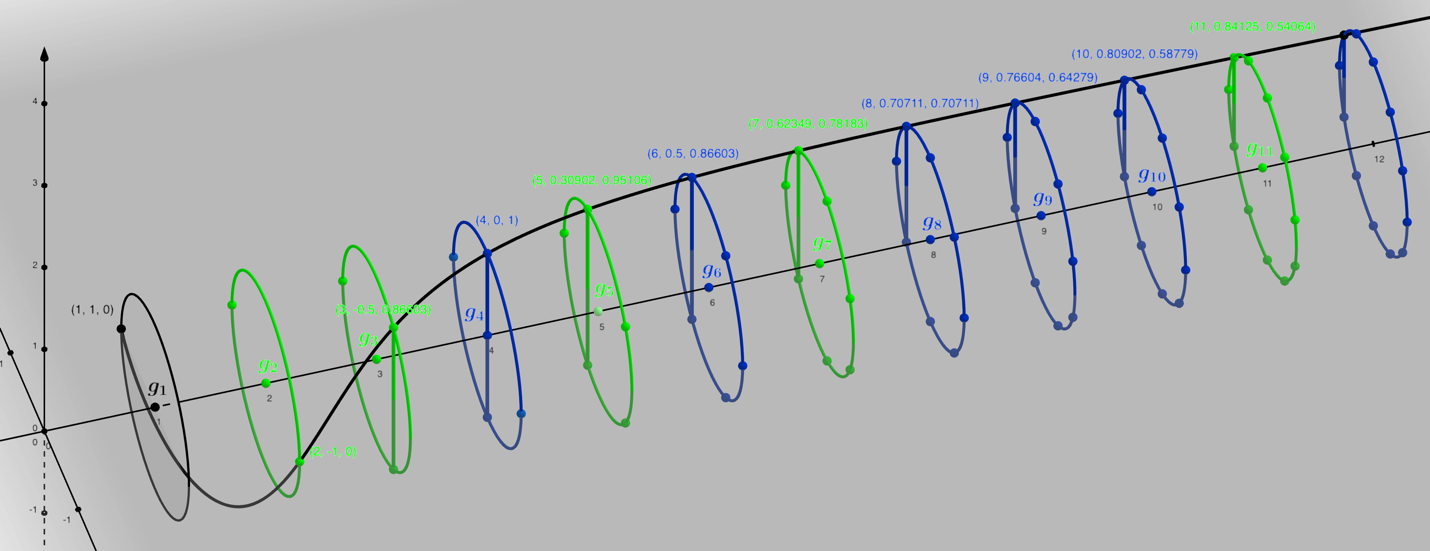
Specif­i­cal­ly, the g+(ℤ+(n))g^{+}\left( \mathbb{Z}^{+}(n) \right) wave­form in­ter­sects each nn-gon at the cor­re­spond­ing pri­ma­ry gen­er­a­tor vertex gn+(e2iπ[1n])g_{n}^{+}\left( e^{2i\pi\left\lbrack \frac{1}{n} \right\rbrack} \right). The g+(ℤ+(n))g^{+}\left( \mathbb{Z}^{+}(n) \right) wave­form is plot­ted in Figure 1.7.36 for prime num­bers gp∈ℙg_{p}\in \mathbb{P} in green, and non-prime num­bers gn∉ℙg_{n}\notin \mathbb{P} in blue. For n≥3n \geq 3, chords con­nect the pos­i­tive and neg­a­tive guar­an­teed pri­ma­ry gen­er­a­tor ver­tices.

Figure
Figure 1.7.36 – The pos­i­tive in­te­ger wave­form func­tion g+(ℤ+(n))g^{+}\left( \mathbb{Z}^{+}(n) \right) in­ter­sects each disc gng_{n} at the pri­ma­ry gen­er­a­tor vertex gn+(e2iπ[1n])g_{n}^{+}\left( e^{2i\pi\left\lbrack \frac{1}{n} \right\rbrack} \right), for the prime num­bers in green and the non-prime num­bers in blue.

The g+(ℤ+(n))g^{+}\left( \mathbb{Z}^{+}(n) \right) wave­form can be ro­tat­ed around the xx-axis to by the spe­cif­ic ar­gu­ment value 2iπ[1n]2i\pi\left\lbrack \frac{1}{n} \right\rbrack, where nn rep­re­sents the in­te­ger value of the nat­ur­al num­bers gng_{n}. We chose to rotate g+(ℤ+(n))g^{+}\left( \mathbb{Z}^{+}(n) \right) in the neg­a­tive/clock­wise ori­en­ta­tion, man­i­fest­ed by the fol­low­ing para­met­ric func­tion

ℕ(gn)=(ℯln⁡(n),cos(2π(1p−1n)),−isin(2π(1p−1n))).\begin{array}{r} \mathbb{N}\left( g_{n} \right) = \left( \mathcal{e}^{\ln(n)},cos\left( 2\pi\left( \frac{1}{p} - \frac{1}{n} \right) \right), - isin\left( 2\pi\left( \frac{1}{p} - \frac{1}{n} \right) \right) \right). \end{array}
(1.7.394)
Figure
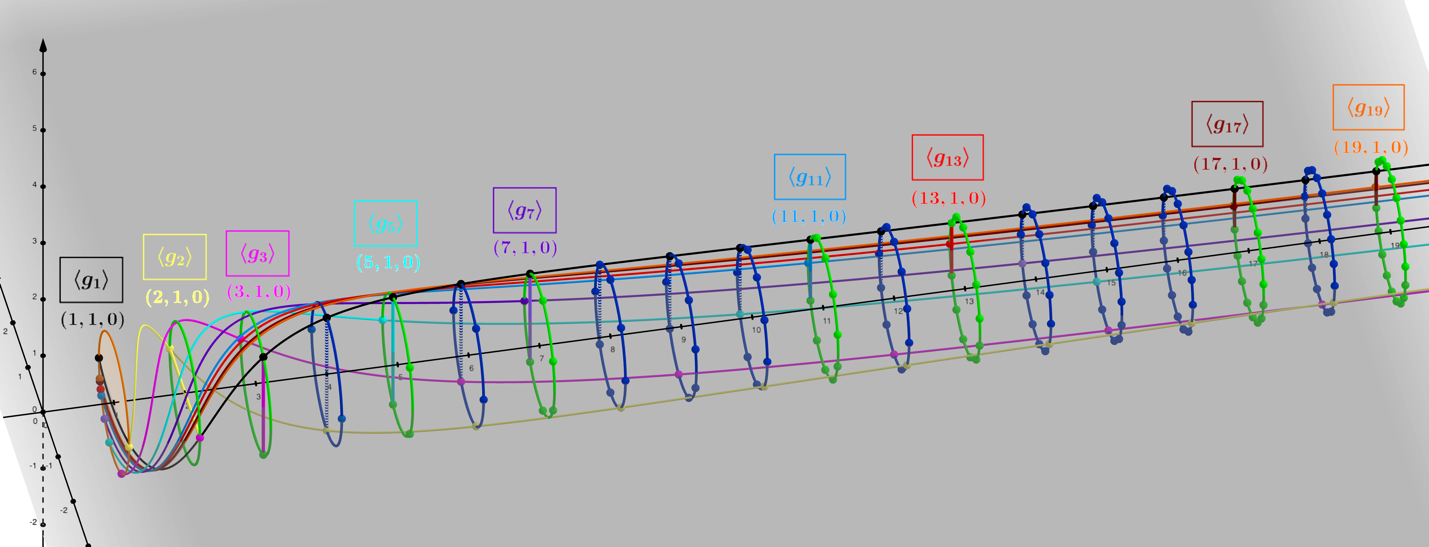
Figure 1.7.37 – The spe­cif­ic nat­ur­al num­bers wave­form ℕ(gn)\mathbb{N}\left( g_{n} \right) for n=[1,19]n = \lbrack 1,19\rbrack. The

Geo­met­ric Primes ⟨gp⟩∈ℙ\left\langle g_{p} \right\rangle\in \mathbb{P} are la­belled for the first eight prime num­bers and ⟨g1⟩\left\langle g_{1} \right\rangle.

For the in­di­vid­ual nat­ur­al number rep­re­sen­ta­tions of ℕ(gn)\mathbb{N}\left( g_{n} \right), the wave­form will in­ter­sect the spe­cif­ic n∈ℕn\in \mathbb{N} at the iden­ti­ty el­e­ment, shown in Figure 1.7.37 for the first eight prime num­bers. For each gng_{n}, the nn-gon rep­re­sen­ta­tion is con­veyed by the points on the unit cir­cles for each of its nn ver­tices.

Figure
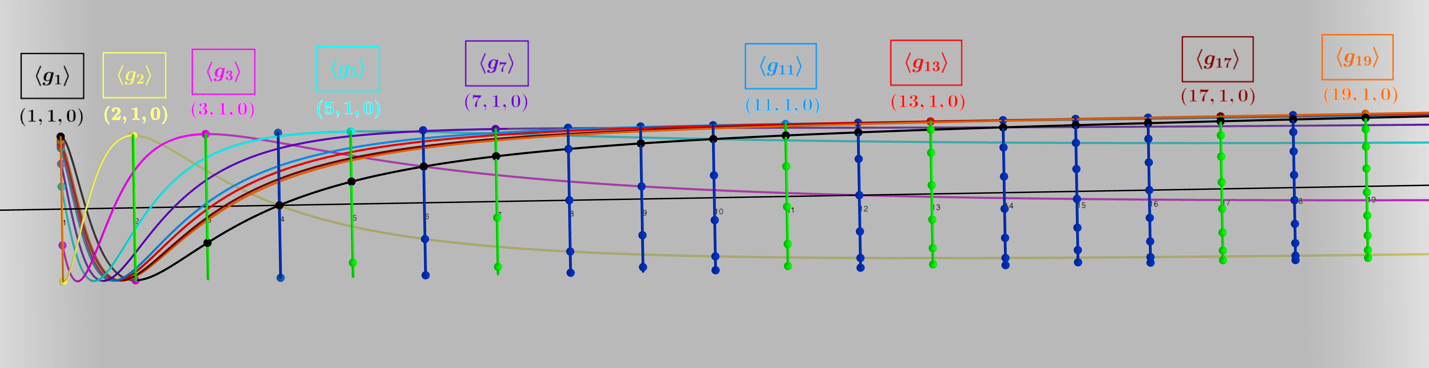
Figure 1.7.38 – The in­ter­sec­tions gn∩ϵng_{n} \cap \epsilon_{n} oc­cur­ring at the pos­i­tive peaks of the wave­forms along the yy-axis.

Evenly di­vis­i­bil­i­ty can be seen geo­met­ri­cal­ly for gn∉ℙg_{n}\notin \mathbb{P} by wave­form in­ter­sects for these num­bers by the ℙ(gp)\mathbb{P}\left( g_{p} \right) wave­forms that com­prise the said num­bers prime de­com­po­si­tion. For ex­am­ple, the g3g_{3} wave­form can be seen to in­ter­sec­tion ver­tices of the blue unit cir­cles at x={g6,g9,g12,g15,g18}x = \left\{ g_{6},g_{9},g_{12},g_{15},g_{18} \right\}. The ℕ(gn)\mathbb{N}\left( g_{n} \right) in­ter­sec­tions with the iden­ti­ty el­e­ment of each gng_{n} is seen in Figure 1.7.38 at the pos­i­tive peaks along the yy-axis for each wave­form.

Figure
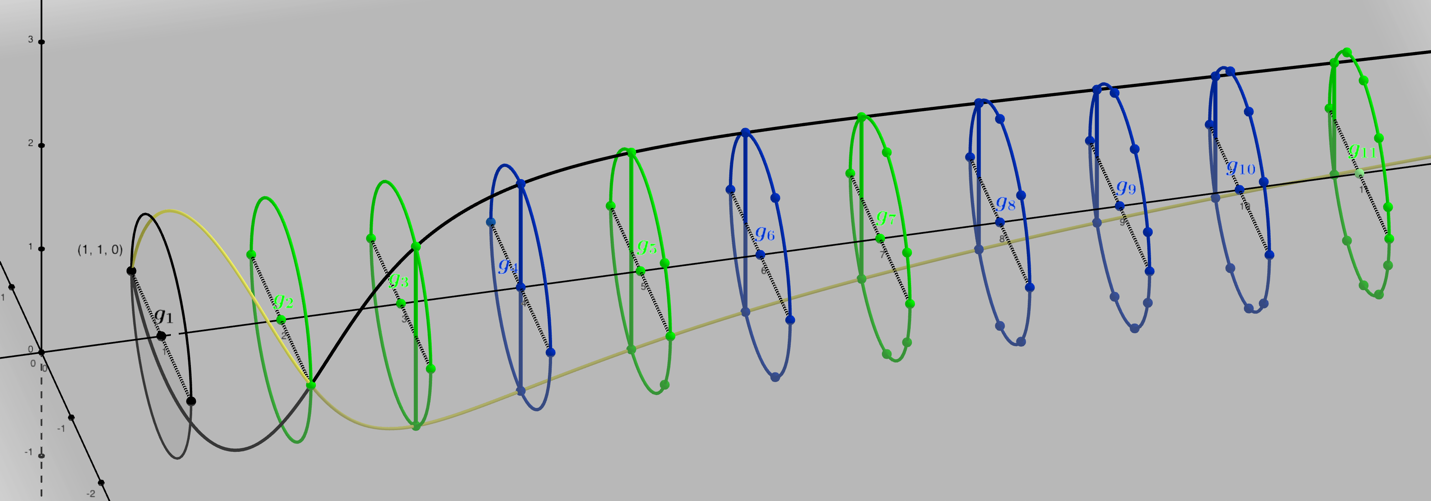
Figure 1.7.39 – Plots of the pos­i­tive in­te­ger wave­form func­tions g+(ℤ+(n))g^{+}\left( \mathbb{Z}^{+}(n) \right) and g−(ℤ+(n))g^{-}\left( \mathbb{Z}^{+}(n) \right) (disc(gn)∩gn±(e2iπ[1n])).\left( disc\left( g_{n} \right) \cap g_{n}^{\pm}\left( e^{2i\pi\left\lbrack \frac{1}{n} \right\rbrack} \right) \right).

We define the pos­i­tive in­te­ger func­tion g−(ℤ+(n))g^{-}\left( \mathbb{Z}^{+}(n) \right), as the wave­form in­ter­sect­ing with each neg­a­tive ori­ent­ed guar­an­teed pri­ma­ry gen­er­a­tor ∀ gn\forall\ g_{n}

g−(ℤ+(n))=(ℯln⁡(n),cos(2πn),−isin(2πn)),\begin{array}{r} g^{-}\left( \mathbb{Z}^{+}(n) \right) = \left( \mathcal{e}^{\ln(n)},cos\left( \frac{2\pi}{n} \right), - isin\left( \frac{2\pi}{n} \right) \right), \end{array}
(1.7.395)

which dif­fers from g+(ℤ+(n))g^{+}\left( \mathbb{Z}^{+}(n) \right) by the sign for the imag­i­nary por­tion of the para­met­ric func­tion. The g+(ℤ+(n))g^{+}\left( \mathbb{Z}^{+}(n) \right) and g−(ℤ+(n))g^{-}\left( \mathbb{Z}^{+}(n) \right) wave func­tions are plot­ted in Figure 1.7.39, in which, it is straight­for­ward to see the wave­forms in­ter­sect with the ver­tices of each nn-gon in a com­plex con­ju­gate re­la­tion­ship to one an­oth­er.