The matrix group plays a pivotal role in physics and the Standard Model and has a very natural isomorphic mapping to the quaternions. The group can be represented in its complex form, as the following matrix
(1.4.13)
Its Lie algebra is composed of skew-Hermitian matrices with traces equal to zero, represented as
(1.4.14)
and has a Lie algebra generated by the following matrices
(1.4.15)
These algebras can be mapped to the quaternion form by changing the sign of the matrix
(1.4.16)
The following quaternionic relationships can be verified for this mapping by setting , for which the following product relationships are found to hold
(1.4.17)
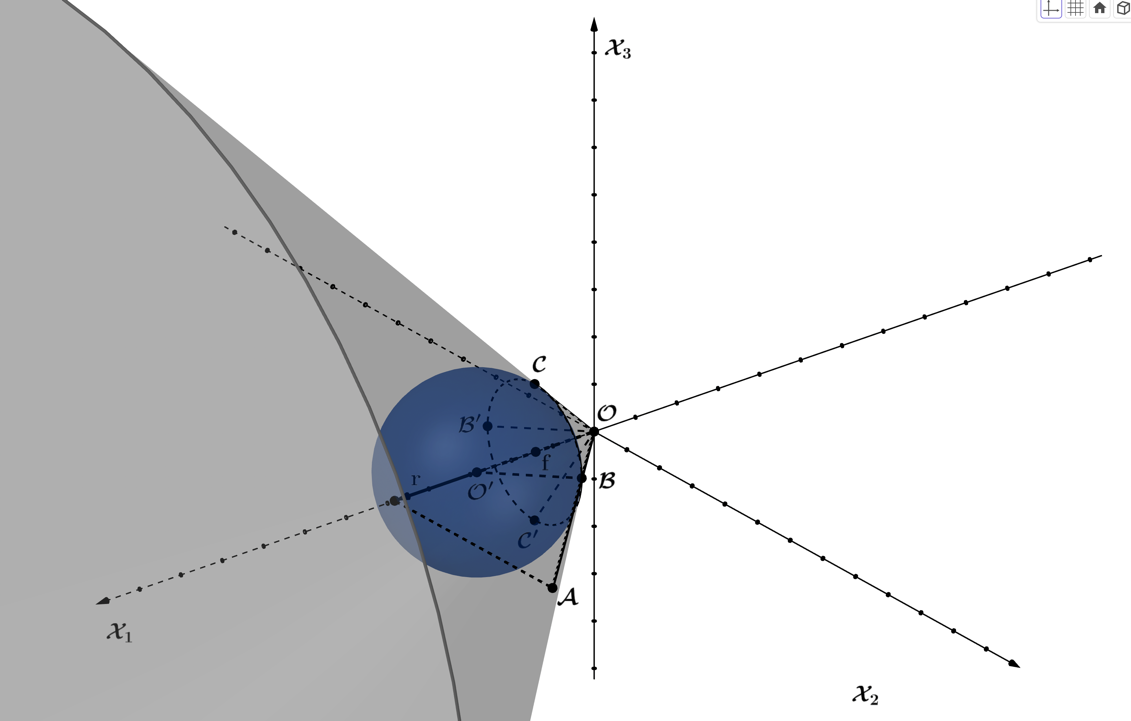
In Figure 1.4.3, we see a sphere of unit radius, centered at the point, , that touches the cone at a circumcircular arc represented on the sphere by . The arc is complex-valued and the segments , are all unit distance, , from the origin of the space, at . Each point, , is a tangent point of the unit sphere where it touches the cone. The points , lay in -plane, and points ,, lay in the -plane, and all of these represent the point of intersection where the asymptotic representations meet the unit sphere in the -planes.
Since is a tangent point, the angle is a right-angle equal to radians, as is the angle . We know the cone intersects the unit sphere at the point , which is radians from the real-axis, therefore angles are also radians in value. In terms of proportionality, and , which we express as the relationship
(1.4.18)
For the chord distance between the points in the -plane, we find imaginary values for both directional orientations
(1.4.19)
which is due to them being separated by the imaginary-valued portion of the -plane. For points in the -plane, we find real values for both
(1.4.20)
Figure 1.4.3 – as the inscribed sphere of the light cone.
We define the segments in matrix forms as , respectively
(1.4.21)
(1.4.22)
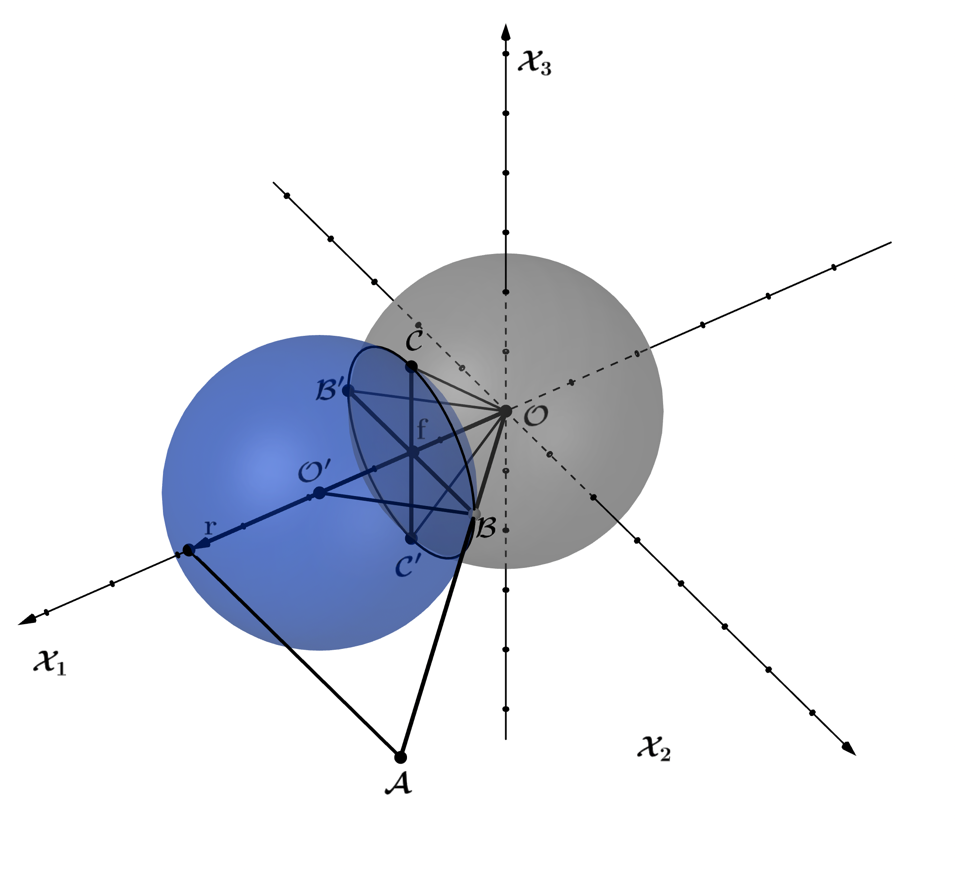
which represent the two points of the -plane along the antidiagonal, and points of the -plane along the main diagonal. The radial modulus is normed and represented as , since we will be taking products of . These matrices are arranged to have points that are clockwise from the -axis in the first row, and points counterclockwise from the -axis in the second row for each. We will continue to maintain this arrangement for our other inscribed sphere groups for consistency. In Figure 1.4.4, are represented as chords on the intersection of the spheres.
Taking the matrices and setting , there are four possible and not necessarily commuting product combinations, which are
=
(1.4.23)
We should immediately recognize these as the elements of the group which map to the quaternions, and taking them as a sum of algebras, we find
(1.4.24)
yields a result that is isomorphic to the quaternions, which we denote as .
Figure 1.4.4 – inscribed sphere with light cone resected and
sphere centered at the origin,,.
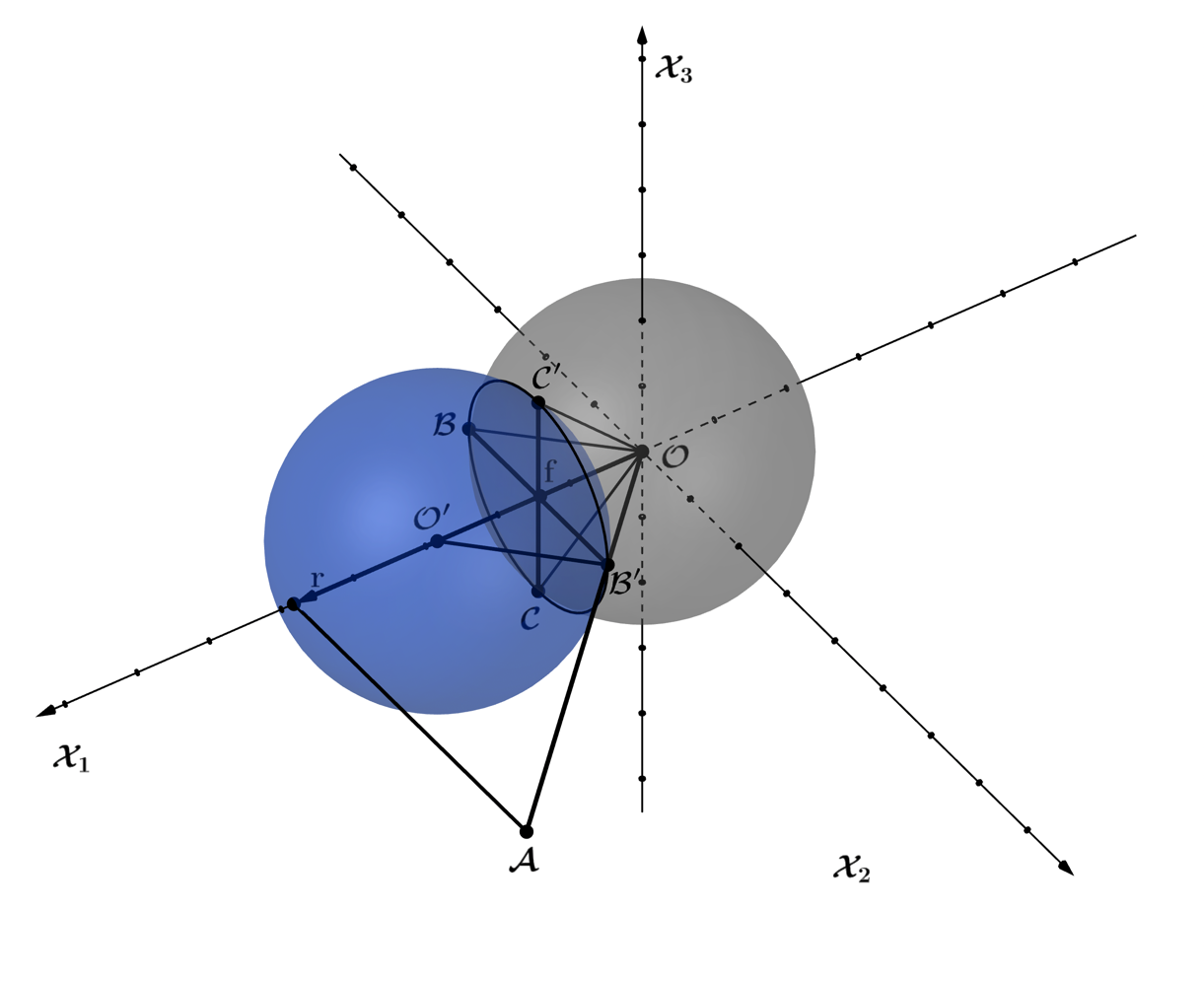
When taking products of with the group elements of , we find there are eight distinct matrices of the form , where the subscript describes the -plane it represents and the iteration value. Below we can see that are the reflections about the main diagonal of , the matrices , represent the chords of the opposing side of the sphere for , and as their respective reflections. When taken together, the composition of the dual reflections , represents a rotation of by radians of the group. This rotation, is essentially, a flipping of the sphere from the up/down to down/up position, seen in Figure 1.4.5, where the point positions for and have been swapped. This will be the same case for the swapping of the point positions, and
(1.4.25)
Exploring further, when taking permutation elements from coinciding iteration pairs , and evaluating their products we find the following -type group forms
(1.4.26)
Figure 1.4.5 – Two reflections , of the inscribed sphere, which is a rotation by radians (light cone resected and sphere centered at the origin). ,.
In Eq. 1.4.26, there are two distinct group representations, the first is our form
(1.4.27)
with individual matrices of the form
(1.4.28)
which are consistent with the Lie algebra , as The other group we denote, as is rotated from , and the conjugate mirror , where
(1.4.29)
has for its matrix elements
(1.4.30)
and we denote the Lie algebra , as
(1.4.31)
For both forms, the following product relationships hold
(1.4.32)
which are the quaternion product relationships for We can continue this process around the sphere to find the other relationships as to how the planes are arranged with respect to one another, where the groups are like the chord matrix groups, which we represent, as
(1.4.33)
The chords are reflected in the products, when compared to the product examples for
(1.4.34)
The forms of the products are
(1.4.35)
while the groups have an anti-symmetric relationship to the previous groups in terms of the products of their elements, and are denoted in terms of their group forms, as
(1.4.36)
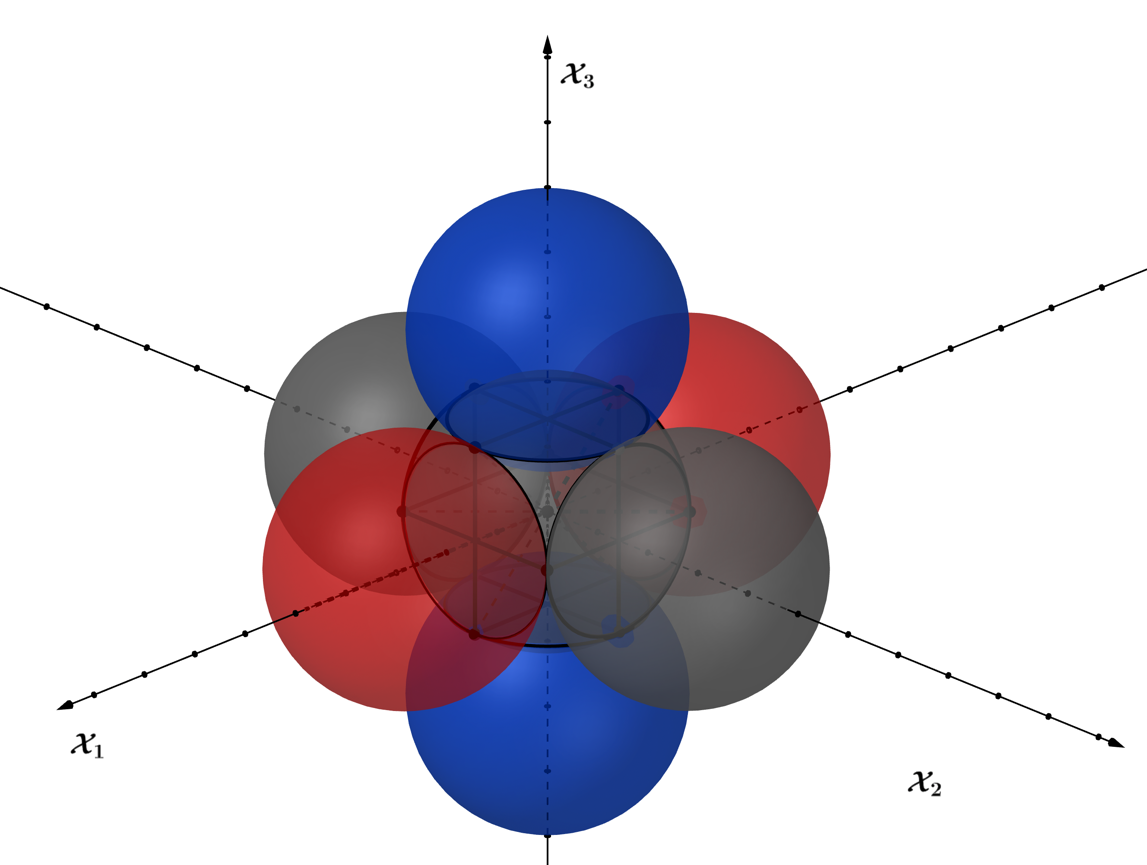
The arrangement of inscribed spheres is shown in Figure 1.4.7, where the red spheres are intersected by the -axis and represent , green spheres are intersected by the -axis and represent , and the blue spheres are intersected by the -axis and represent . Other forms of the group can be found to exist with combinations of , for, where taking the example , we find the product pairs are
(1.4.37)
which yields an group of the form
(1.4.38)
Eq. 1.4.37 represents an group of the form
(1.4.38)
for which all the following still hold
Figure 1.4.7 – Inscribed spheres of with light cone resected and sphere centered at origin.
(1.4.39)
Calculating , would equate to finding the products of the matrix chord with the mirror of , yielding the alternate algebras
(1.4.40)
which comprises an group of the form
(1.4.41)
for which the following still hold
(1.4.42)
This group differs, in that the products of the elements have become negative/reversed
(1.4.43)
Similar product calculations for , result in the group
comprised of the elements
whose inter-products will have the same reversals of the aforementioned group
(1.4.44)
From the standpoint of the matrices, we see that they are both positive and negative in their group results, and we will have a total of different possible forms of , which we denote as the set
(1.4.45)
all of which have determinants equal to . The groups with asterisks in the set hold to the reverse products
(1.4.46)
and the groups in bold font denote the inscribed spheres in the cones that we have been considering. The other groups can be generated by chords that span from one cone to another, and two examples are
(1.4.47)
(1.4.48)
which yield groups , not from the inscribed sphere groups. We can also note that the subgroup
is formed as the result of chords on opposite sides of the sphere