
1.6.10 Summary
In Chapter 5, the sphere of tangent spaces was made continuous, which led to the definition of the infinite symmetry group , and its Lie algebra , and this smooth space is caused by a subtangent space underlying the Lie algebra of the infinite symmetry group. As we have mentioned, one of the most remarkable facts about Lie theory is that the elements of the Lie algebra contain all the information about the group, that ordinarily might be obscured by the exponential mapping. The infinite Lie algebra of the group resides on the boundary of infinite sphere of tangent spaces , shown in Figure 1.6.28 to represent a handful of the infinite number of its Lie algebras. is the singularity at the heart of the whole infinite symmetry group, encoding holographically all the group's information on its surface.
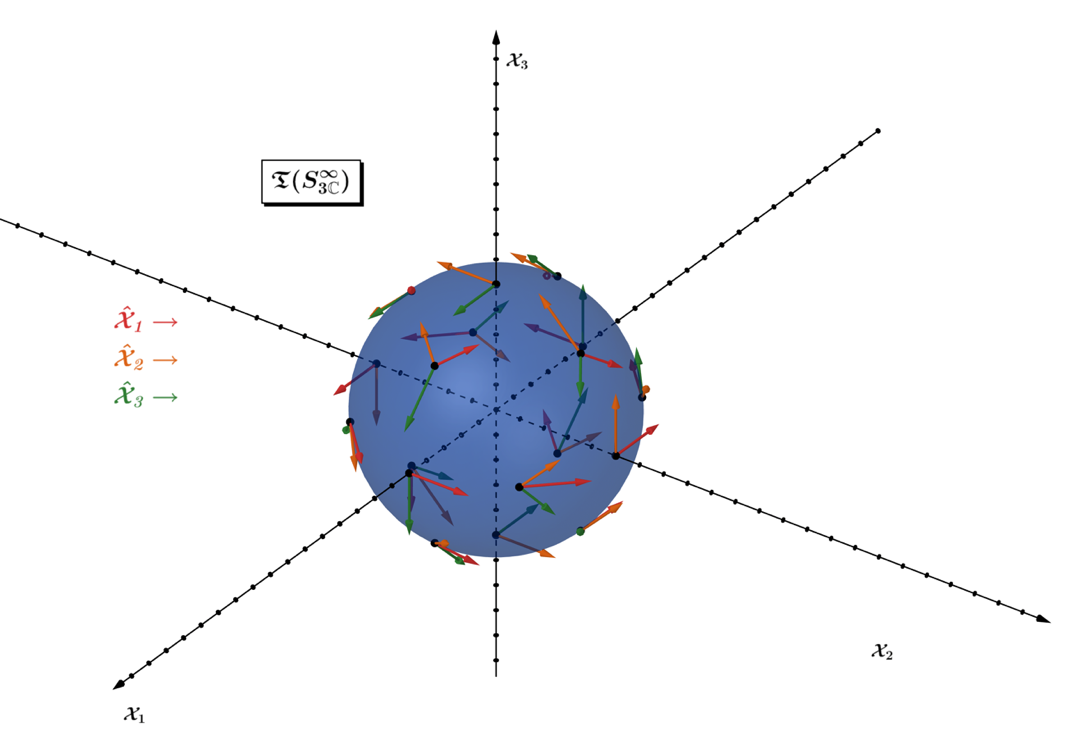
This chapter represents the synthetic culmination of many disciplines in mathematics, and results in an in-depth treatment of the singularity and its dynamics. Mathematically, the singularity can be envisioned as the kernel that drives all the phenomenology in the exponentiated spaces around it. It may be hard to contemplate from the standpoint of the anthropomorphic bias, but any interaction that occurs in the exponentiated space under the auspices of the singularity is engrained in the Lie algebras on its surface. The Lie algebra transform in representation theory is synonymous with the Fourier transform from the frequency domain for wave-like groups, and synonymous with Laplace transforms for complex-valued Lie algebra arguments.
The surface of the singularity is the boundary where the logarithm and exponential functions meet, and we have found these functions are distinct methods of integration and differentiation. The study of the infinite symmetry group , with its continuous tangent space, reveals mathematically, the non-extended singularity exists as the sine qua non for which extended phenomenon is contingent. Non-extended forms move freely in the singularity and all other extended or contracted spaces through the space of angles, which are not limited to the geometric constraints of movement in exponential subgroup extension. The outer product approach to the two infinite series that comprise Euler's formula shows that the numeric interaction of non-extended forms with an energy state below , stays within the boundary of the singularity and the energy states above this threshold manifest in the extended state.