In the last section, we saw that by taking the limit of the minimal element infinitesimally close to the identity element, we were able to smooth the minimal element yielding a continuous function space that was infinitely differentiable. All the dihedral groups that we have described in this book have generalized permutations in six forms, which we arrange as the following two subsets ,:
(1.5.125)
Up until this point, the matrix entries were from the following number set , having its basis determined by the minimal element choice . For a minimal element taken as the infinitesimal of the function, described in the last section, the matrix entries can locate on any point on the unit circle for specific values in the infinite set . We can recast the element subsets with the function in mind, where the set is composed of the following subsets
(1.5.126)
We can see from the above that the products of any elements from these subsets would yield another element with all entries , for . All these elements can be further considered as the infinite tangent space of the group , denoted as
and this infinite tangent space is an infinite Lie algebra as well. Concerning this infinite tangent space, we can now define the infinite symmetry group :
Definition (1.5.127) – The unitary Infinite Symmetry Groupis a group under composition sitting in the complex geometric space, which is comprised offunctions for its infinitesimal minimal element basisyielding the infinite setof unitary elements in tangent space.
Theorem (1.5.128) –Foras a set, the set of permutationsforms a group under composition
Proof – Verification of group axioms
Closure:All elementsare bijective, and the composition of any elementsis also bijective.
Associativity: Permutations are functions, and their compositions are associative.
Identity: The identity functionbijectively maps all elements of the setto themselves.
Inverse:is a permutation and is thus bijective, and there exists a functionthat is also bijective.
When considering the infinite tangent space of elements and how the elements are composed of , we can mathematically consider the existence of a subtangent space to the tangent space, defined as:
Definition (1.5.129) – The Subtangent Spaceis the matrix logarithm of the infinite tangent space,,
In the definition above, the subtangent space, when paired down, operates as the matrix logarithm of the Lie algebra elements , whereas the tangent space operates as the matrix logarithm of the Lie group It turns out that the subtangent space is very consistent with what we already know about Lie algebras in general, where many of the same properties hold in the subtangent space, and this opens up many possibilities about how we may go about considering group interrelationships. We start by first defining the identity group as the symmetry group:
Definition (1.5.130) – The Identity Group, of the infinity symmetry groupis the set of elementscomprising thesymmetry group
We take the tangent space to be the following set of infinity elements
(1.5.131)
to define the matrix logarithm , as
(1.5.132)
then state the following theorem:
Theorem (1.5.133) – The differential subtangent space of, denoted by, consists of the complexmatrices which represent the differential angle space of the tangent space, for all, as equal to an element of the identity group, for, and the derivative of the tangent space, equals the subtangent space, in the neighborhood of the identity group and its elements, for.
Proof – The elements of the tangent spacehave three matrix entries in the form, resulting from the exponentiation of the individual matrix entries and not the matrix exponential. As such, the matrix differential will take the form comprised of elements, forrepresenting the angle arguments for each exponential entry. These angle arguments, arranged in their respective matrices, have been defined as the subtangent space, and therefore,For any exponential entry in a tangent space matrix of the form, for, we find that, and all matrices take the form of an element in the identity group.
Mindful as we continue, stated in the theorem is that the subtangent space basis is made up of the space of angles from the group's tangent space. Expanding the definition of how the identity is a profound concept, helping to link previously disparate groups together. Previously we considered the identity element of our dihedral groups, as
(1.5.134)
and in the context of the subtangent space, we can see that the identity element is just an element in the identity group. We may consider our original identity , as the identity of an identity group, where the concept of nesting identities necessarily arises, which leads to the following definition:
Definition (1.5.135) – The Identity Groupof the subtangent spaceis the group of elements from the defined tangent space
realized for
for, equal to, and is therefore a group under composition as proven previously.
As defined, the differential subtangent space is the argument composition of the angle space. From the logarithmic standpoint, these angle space arguments would represent the element-by-element principal logarithms of the tangent space for , and not the matrix logarithm function. From the perspective of the taking the logarithm of individual entries in the matrix elements , negative infinities are the result for the zero-valued entries. An example offered is the element-by-element principal logarithm of , which we define using the notation
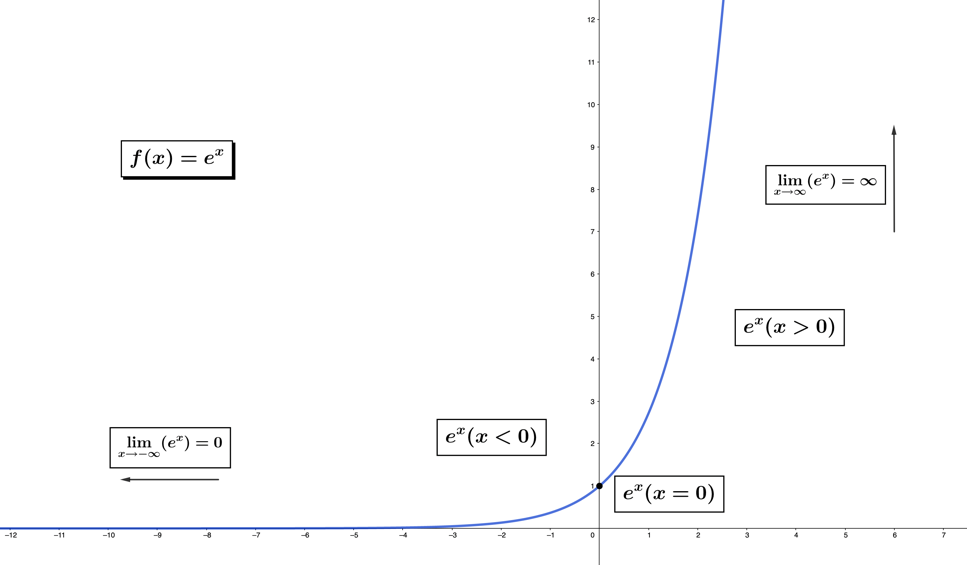
Figure 1.5.1 – The Exponential Function: Zero and Infinity
(1.5.136)
We know that these negative infinities arise as solutions for in the equation . In Figure 1.5.1, we plot the function, for , where we see the identity is the point where the function crosses the vertical axis, and the function goes to , as , while for , the function goes to zero
Like the principal element-by-element logarithm, the differential subtangent algebra is transformed to the algebras of tangent space by the exponential function, and not the matrix exponential. Since the differential subtangent space is defined as a derivative with respect to for it is consistent with the definition for the tangent space in Lie theory, differing from the matrix logarithm operation, which defines the tangent space . We demonstrate this with an example using the element
(1.5.137)
and calculate its matrix logarithm
(1.5.138)
and by assuming a principal valued matrix logarithm for , this simplifies to
(1.5.139)
A similar approach applied for the other element , results in the subset of elements based upon the principal matrix logarithms for ,
(1.5.140)
For the infinity elements the principal matrix logarithm of is straightforward
(1.5.141)
For the evaluation of the infinity elements , we apply the eigendecomposition for
(1.5.142)
finding the eigenvalue, eigenvector matrices, and inverse eigenvector matrices
(1.5.143)
The principal matrix logarithm is then easily calculated
(1.5.144)
with which we determine for, the product
(1.5.145)
The similar principle matrix logarithm , using the eigendecomposition, would then round out the infinity matrix logarithm subset, holding for
(1.5.146)
With the matrix logarithm subtangent space forms determined, we state the following theorem:
Theorem (1.5.147) – The logarithmic subtangent space of, denoted, is comprised of complexmatrices which represent the angle function space of the tangent space for all, equal to an element of the identity groupfor. The principal logarithm of the tangent space, for angle arguments, equals the logarithmic subtangent space, in the neighborhood of the identity group and its elements, for.
Proof – The elements of the tangent spacehave three matrix entries, resulting from the matrix exponential. As such, the matrix logarithm will take the form of algebraic function groupswhich represent the matrix logarithm of the angle arguments of the tangent space matrices. These angle functions arranged in their respective matrices are defined as the logarithmic subtangent space, and therefore,Taking any matrix group, for all angle variables, it holdsthat they take the form of a element in the identity group.
Mathematically, we have seen that a consistent subtangent space exists and is logarithmically related to the tangent space located on the sphere of tangent spaces. The defined differential subtangent space, presents an arrangement comprised of finite angle elements, taking form as a result of the zero-point . Whereas the defined logarithmic subtangent space is a well-defined angle space function, oriented at a mathematical crossroads where infinities take finite forms.