The general linear group consists of invertible linear matrices over the field F with degree , representing , for . If we chose F to be over , there are an infinite number of possibilities, implying the group's order will also be infinite. We find a finite-element group when choosing F to be finite. Starting with the example , this represents the general linear group of order of two, having either 1 or 0 for its matrix entries. There are two options , for each of the four entries , in each of the group's permutation matrices, totaling sixteen possible permutations
(1.1.5)
Its matrices must be invertible from the standpoint of matrix group theory, which requires non-zero determinants. From the sixteen possible permutations, we omit the ten following non-invertible matrices
(1.1.6)
leaving us with the six matrices that form the group
(1.1.7)
These six matrices can be seen as symmetric permutations of three objects denoted by . The permutations of are usually represented as all the possible combinations to arrange the letters ABC
(1.1.8)
We will typically consider matrices in the book with only be one entry for each row/column pairing. The symmetry group can then be represented in a finite group form using the six permutation matrices,
(1.1.9)
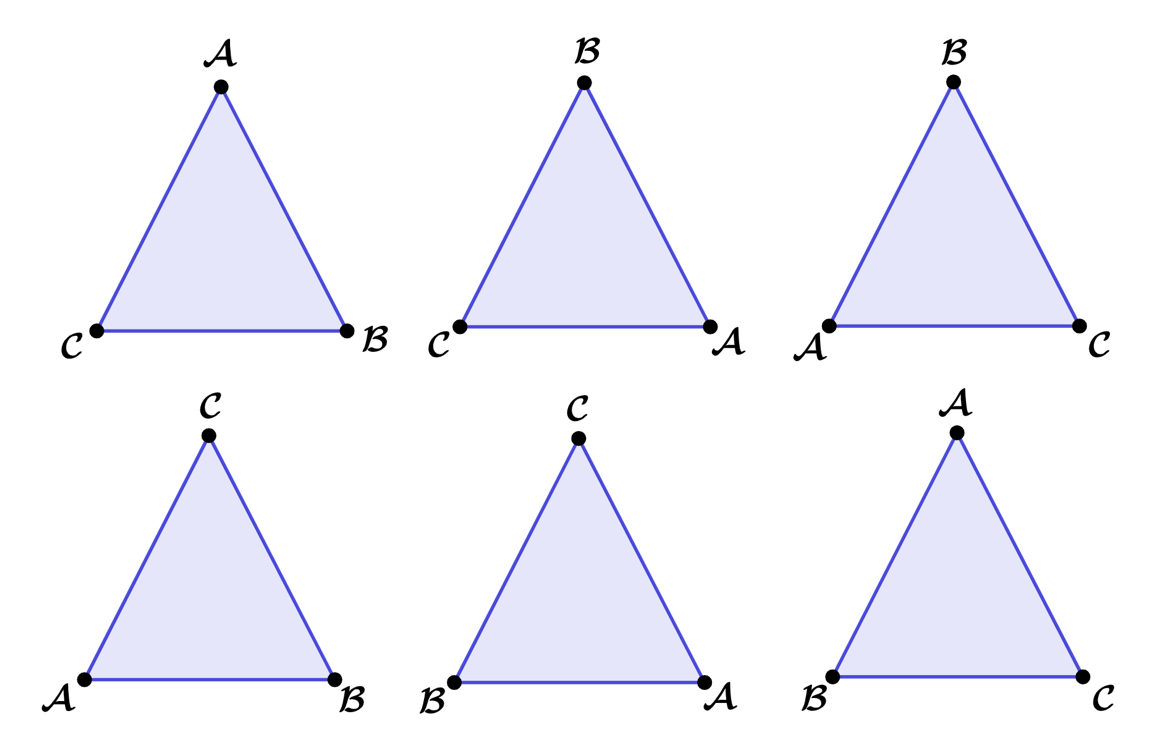
The geometric interpretation of these matrices can be seen as the number of ways we can rotate the three vertices of an equilateral triangle, as seen in the following figure.
Figure 1.1.1 – The symmetry group and its triangle permutations.
A generalization for the number of permutations expected for the number of permutating objects , would be equal to . This number coincides with the triangle's three vertices in terms of the group, for , and gives the total of invertible permutations. Taking the set of matrices from Eq. 1.1.9, their matrix-multiplication products will then form the finite matrix group representation . An example of the matrix-multiplication group operation comes by taking the product , to find the result
(1.1.10)
We are mindful that our group satisfies all the group properties, having an identity matrix, multiplicative closure, multiplicative associativity, and inverses exists for all the elements.