Masteries · Jason GlowneyArithmoí Book 1

Masteries

1.3.10 The Curvature of Light

We end the chap­ter by con­sid­er­ing the cur­va­ture of the as­ymp­tot­ic light forms. Given how these curves appear flat in their para­met­ric plots, we expect to find that their cur­va­ture equals zero. To eval­u­ate the merits of this ex­pec­ta­tion, we first take the cir­cu­lar light func­tion

f(t)=(1+i)sin⁡(t+π4),\begin{array}{r} f(t) = (1 + i)\sin\left( t + \frac{\pi}{4} \right), \end{array}
(1.3.395)

and eval­u­ate its polar form, by first, con­sid­er­ing the radial com­po­nent from f(t)=r(t)eiϕ(t)f(t) = r(t)e^{i\phi(t)}

r=sin2⁡(t+π4)+sin2⁡(t+π4)=2(sin⁡(t+π4)),\begin{array}{r} r = \sqrt{\sin^{2}\left( t + \frac{\pi}{4} \right) + \sin^{2}\left( t + \frac{\pi}{4} \right)} = \sqrt{2}\left( \sin\left( t + \frac{\pi}{4} \right) \right), \end{array}
(1.3.396)

where we see the pa­ra­me­ter in time changes the func­tion's radius. Next, we cal­cu­late the in­verse tan­gent func­tion to see how the radial el­e­ment ro­tates in time, ac­com­plished by noting the iden­ti­ty

tan−1⁡(θ)=i2(ln⁡(1−iθ)−ln⁡(1+iθ)),\begin{array}{r} \tan^{- 1}(\theta) = \frac{i}{2}\left( \ln(1 - i\theta) - \ln(1 + i\theta) \right), \end{array}
(1.3.397)

to then con­sid­er the ex­pres­sion

itan−1(sin⁡(t+π4)sin⁡(t+π4))=itan−1(1),\begin{array}{r} itan^{- 1}\left( \frac{\sin\left( t + \frac{\pi}{4} \right)}{\sin\left( t + \frac{\pi}{4} \right)} \right) = itan^{- 1}(1), \end{array}
(1.3.398)

set­ting θ=1\theta = 1, in the pre­vi­ous iden­ti­ty, to then solve for tan⁡(1)\tan(1)

tan−1⁡(1)=i2(ln⁡(1−i)−ln⁡(1+i))\tan^{- 1}(1) = \frac{i}{2}\left( \ln(1 - i) - \ln(1 + i) \right)
=i2ln⁡((1−i)(1+i))=i2ln⁡(2e−iπ42eiπ4)=i2ln⁡(e−iπ2)=i2(−iπ2)=π4.\begin{array}{r} = \frac{i}{2}\ln\left( \frac{(1 - i)}{(1 + i)} \right) = \frac{i}{2}\ln\left( \frac{\sqrt{2}e^{- \frac{i\pi}{4}}}{\sqrt{2}e^{\frac{i\pi}{4}}} \right) = \frac{i}{2}\ln\left( e^{- \frac{i\pi}{2}} \right) = \frac{i}{2}\left( - \frac{i\pi}{2} \right) = \frac{\pi}{4}. \end{array}
(1.3.399)

Sub­sti­tut­ing this result back into the polar form, we find

f(t)=r(t)eiϕ(t)=2(sin⁡(t+π4))eiπ4,\begin{array}{r} f(t) = r(t)e^{i\phi(t)} = \sqrt{2}\left( \sin\left( t + \frac{\pi}{4} \right) \right)e^{\frac{i\pi}{4}}, \end{array}
(1.3.400)

show­ing that the radial com­po­nent of f(t)f(t) does not rotate in the com­plex plane, main­tain­ing a line with the angle e(iπ4)e^{\left( \frac{i\pi}{4} \right)} from the real-axis. In polar co­or­di­nates, we can define the signed cur­va­ture for a curve in the com­plex plane, as

k=idϕ(t)dr(t),\begin{array}{r} k = \frac{id\phi(t)}{dr(t)}, \end{array}
(1.3.401)

rep­re­sent­ing the ratio of an in­fin­i­tes­i­mal change of the an­gu­lar ro­ta­tion over an in­fin­i­tes­i­mal change in the radius in time. In the case of f(t)f(t), ϕ(t)\phi(t), this will equal

iϕ(t)=ln⁡(eiπ4)=iπ4,\begin{array}{r} i\phi(t) = \ln{\left( e^{\frac{i\pi}{4}} \right) = \frac{i\pi}{4}}, \end{array}
(1.3.402)

and since it is not time-de­pen­dent, it is a con­stant whose de­riv­a­tive is equal to zero

diϕ(t)=0,\begin{array}{r} di\phi(t) = 0, \end{array}
(1.3.403)

im­ply­ing, as ex­pect­ed, the signed cur­va­ture for f(t)f(t) equals zero

k=idϕ(t)dr(t)=iddt(iπ4)ddt(2(sin⁡(t+π4)))=02cos⁡(t+π4).\begin{array}{r} k = \frac{id\phi(t)}{dr(t)} = \frac{i\frac{d}{dt}\left( \frac{i\pi}{4} \right)}{\frac{d}{dt}\left( \sqrt{2}\left( \sin\left( t + \frac{\pi}{4} \right) \right) \right)} = \frac{0}{\sqrt{2}\cos\left( t + \frac{\pi}{4} \right)}. \end{array}
(1.3.404)

Next, we con­tem­plate the cur­va­ture of the as­ymp­tot­ic para­met­ric curve γ(t)\gamma(t)

γ(t)=x(t),y(t)=sin⁡(t+π4),isin(t+π4),\begin{array}{r} \gamma(t) = x(t),y(t) = \sin\left( t + \frac{\pi}{4} \right),{isin}\left( t + \frac{\pi}{4} \right), \end{array}
(1.3.405)

which has the fol­low­ing first and second-order de­riv­a­tives

γ′(t)=x′(t),y′(t)=cos⁡(t+π4),icos(t+π4),\begin{array}{r} \gamma^{'}(t) = x^{'}(t),y^{'}(t) = \cos\left( t + \frac{\pi}{4} \right),{icos}\left( t + \frac{\pi}{4} \right), \end{array}
(1.3.406)
γ′′(t)=x′′(t),y′′(t)=−sin⁡(t+π4),−isin(t+π4).\begin{array}{r} \gamma^{''}(t) = x^{''}(t),y^{''}(t) = - \sin\left( t + \frac{\pi}{4} \right), - {isin}\left( t + \frac{\pi}{4} \right). \end{array}
(1.3.407)

The in­fin­i­tes­i­mal dis­tance rep­re­sen­ta­tion with re­spect to time for our com­plex pa­ram­e­triza­tion is the two-norm

dsdt=‖γ(t)‖=γ′(t)γ′(t)∗=x′(t)2+Im(y′(t))2,\begin{array}{r} \frac{ds}{dt} = \left\| \gamma(t) \right\| = \sqrt{\gamma'(t)\gamma'(t)^{*}} = \sqrt{{x^{'}(t)}^{2} + Im\left( y^{'}(t) \right)^{2}}, \end{array}
(1.3.408)

and the com­plex-valued tan­gent func­tion itan(ϕ(t)){itan}\left( \phi(t) \right), rep­re­sents

itan(ϕ(t))=iIm(y′(t))x′(t),\begin{array}{r} {itan}\left( \phi(t) \right) = i\frac{Im\left( y^{'}(t) \right)}{x^{'}(t)}, \end{array}
(1.3.409)

which, by way of the in­verse tan­gent func­tion iϕ(t)i\phi(t), is equal to

iϕ(t)=itan−1⁡(tan⁡(ϕ(t)))=itan−1⁡(Im(y′(t))x′(t)).\begin{array}{r} i\phi(t) = {i\tan^{- 1}}\left( \tan\left( \phi(t) \right) \right) = {i\tan^{- 1}}\left( \frac{Im\left( y^{'}(t) \right)}{x^{'}(t)} \right). \end{array}
(1.3.410)

We im­plic­it­ly dif­fer­en­ti­ate

idϕdt[ϕ(t)]=iddt[tan−1⁡(tan⁡(ϕ(t)))]=i1+tan2⁡(ϕ(t))(ddttan⁡(ϕ(t))),\begin{array}{r} i\frac{d\phi}{dt}\left\lbrack \phi(t) \right\rbrack = i\frac{d}{dt}\left\lbrack \tan^{- 1}\left( \tan\left( \phi(t) \right) \right) \right\rbrack = \frac{i}{1 + \tan^{2}\left( \phi(t) \right)}\left( \frac{d}{dt}\tan\left( \phi(t) \right) \right), \end{array}
(1.3.411)

find­ing ∂ttan⁡(ϕ(t))\partial t\tan\left( \phi(t) \right) equals

ddt(tan⁡(ϕ(t)))=ddt[y′(t)x′(t)]=y′′(t)x′(t)−y′(t)x′′(t)x′(t)2.\begin{array}{r} \frac{d}{dt}\left( \tan\left( \phi(t) \right) \right) = \frac{d}{dt}\left\lbrack \frac{y^{'}(t)}{x^{'}(t)} \right\rbrack = \frac{y^{''}(t)x^{'}(t) - y^{'}(t)x^{''}(t)}{{x^{'}(t)}^{2}}. \end{array}
(1.3.412)

By sub­sti­tut­ing, tan⁡(ϕ(t))=(Im(y′(t))x′(t))\tan\left( \phi(t) \right) = \left( \frac{Im\left( y^{'}(t) \right)}{x^{'}(t)} \right), dϕdt\frac{d\phi}{dt} equals

dϕdt=(i1+(Im(y′(t))x′(t))2)(y′′(t)x′(t)−y′(t)x′′(t)x′(t)2)=(iy′′(t)x′(t)−iy′(t)x′′(t)x′(t)2+(Im(y′(t)))2),\begin{array}{r} \frac{d\phi}{dt} = \left( \frac{i}{1 + \left( \frac{Im\left( y^{'}(t) \right)}{x^{'}(t)} \right)^{2}} \right)\left( \frac{y^{''}(t)x^{'}(t) - y^{'}(t)x^{''}(t)}{{x^{'}(t)}^{2}} \right) = \left( \frac{{iy}^{''}(t)x^{'}(t) - {iy}^{'}(t)x^{''}(t)}{{x^{'}(t)}^{2} + \left( Im\left( y^{'}(t) \right) \right)^{2}} \right), \end{array}
(1.3.413)

lead­ing to pa­ram­e­trized signed cur­va­ture result

k=dtdsdϕdt=(1x′(t)2+Im(y′(t))2)(iy′′(t)x′(t)−iy′(t)x′′(t)x′(t)2+(Im(y′(t)))2)=iy′′(t)x′(t)−iy′(t)x′′(t)(x′(t)2+(Im(y′(t)))2)32.\begin{array}{r} k = \frac{dt}{ds}\frac{d\phi}{dt} = \left( \frac{1}{\sqrt{{x^{'}(t)}^{2} + Im\left( y^{'}(t) \right)^{2}}} \right)\left( \frac{{iy}^{''}(t)x^{'}(t) - {iy}^{'}(t)x^{''}(t)}{{x^{'}(t)}^{2} + \left( Im\left( y^{'}(t) \right) \right)^{2}} \right) = \frac{{iy}^{''}(t)x^{'}(t) - {iy}^{'}(t)x^{''}(t)}{\left( {x^{'}(t)}^{2} + \left( Im\left( y^{'}(t) \right) \right)^{2} \right)^{\frac{3}{2}}}. \end{array}
(1.3.414)

We sub­sti­tute the values for the first and second-order de­riv­a­tives for γ(t)\gamma(t) into the signed cur­va­ture for­mu­la

k=i(−sin(t+π4)(cos⁡(t+π4))−(icos(t+π4))(−sin⁡(t+π4)))((cos⁡(t+π4))2+(cos⁡(t+π4))2)32,\begin{array}{r} k = \frac{i\left( - sin\left( t + \frac{\pi}{4} \right)\left( \cos\left( t + \frac{\pi}{4} \right) \right) - \left( {icos}\left( t + \frac{\pi}{4} \right) \right)\left( - \sin\left( t + \frac{\pi}{4} \right) \right) \right)}{\left( \left( \cos\left( t + \frac{\pi}{4} \right) \right)^{2} + \left( \cos\left( t + \frac{\pi}{4} \right) \right)^{2} \right)^{\frac{3}{2}}}, \end{array}
(1.3.415)

and sim­pli­fy, find­ing once again that the cur­va­ture is equal to zero for the as­ymp­tot­ic para­met­ric curve in the com­plex plane

k=−icos⁡(t+π4)sin⁡(t+π4)+icos(t+π4)sin⁡(t+π4)(2cos2⁡(t+π4))32=0.\begin{array}{r} k = \frac{- i\cos\left( t + \frac{\pi}{4} \right)\sin\left( t + \frac{\pi}{4} \right) + icos\left( t + \frac{\pi}{4} \right)\sin\left( t + \frac{\pi}{4} \right)}{\left( 2\cos^{2}\left( t + \frac{\pi}{4} \right) \right)^{\frac{3}{2}}} = 0. \end{array}
(1.3.416)

Next, we can con­sid­er the geo­met­ric prod­uct which ro­tates the unit hy­per­bo­la to the as­ymp­tote, by first, defin­ing the vec­tors uu, vv, as

u=(cosh⁡(t)e1+sinh⁡(t)e1,0),\begin{array}{r} u = \left( \cosh(t)e_{1} + \sinh(t)e_{1},0 \right), \end{array}
(1.3.417)
v=(e12,e22),\begin{array}{r} v = \left( \frac{e_{1}}{\sqrt{2}},\frac{e_{2}}{\sqrt{2}} \right), \end{array}
(1.3.418)

with com­plex basis vec­tors equal to

e1=(10),   e2=(01).\begin{array}{r} e_{1} = \begin{pmatrix} 1 \\ 0 \end{pmatrix},\ \ \ e_{2} = \begin{pmatrix} 0 \\ 1 \end{pmatrix}. \end{array}
(1.3.419)

We cal­cu­late the geo­met­ric prod­uct uvuv, as fol­lows

uv=u∙v+u∧vuv = u \bullet v + u \land v
=cosh⁡(t)+sinh⁡(t)2+(cosh⁡(t)e1+sinh⁡(t)e1+0)∧(e12+e22)= \frac{\cosh(t) + \sinh(t)}{\sqrt{2}} + \left( \cosh(t)e_{1} + \sinh(t)e_{1} + 0 \right) \land \left( \frac{e_{1}}{\sqrt{2}} + \frac{e_{2}}{\sqrt{2}} \right)
=cosh⁡(t)+sinh⁡(t)2+cosh⁡(t)e1∧e1+cosh⁡(t)e1∧e2+sinh⁡(t)e1∧e1+sinh⁡(t)e1∧e22= \frac{\cosh(t) + \sinh(t)}{\sqrt{2}} + \frac{\cosh(t)e_{1} \land e_{1} + \cosh(t)e_{1} \land e_{2} + \sinh(t)e_{1} \land e_{1} + \sinh(t)e_{1} \land e_{2}}{\sqrt{2}}
=(1+i)2(cosh⁡(t)+sinh⁡(t)).\begin{array}{r} = \frac{(1 + i)}{\sqrt{2}}\left( \cosh(t) + \sinh(t) \right). \end{array}
(1.3.420)

This result can be put into a polar form con­sis­tent with f(t)=r(t)eiϕ(t)f(t) = r(t)e^{i\phi(t)}, as

f(t)=eteiπ4,\begin{array}{r} f(t) = e^{t}e^{\frac{i\pi}{4}}, \end{array}
(1.3.421)

where this func­tion's radius will vary in time, but the rate of change of the angle this radial com­po­nent makes with the real-axis is a con­stant, lead­ing to the straight­for­ward con­clu­sion, the cur­va­ture of f(t)f(t) at all points is also zero, given that

k=dϕ(t)dr(t)=ddt(π4)ddt(et)=0et=0.\begin{array}{r} k = \frac{d\phi(t)}{dr(t)} = \frac{\frac{d}{dt}\left( \frac{\pi}{4} \right)}{\frac{d}{dt}\left( e^{t} \right)} = \frac{0}{e^{t}} = 0. \end{array}
(1.3.422)

We con­sid­er the final ex­am­ple of light cur­va­ture, by eval­u­at­ing a 𝔏(t,−1)\mathfrak{L}(t, - 1)-type uni­fied light func­tion,

𝔏(t,−1)=eit−iπ4+et−iπ4+iπ2=(12−i2)eit+(12+i2)et,\begin{array}{r} \mathfrak{L}(t, - 1) = e^{it - \frac{i\pi}{4}} + e^{t - \frac{i\pi}{4} + \frac{i\pi}{2}} = \left( \frac{1}{\sqrt{2}} - \frac{i}{\sqrt{2}} \right)e^{it} + \left( \frac{1}{\sqrt{2}} + \frac{i}{\sqrt{2}} \right)e^{t}, \end{array}
(1.3.423)

which can be sep­a­rat­ed into real and imag­i­nary com­po­nents

𝔏(t,−1)=(et2+sin⁡(t+π4))+(Iet2+Isin(t−π4)).\begin{array}{r} \mathfrak{L}(t, - 1) = \left( \frac{e^{t}}{\sqrt{2}} + \sin\left( t + \frac{\pi}{4} \right) \right) + \left( \frac{Ie^{t}}{\sqrt{2}} + {Isin}\left( t - \frac{\pi}{4} \right) \right). \end{array}
(1.3.424)

Next, by defin­ing the para­met­ric form 𝔏(t,−1)\mathfrak{L}(t, - 1), as

γ(t)=x(t),y(t)=(et2+sin⁡(t+π4),Iet2+Isin(t−π4)),\begin{array}{r} \gamma(t) = x(t),y(t) = \left( \frac{e^{t}}{\sqrt{2}} + \sin\left( t + \frac{\pi}{4} \right),\frac{Ie^{t}}{\sqrt{2}} + {Isin}\left( t - \frac{\pi}{4} \right) \right), \end{array}
(1.3.425)

γ(t)\gamma(t) has the fol­low­ing first and second de­riv­a­tives

γ′(t)=(et2+cos⁡(t+π4), Iet2+Icos(t−π4)),\begin{array}{r} \gamma^{'}(t) = \left( \frac{e^{t}}{\sqrt{2}} + \cos\left( t + \frac{\pi}{4} \right),\ \frac{Ie^{t}}{\sqrt{2}} + {Icos}\left( t - \frac{\pi}{4} \right) \right), \end{array}
(1.3.426)
γ′′(t)=(et2−sin⁡(t+π4),Iet2−Isin(t−π4)).\begin{array}{r} \gamma^{''}(t) = \left( \frac{e^{t}}{\sqrt{2}} - \sin\left( t + \frac{\pi}{4} \right),\frac{Ie^{t}}{\sqrt{2}} - {Isin}\left( t - \frac{\pi}{4} \right) \right). \end{array}
(1.3.427)

The in­fin­i­tes­i­mal dis­tance rep­re­sen­ta­tion with re­spect to time for our com­plex pa­ram­e­triza­tion is the two-norm

dsdt=‖γ(t)‖=γ′(t)γ′(t)∗=|x′|2+|y′|2,\begin{array}{r} \frac{ds}{dt} = \left\| \gamma(t) \right\| = \sqrt{\gamma^{'}(t)\gamma^{'}(t)^{*}} = \sqrt{\left| x^{'} \right|^{2} + \left| y^{'} \right|^{2}}, \end{array}
(1.3.428)

and using the values from 𝔏(t,−1)\mathfrak{L}(t, - 1), dsdt\frac{ds}{dt} equals

(et2+cos⁡(t+π4))2+(Iet2+Icos(t−π4))(Iet2+Icos(t−π4))∗=e2t+2etcos⁡(t)+1 .\begin{array}{r} \sqrt{\left( \frac{e^{t}}{\sqrt{2}} + \cos\left( t + \frac{\pi}{4} \right) \right)^{2} + \left( \frac{Ie^{t}}{\sqrt{2}} + {Icos}\left( t - \frac{\pi}{4} \right) \right)\left( \frac{Ie^{t}}{\sqrt{2}} + {Icos}\left( t - \frac{\pi}{4} \right) \right)^{*}} = \sqrt{e^{2t} + 2e^{t}\cos(t) + 1\ }. \end{array}
(1.3.429)

The com­plex-valued tan­gent func­tion itan(ϕ(t)){itan}\left( \phi(t) \right), rep­re­sents

itan(ϕ(t))=iIm(y′(t))x′(t)=i(Im(Iet2+Icos(t−π4))et2+cos⁡(t+π4))=i(et+cos⁡(t)+sin(t)et+cos⁡(t)−sin⁡(t)),\begin{array}{r} {itan}\left( \phi(t) \right) = i\frac{{Im(y}^{'}(t))}{x^{'}(t)} = i\left( \frac{Im\left( \frac{Ie^{t}}{\sqrt{2}} + {Icos}\left( t - \frac{\pi}{4} \right) \right)}{\frac{e^{t}}{\sqrt{2}} + \cos\left( t + \frac{\pi}{4} \right)} \right) = i\left( \frac{e^{t} + \cos(t) + sin(t)}{e^{t} + \cos(t) - \sin(t)} \right), \end{array}
(1.3.430)

which im­plies the in­verse tan­gent func­tion of itan(ϕ(t)){itan}\left( \phi(t) \right), equals ϕ(t)\phi(t)

ϕ(t)=itan−1(tan⁡(ϕ(t)))=itan−1(et+cos⁡(t)+sin(t)et+cos⁡(t)−sin⁡(t)).\begin{array}{r} \phi(t) = itan^{- 1}\left( \tan\left( \phi(t) \right) \right) = itan^{- 1}\left( \frac{e^{t} + \cos(t) + sin(t)}{e^{t} + \cos(t) - \sin(t)} \right). \end{array}
(1.3.431)

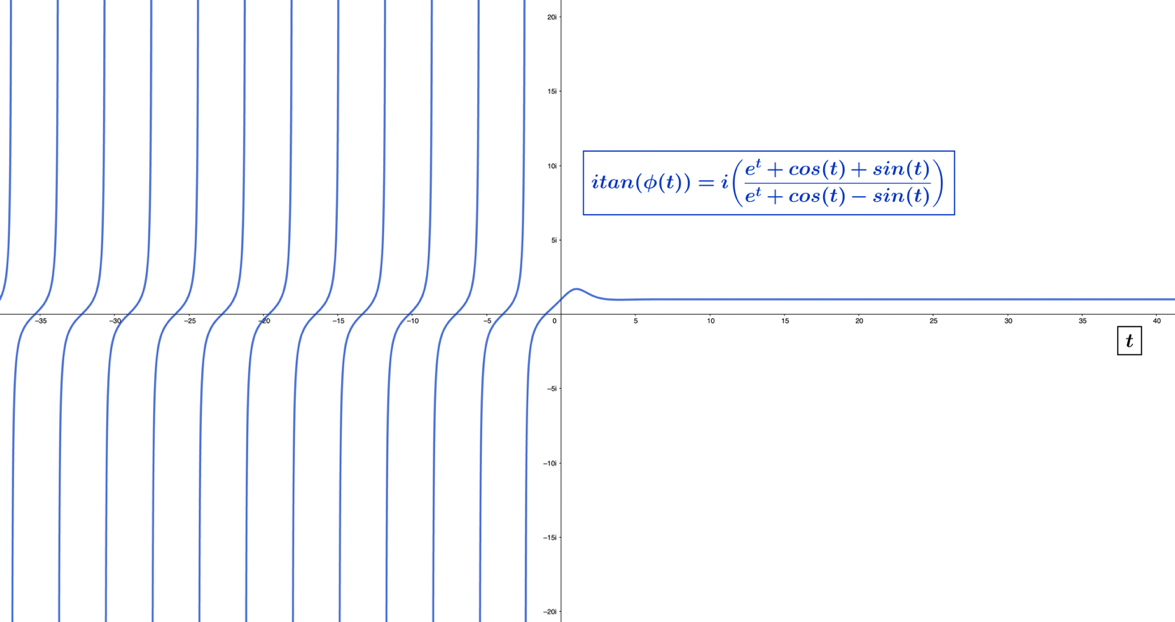
We plot the itan(ϕ(t)){itan}\left( \phi(t) \right) func­tion in Figure 1.3.39, which re­veals that for t<0,t < 0,the graph ap­pears tan­gent-like. For in­creas­ing values of t∈ℝ+t \in \mathbb{R}^{+}, the curve ap­pears flat due to the ex­po­nen­tial func­tion ete^{t} in the nu­mer­a­tor and de­nom­i­na­tor. This flat­ness im­plies very little change occurs for the itan(ϕ(t)){itan}\left( \phi(t) \right) func­tion for large t∈ℝ+.t \in \mathbb{R}^{+}.

Figure
Figure 1.3.39 – The func­tion plot for itan(ϕ(t))=i(et+cos⁡(t)+sin(t)et+cos⁡(t)−sin⁡(t)).{itan}\left( \phi(t) \right) = i\left( \frac{e^{t} + \cos(t) + sin(t)}{e^{t} + \cos(t) - \sin(t)} \right).

Con­tin­u­ing, we use im­plic­it dif­fer­en­ti­a­tion to find

idϕdt[ϕ(t)]=iddt[tan−1⁡(tan⁡(ϕ(t)))]=i1+tan2⁡(ϕ(t))(ddtitan⁡(ϕ(t))),\begin{array}{r} i\frac{d\phi}{dt}\left\lbrack \phi(t) \right\rbrack = i\frac{d}{dt}\left\lbrack \tan^{- 1}\left( \tan\left( \phi(t) \right) \right) \right\rbrack = \frac{i}{1 + \tan^{2}\left( \phi(t) \right)}\left( \frac{d}{dt}i\tan\left( \phi(t) \right) \right), \end{array}
(1.3.432)

first, eval­u­at­ing for

i1+tan2⁡(ϕ(t))=i((et+cos⁡(t)−sin(t)et+cos⁡(t)−sin⁡(t))2+(et+cos⁡(t)+sin(t)et+cos⁡(t)−sin⁡(t))2)\frac{i}{1 + \tan^{2}\left( \phi(t) \right)} = \frac{i}{\left( \left( \frac{e^{t} + \cos(t) - sin(t)}{e^{t} + \cos(t) - \sin(t)} \right)^{2} + \left( \frac{e^{t} + \cos(t) + sin(t)}{e^{t} + \cos(t) - \sin(t)} \right)^{2} \right)}
→i(et+cos⁡(t)−sin(t))2(et+cos⁡(t)−sin⁡(t))2+(et+cos⁡(t)+sin⁡(t))2=i(et+cos⁡(t)−sin(t))22(e2t+2etcos⁡(t)+1 ).\begin{array}{r} \rightarrow \frac{i\left( e^{t} + \cos(t) - sin(t) \right)^{2}}{\left( e^{t} + \cos(t) - \sin(t) \right)^{2} + \left( e^{t} + \cos(t) + \sin(t) \right)^{2}} = \frac{i\left( e^{t} + \cos(t) - sin(t) \right)^{2}}{2\left( e^{2t} + 2e^{t}\cos(t) + 1\ \right)}. \end{array}
(1.3.433)

Next, we find that ∂t(tan⁡(ϕ(t)))\partial t\left( \tan\left( \phi(t) \right) \right) equals

ddt(tan⁡(ϕ(t)))=ddt(et+cos⁡(t)+sin(t)et+cos⁡(t)−sin⁡(t))=2(−etsin⁡(t)+etcos⁡(t)+1)(et+cos⁡(t)−sin⁡(t))2,\begin{array}{r} \frac{d}{dt}\left( \tan\left( \phi(t) \right) \right) = \frac{d}{dt}\left( \frac{e^{t} + \cos(t) + sin(t)}{e^{t} + \cos(t) - \sin(t)} \right) = \frac{2\left( - e^{t}\sin(t) + e^{t}\cos(t) + 1 \right)}{\left( e^{t} + \cos(t) - \sin(t) \right)^{2}}, \end{array}
(1.3.434)

and by com­bin­ing both parts as a prod­uct, dϕdt\ \frac{d\phi}{dt} equals

idϕdt=i(i(et+cos⁡(t)−sin(t))22(e2t+2etcos⁡(t)+1 )2(−etsin⁡(t)+etcos⁡(t)+1)(et+cos⁡(t)−sin⁡(t))2)=etsin⁡(t)−etcos⁡(t)−1e2t+2etcos⁡(t)+1.\begin{array}{r} i\frac{d\phi}{dt} = i\left( \frac{i\left( e^{t} + \cos(t) - sin(t) \right)^{2}}{2\left( e^{2t} + 2e^{t}\cos(t) + 1\ \right)}\frac{2\left( - e^{t}\sin(t) + e^{t}\cos(t) + 1 \right)}{\left( e^{t} + \cos(t) - \sin(t) \right)^{2}} \right) = \frac{e^{t}\sin(t) - e^{t}\cos(t) - 1}{e^{2t} + 2e^{t}\cos(t) + 1}. \end{array}
(1.3.435)

Using the signed cur­va­ture for­mu­la

k=dtdsdϕdt,\begin{array}{r} k = \frac{dt}{ds}\frac{d\phi}{dt}, \end{array}
(1.3.436)

we take the prod­uct of the in­verse of the dsdt\frac{ds}{dt} func­tion with dϕdt\frac{d\phi}{dt}, find­ing the signed cur­va­ture

k=dtdsdϕdt=1e2t+2etcos⁡(t)+1 etsin⁡(t)−etcos⁡(t)−1e2t+2etcos⁡(t)+1=etsin⁡(t)−etcos⁡(t)−1(e2t+2etcos⁡(t)+1)32,\begin{array}{r} k = \frac{dt}{ds}\frac{d\phi}{dt} = \frac{1}{\sqrt{e^{2t} + 2e^{t}\cos(t) + 1\ }}\frac{e^{t}\sin(t) - e^{t}\cos(t) - 1}{e^{2t} + 2e^{t}\cos(t) + 1} = \frac{e^{t}\sin(t) - e^{t}\cos(t) - 1}{\left( e^{2t} + 2e^{t}\cos(t) + 1 \right)^{\frac{3}{2}}}, \end{array}
(1.3.437)

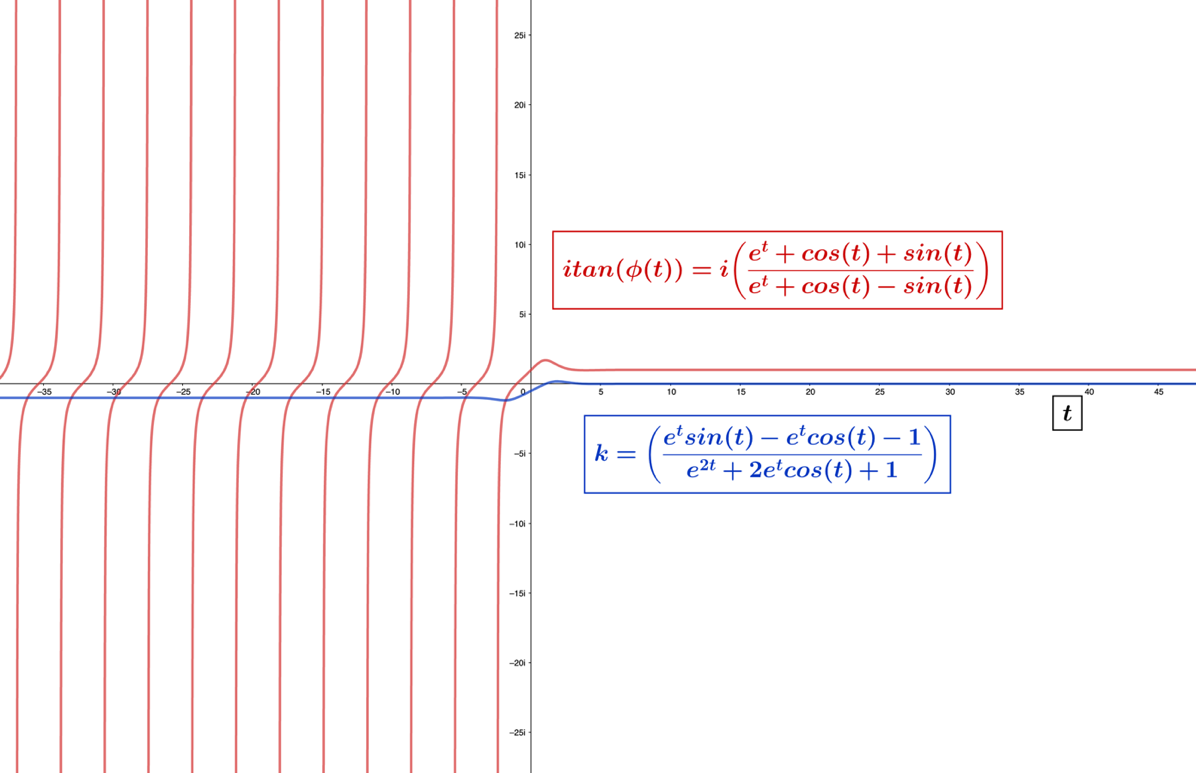
which is plot­ted in Figure 1.3.40, as com­pared to the itan(ϕ(t)){itan}\left( \phi(t) \right) func­tion. Due to the dom­i­nance of the ex­po­nen­tial func­tion ete^{t} in the ex­pres­sion for kk, the cur­va­ture rapid­ly ap­proach­es zero for large values of t∈ℝ+t \in \mathbb{R}^{+}. It is also seen that for neg­a­tive values of t∈ℝ−t \in \mathbb{R}^{-}, the func­tion rapid­ly con­verges to a cur­va­ture of one, which is con­sis­tent with the wave-like char­ac­ter­is­tics and cur­va­ture of the unit circle.

Figure
Figure 1.3.40 – The plot for the cur­va­ture of the 𝔏(t,−1)\mathfrak{L}(t, - 1) uni­fied light func­tion

in the γ(t)\gamma(t) para­met­ric form, along with the itan(ϕ(t)){itan}\left( \phi(t) \right) func­tion.

Fi­nal­ly, we verify that the cur­va­ture result is con­sis­tent with the com­plex para­met­ric signed cur­va­ture ex­pres­sion

k=i(y′′(t)x′(t)−y′(t)x′′(t))(x′(t)2+(Im(y′(t)))2)32,\begin{array}{r} k = \frac{i\left( y^{''}(t)x^{'}(t) - y^{'}(t)x^{''}(t) \right)}{\left( {x^{'}(t)}^{2} + \left( Im\left( y^{'}(t) \right) \right)^{2} \right)^{\frac{3}{2}}}, \end{array}
(1.3.438)

by sub­sti­tut­ing the de­riv­a­tive values into the kk ex­pres­sion

k=(i((iet2−isin(t−π4))(et2+cos⁡(t+π4))−(iet2+icos(t−π4))(et2−sin⁡(t+π4)))(e2t+2etcos⁡(t)+1 )32)=etsin⁡(t)−etcos⁡(t)−1(e2t+2etcos⁡(t)+1)32,\begin{array}{r} k = \left( \frac{i\left( \begin{array}{r} \left( \frac{ie^{t}}{\sqrt{2}} - {isin}\left( t - \frac{\pi}{4} \right) \right)\left( \frac{e^{t}}{\sqrt{2}} + \cos\left( t + \frac{\pi}{4} \right) \right) \\ - \left( \frac{ie^{t}}{\sqrt{2}} + {icos}\left( t - \frac{\pi}{4} \right) \right)\left( \frac{e^{t}}{\sqrt{2}} - \sin\left( t + \frac{\pi}{4} \right) \right) \end{array} \right)}{\left( e^{2t} + 2e^{t}\cos(t) + 1\ \right)^{\frac{3}{2}}} \right) = \frac{e^{t}\sin(t) - e^{t}\cos(t) - 1}{\left( e^{2t} + 2e^{t}\cos(t) + 1 \right)^{\frac{3}{2}}}, \end{array}
(1.3.439)

find­ing the cur­va­ture re­sults are equiv­a­lent.

The analy­sis per­formed in this sec­tion on the cur­va­ture of the as­ymp­tot­ic light func­tions is con­sis­tent with the ex­pec­ta­tions that these func­tions have flat cur­va­ture. Most of the as­ymp­tot­ic light forms are ab­solute in zero cur­va­ture, while the uni­fied light func­tions, when taken as sole func­tions, rapid­ly con­verge to zero cur­va­ture, for t∈ℝ+t \in \mathbb{R}^{+}.