Masteries · Jason GlowneyArithmoí Book 1

Masteries

1.2.4 The Dihedral Differential Group ∈3ℝ\in 3\mathbb{R}

We con­tin­ue with dif­fer­en­tial forms for the D3ℝD_{3\mathbb{R}} group, which has a per­mu­ta­tion set Aℝ∈ℝ3A^{\mathbb{R}} \in \mathbb{R}^{3}, com­prised of the six fol­low­ing ma­tri­ces

Aℝ={Xjℝ,Yjℝ}={(100001010),(001010100),(010100001),(100010001),(010001100),(001100010)}.\begin{array}{r} A^{\mathbb{R}} = \left\{ X_{j}^{\mathbb{R}},Y_{j}^{\mathbb{R}} \right\} = \left\{ \begin{array}{r} \begin{pmatrix} 1 & 0 & 0 \\ 0 & 0 & 1 \\ 0 & 1 & 0 \end{pmatrix},\begin{pmatrix} 0 & 0 & 1 \\ 0 & 1 & 0 \\ 1 & 0 & 0 \end{pmatrix},\begin{pmatrix} 0 & 1 & 0 \\ 1 & 0 & 0 \\ 0 & 0 & 1 \end{pmatrix}, \\ \begin{pmatrix} 1 & 0 & 0 \\ 0 & 1 & 0 \\ 0 & 0 & 1 \end{pmatrix},\begin{pmatrix} 0 & 1 & 0 \\ 0 & 0 & 1 \\ 1 & 0 & 0 \end{pmatrix},\begin{pmatrix} 0 & 0 & 1 \\ 1 & 0 & 0 \\ 0 & 1 & 0 \end{pmatrix} \end{array} \right\}. \end{array}
(1.2.62)

The G(x1X1ℝ)G\left( {x_{1}X}_{1}^{\mathbb{R}} \right) group is the result of taking the ex­po­nen­tial map­ping of the x1X1ℝ{x_{1}X}_{1}^{\mathbb{R}} al­ge­bra,

G(x1X1ℝ)=(ex1000sinh⁡(x1)cosh⁡(x1)0cosh⁡(x1)sinh⁡(x1)),\begin{array}{r} G\left( {x_{1}X}_{1}^{\mathbb{R}} \right) = \begin{pmatrix} e^{x_{1}} & 0 & 0 \\ 0 & \sinh\left( x_{1} \right) & \cosh\left( x_{1} \right) \\ 0 & \cosh\left( x_{1} \right) & \sinh\left( x_{1} \right) \end{pmatrix}, \end{array}
(1.2.63)

which com­pris­es the ex­po­nen­tial func­tion for its axis entry and the hy­per­bol­ic trigono­met­ric func­tions for the non-axis matrix en­tries. The matrix de­riv­a­tive of the G(x1X1ℝ)G\left( {x_{1}X}_{1}^{\mathbb{R}} \right) group is

G′(x1X1ℝ)=ddx1(ex1000cosh⁡(x1)sinh⁡(x1)0sinh⁡(x1)cosh⁡(x1))=(ex1000sinh⁡(x1)cosh⁡(x1)0cosh⁡(x1)sinh⁡(x1)),\begin{array}{r} G^{'}\left( {x_{1}X}_{1}^{\mathbb{R}} \right) = \frac{d}{dx_{1}}\begin{pmatrix} e^{x_{1}} & 0 & 0 \\ 0 & \cosh\left( x_{1} \right) & \sinh\left( x_{1} \right) \\ 0 & \sinh\left( x_{1} \right) & \cosh\left( x_{1} \right) \end{pmatrix} = \begin{pmatrix} e^{x_{1}} & 0 & 0 \\ 0 & \sinh\left( x_{1} \right) & \cosh\left( x_{1} \right) \\ 0 & \cosh\left( x_{1} \right) & \sinh\left( x_{1} \right) \end{pmatrix}, \end{array}
(1.2.64)

for which the cosh⁡(x1)\cosh\left( x_{1} \right) and sinh⁡(x1)\sinh\left( x_{1} \right) terms have switched. The reason for this switch is due to the pres­ence of the hy­per­bol­ic

trigono­met­ric func­tions ∈ex1\in e^{x_{1}}, and eval­u­at­ing the de­riv­a­tive of the ex­pand­ed trigono­met­ric form ex1e^{x_{1}}, we find

ddx1(ex1)=ddx1(cosh⁡(x1)+sinh⁡(x1))=sinh⁡(x1)+cosh⁡(x1).\begin{array}{r} \frac{d}{dx_{1}}\left( e^{x_{1}} \right) = \frac{d}{dx_{1}}\left( \cosh\left( x_{1} \right) + \sinh\left( x_{1} \right) \right) = \sinh\left( x_{1} \right) + \cosh\left( x_{1} \right). \end{array}
(1.2.65)

To com­pare the forms G(x1X1ℝ)G\left( {x_{1}X}_{1}^{\mathbb{R}} \right) and G′(x1X1ℝ)G^{'}\left( {x_{1}X}_{1}^{\mathbb{R}} \right), we set x1=0x_{1} = 0, and eval­u­ate the fol­low­ing matrix-vector prod­ucts

(e0000cosh⁡(0)sinh⁡(0)0sinh⁡(0)cosh⁡(0))(ABC)=(100010001)(ABC)=(ABcosh(0)+Csinh(0)Ccosh(0)+Bsinh(0))=(ABC),\begin{array}{r} \begin{pmatrix} e^{0} & 0 & 0 \\ 0 & \cosh(0) & \sinh(0) \\ 0 & \sinh(0) & \cosh(0) \end{pmatrix}\begin{pmatrix} A \\ B \\ C \end{pmatrix} = \begin{pmatrix} 1 & 0 & 0 \\ 0 & 1 & 0 \\ 0 & 0 & 1 \end{pmatrix}\begin{pmatrix} A \\ B \\ C \end{pmatrix} = \begin{pmatrix} A \\ Bcosh(0) + Csinh(0) \\ Ccosh(0) + Bsinh(0) \end{pmatrix} = \begin{pmatrix} A \\ B \\ C \end{pmatrix}, \end{array}
(1.2.66)
(e0000sinh⁡(0)cosh⁡(0)0cosh⁡(0)sinh⁡(0))(ABC)=(100001010)(ABC)=(ACcosh(0)+Bsinh(0)Bcosh(0)+Csinh(0))=(ACB),\begin{array}{r} \begin{pmatrix} e^{0} & 0 & 0 \\ 0 & \sinh(0) & \cosh(0) \\ 0 & \cosh(0) & \sinh(0) \end{pmatrix}\begin{pmatrix} A \\ B \\ C \end{pmatrix} = \begin{pmatrix} 1 & 0 & 0 \\ 0 & 0 & 1 \\ 0 & 1 & 0 \end{pmatrix}\begin{pmatrix} A \\ B \\ C \end{pmatrix} = \begin{pmatrix} A \\ Ccosh(0) + Bsinh(0) \\ Bcosh(0) + Csinh(0) \end{pmatrix} = \begin{pmatrix} A \\ C \\ B \end{pmatrix}, \end{array}
(1.2.67)

find­ing that G(x1X1ℝ)G\left( {x_{1}X}_{1}^{\mathbb{R}} \right) acts as an iden­ti­ty, leav­ing the vector un­changed, while G′(x1X1ℝ)G^{'}\left( {x_{1}X}_{1}^{\mathbb{R}} \right) re­flects in the X2/X3X_{2}/X_{3}-plane. With the above cal­cu­la­tion, we get the first clues sur­round­ing the nature of the de­riv­a­tive D3ℝD_{3\mathbb{R}}, namely, a swap­ping of the hy­per­bol­ic trigono­met­ric func­tions for the XjX_{j} el­e­ments of the group. This means that each cosh⁡(xk)\cosh\left( x_{k} \right) el­e­ment ro­tates in ℂ3\mathbb{C}^{3} space by iπ2\frac{i\pi}{2} ra­di­ans in the coun­ter­clock­wise di­rec­tion, ar­riv­ing to ori­en­tate itself with what was pre­vi­ous­ly the sinh⁡(xk)\sinh\left( x_{k} \right) coun­ter­part. For the sinh⁡(xk)\sinh\left( x_{k} \right) func­tions, they rotate −iπ2\ \frac{- i\pi}{2} ra­di­ans for a clock­wise ro­ta­tion in ℂ3\mathbb{C}^{3} space, to arrive at the ori­en­ta­tion of the orig­i­nal cosh⁡(xk)\cosh\left( x_{k} \right) coun­ter­part.

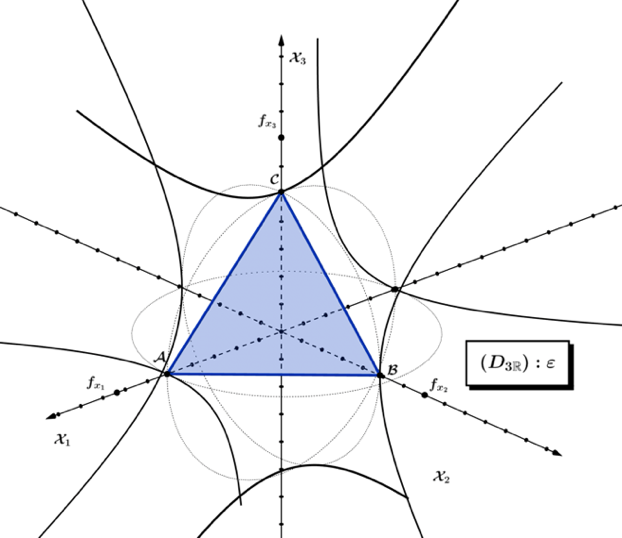
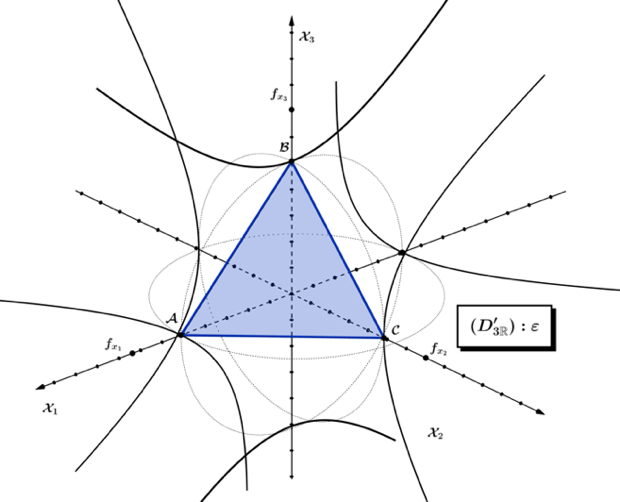
Fig­ures 1.2.3,4 – Iden­ti­ty el­e­ment ϵ\epsilon ori­en­ta­tion in D3ℝD_{3\mathbb{R}} (left), and ori­en­ta­tion for D3ℝ′D_{3\mathbb{R}}^{'} (right).

In Fig­ures 1.2.3-4, we see how the ver­tices are arranged for each iden­ti­ty in re­la­tion­ship to one an­oth­er in ℂ3\mathbb{C}^{3} space. For the (xjXjℝ)′\left( x_{j}X_{j}^{\mathbb{R}} \right)^{'} el­e­ments, we find com­plex phase shifts in ra­di­ans for the fol­low­ing Lie al­ge­bra el­e­ments ∈(𝔤ℝ)′\in \left( \mathfrak{g}^{\mathbb{R}} \right)^{'}

(xjXjℝ)′ ={(x1000iπ2x1−iπ20x1−iπ2iπ2),   (iπ20x2−iπ20x20x2−iπ20iπ2),   (iπ2x2−iπ20x2−iπ2iπ2000x3)},\begin{array}{r} \left( x_{j}X_{j}^{\mathbb{R}} \right)'\ = \left\{ \begin{array}{r} \begin{pmatrix} x_{1} & 0 & 0 \\ 0 & \frac{i\pi}{2} & x_{1} - \frac{i\pi}{2} \\ 0 & x_{1} - \frac{i\pi}{2} & \frac{i\pi}{2} \end{pmatrix},\ \ \ \begin{pmatrix} \frac{i\pi}{2} & 0 & x_{2} - \frac{i\pi}{2} \\ 0 & x_{2} & 0 \\ x_{2} - \frac{i\pi}{2} & 0 & \frac{i\pi}{2} \end{pmatrix},\ \ \ \begin{pmatrix} \frac{i\pi}{2} & x_{2} - \frac{i\pi}{2} & 0 \\ x_{2} - \frac{i\pi}{2} & \frac{i\pi}{2} & 0 \\ 0 & 0 & x_{3} \end{pmatrix} \end{array} \right\}, \end{array}
(1.2.68)

and once ex­po­nen­ti­at­ed, the e(xj(Xjℝ)′ )e^{\left( x_{j}\left( X_{j}^{\mathbb{R}} \right)^{'}\ \right)} gen­er­a­tor­sare the fol­low­ing

G((xjXjℝ)′ )={(ex1000sinh⁡(x1)cosh⁡(x1)0cosh⁡(x1)sinh⁡(x1)),   (sinh⁡(x2)0cosh⁡(x2)0ex20cosh⁡(x2)0sinh⁡(x2)),   (sinh⁡(x1)cosh⁡(x2)0cosh⁡(x2)sinh⁡(x1)000ex3 )}.\begin{array}{r} G\left( \left( x_{j}X_{j}^{\mathbb{R}} \right)^{'}\ \right) = \left\{ \begin{array}{r} \begin{array}{r} \begin{pmatrix} e^{x_{1}} & 0 & 0 \\ 0 & \sinh\left( x_{1} \right) & \cosh\left( x_{1} \right) \\ 0 & \cosh\left( x_{1} \right) & \sinh\left( x_{1} \right) \end{pmatrix} \end{array},\ \ \ \begin{pmatrix} \sinh\left( x_{2} \right) & 0 & \cosh\left( x_{2} \right) \\ 0 & e^{x_{2}} & 0 \\ \cosh\left( x_{2} \right) & 0 & \sinh\left( x_{2} \right) \end{pmatrix},\ \ \ \begin{pmatrix} \sinh\left( x_{1} \right) & \cosh\left( x_{2} \right) & 0 \\ \cosh\left( x_{2} \right) & \sinh\left( x_{1} \right) & 0 \\ 0 & 0 & e^{x_{3}}\ \end{pmatrix} \end{array} \right\}. \end{array}
(1.2.69)

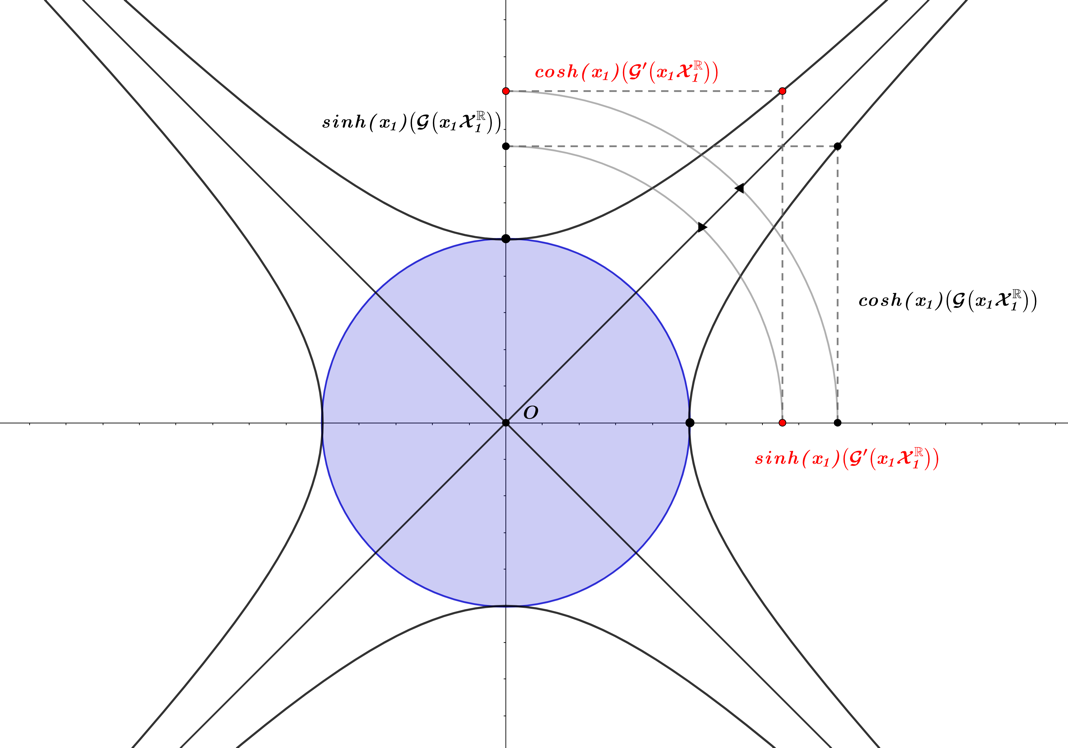
The (xjXjℝ)′\left( x_{j}X_{j}^{\mathbb{R}} \right)^{'} de­riv­a­tive al­ge­bras are a de­par­ture from the last sec­tion's (xjXjℂ)′\left( x_{j}X_{j}^{\mathbb{C}} \right)^{'}, given the al­ge­bras have gone from three non-zero en­tries to five. From 1.2.68, the de­riv­a­tive al­ge­bras (xjXjℝ)′\left( x_{j}X_{j}^{\mathbb{R}} \right)^{'} have phase shifts of iπ2\frac{i\pi}{2} ra­di­ans for the non-axis di­ag­o­nal el­e­ments, and −iπ2- \frac{i\pi}{2} ra­di­ans for the non-axis en­tries with xjx_{j} vari­ables. In Figure 1.2.5, we show the phase-shift­ing ro­tates the non-axis hy­per­bol­ic func­tions ∈G(x1X1ℝ)\in G\left( {x_{1}X}_{1}^{\mathbb{R}} \right), to the that of the non-axis hy­per­bol­ic func­tions ∈G′(x1X1ℝ)\in G^{'}\left( {x_{1}X}_{1}^{\mathbb{R}} \right). The phase-shift­ing be­comes a ro­ta­tion once the al­ge­bra is ex­po­nen­ti­at­ed, seen as the arcs that rotate by iπ2\frac{i\pi}{2} ra­di­ans for cosh⁡(x1)G(x1X1ℝ)→cosh⁡(x1)G′(x1X1ℝ)\cosh\left( x_{1} \right)G\left( {x_{1}X}_{1}^{\mathbb{R}} \right) \rightarrow \cosh\left( x_{1} \right)G'\left( {x_{1}X}_{1}^{\mathbb{R}} \right), and by −iπ2- \frac{i\pi}{2} ra­di­ans for sinh⁡(x1)G(x1X1ℝ)→sinh⁡(x1)G′(x1X1ℝ)\sinh\left( x_{1} \right)G\left( {x_{1}X}_{1}^{\mathbb{R}} \right) \rightarrow \sinh\left( x_{1} \right)G'\left( {x_{1}X}_{1}^{\mathbb{R}} \right).

Figure
Figure 1.2.5 – The geo­met­ric arrange­ment of the G(xjXjℝ)G\left( {x_{j}X}_{j}^{\mathbb{R}} \right) group's hy­per­bol­ic

func­tions (black), and that of its de­riv­a­tive group's, G′(xjXjℝ)G'\left( {x_{j}X}_{j}^{\mathbb{R}} \right), (red).

For unit hy­per­bo­lae ∈ℝ2\in \mathbb{R}^{2}, those ori­ent­ed along the hor­i­zon­tal axis will have the equa­tion

x2−y2=1,\begin{array}{r} x^{2} - y^{2} = 1, \end{array}
(1.2.70)

which has the fol­low­ing hy­per­bol­ic trigono­met­ric func­tion rep­re­sen­ta­tion

cosh2⁡(x)−sinh2⁡(x)=1.\begin{array}{r} \cosh^{2}{(x) - \sinh^{2}{(x) = 1}}. \end{array}
(1.2.71)

The equa­tion for a ver­ti­cal­ly ori­ent­ed unit hy­per­bo­la is

y2−x2=1,\begin{array}{r} y^{2} - x^{2} = 1, \end{array}
(1.2.72)

which has the hy­per­bol­ic trigono­met­ric func­tion rep­re­sen­ta­tion

sinh2⁡(x)−cosh2⁡(x)=−1.\begin{array}{r} \sinh^{2}{(x) - \cosh^{2}{(x) = - 1.}} \end{array}
(1.2.73)

Using the fol­low­ing 2×22 \times 2 matrix com­posed of hy­per­bol­ic trigono­met­ric func­tions, we find its de­ter­mi­nant is a match with the first hy­per­bol­ic iden­ti­ty

det⁡(cosh⁡(x)sinh⁡(x)sinh⁡(x)cosh⁡(x))=cosh2⁡(x)−sinh2⁡(x)=1,\begin{array}{r} \det\begin{pmatrix} \cosh(x) & \sinh(x) \\ \sinh(x) & \cosh(x) \end{pmatrix} = \cosh^{2}{(x) - \sinh^{2}{(x) = 1,}} \end{array}
(1.2.74)

and the de­riv­a­tive de­ter­mi­nant match­es the second hy­per­bol­ic iden­ti­ty

det⁡(ddx(cosh⁡(x)sinh⁡(x)sinh⁡(x)cosh⁡(x)))→det⁡(sinh⁡(x)cosh⁡(x)cosh⁡(x)sinh⁡(x)) =sinh2⁡(x)−cosh2⁡(x)=−1.\begin{array}{r} \det\left( \frac{d}{dx}\begin{pmatrix} \cosh(x) & \sinh(x) \\ \sinh(x) & \cosh(x) \end{pmatrix} \right) \rightarrow \det\begin{pmatrix} \sinh(x) & \cosh(x) \\ \cosh(x) & \sinh(x) \end{pmatrix}\ = \sinh^{2}{(x) - \cosh^{2}{(x) = - 1.}} \end{array}
(1.2.75)

When taking the de­ter­mi­nants of the ex­po­nen­tial de­riv­a­tives e(xjXjℝ)′ e^{\left( x_{j}X_{j}^{\mathbb{R}} \right)^{'}\ }, we find a sim­i­lar re­la­tion­ship to the ver­ti­cal unit hy­per­bo­la with neg­a­tive de­ter­mi­nants, where­by taking the result for e(x1X1ℝ)′ e^{\left( x_{1}X_{1}^{\mathbb{R}} \right)^{'}\ }

det⁡(ex1000sinh⁡(x1)cosh⁡(x1)0cosh⁡(x1)sinh⁡(x1))=ex1(sinh2⁡(x1)−cosh2⁡(x1))=−ex1,\begin{array}{r} \det\begin{pmatrix} e^{x_{1}} & 0 & 0 \\ 0 & \sinh\left( x_{1} \right) & \cosh\left( x_{1} \right) \\ 0 & \cosh\left( x_{1} \right) & \sinh\left( x_{1} \right) \end{pmatrix} = e^{x_{1}}\left( \sinh^{2}{(x_{1}} \right) - \cosh^{2}{(x_{1})) = {- e}^{x_{1}}}, \end{array}
(1.2.76)

we find that the neg­a­tive de­ter­mi­nant is scaled by the mag­ni­tude of the axis com­po­nent, ex1.e^{x_{1}}.

The key in­sight re­vealed by the (xjXjℝ)′\left( x_{j}X_{j}^{\mathbb{R}} \right)^{'} de­riv­a­tive al­ge­bras is that the G(xjXjℝ)G\left( {x_{j}X}_{j}^{\mathbb{R}} \right) groups sit in ℂ3\mathbb{C}^{3} space, ev­i­denced by the imag­i­nary phase shift values in its Lie al­ge­bras. To argue that these do not sit in ℂ3\mathbb{C}^{3} space would be to accept the non-ex­is­tence of their de­riv­a­tives. The (yjYjℝ)′\left( {y_{j}Y}_{j}^{\mathbb{R}} \right)^{'} are the same as the (yjYjℂ)′\left( {y_{j}Y}_{j}^{\mathbb{C}} \right)^{'} al­ge­bras, with the ex­cep­tion that they are solely pos­i­tive in value, and for the sake of brevi­ty, the reader may go back to ref­er­ence Eq. 1.2.61.