1.3.1 Curvature and Light
The standard approach to matrix groups involves considerations about the type of space and how one might measure distance in this space. A general practice is to consider spaces as Euclidean or non-Euclidean, along with the number of represented dimensions. Euclidean spaces are flat, and an excellent way to test for this flatness is to add up the three angles of a triangle and ensure it sums to . As the most intuitive non-Euclidean geometry, the sphere's surface has positive curvature, where the sum of the angles of the triangle's angles is a value greater than . Hyperbolic spaces may be less intuitive for some, having negative curvature and triangular angle sums less than .
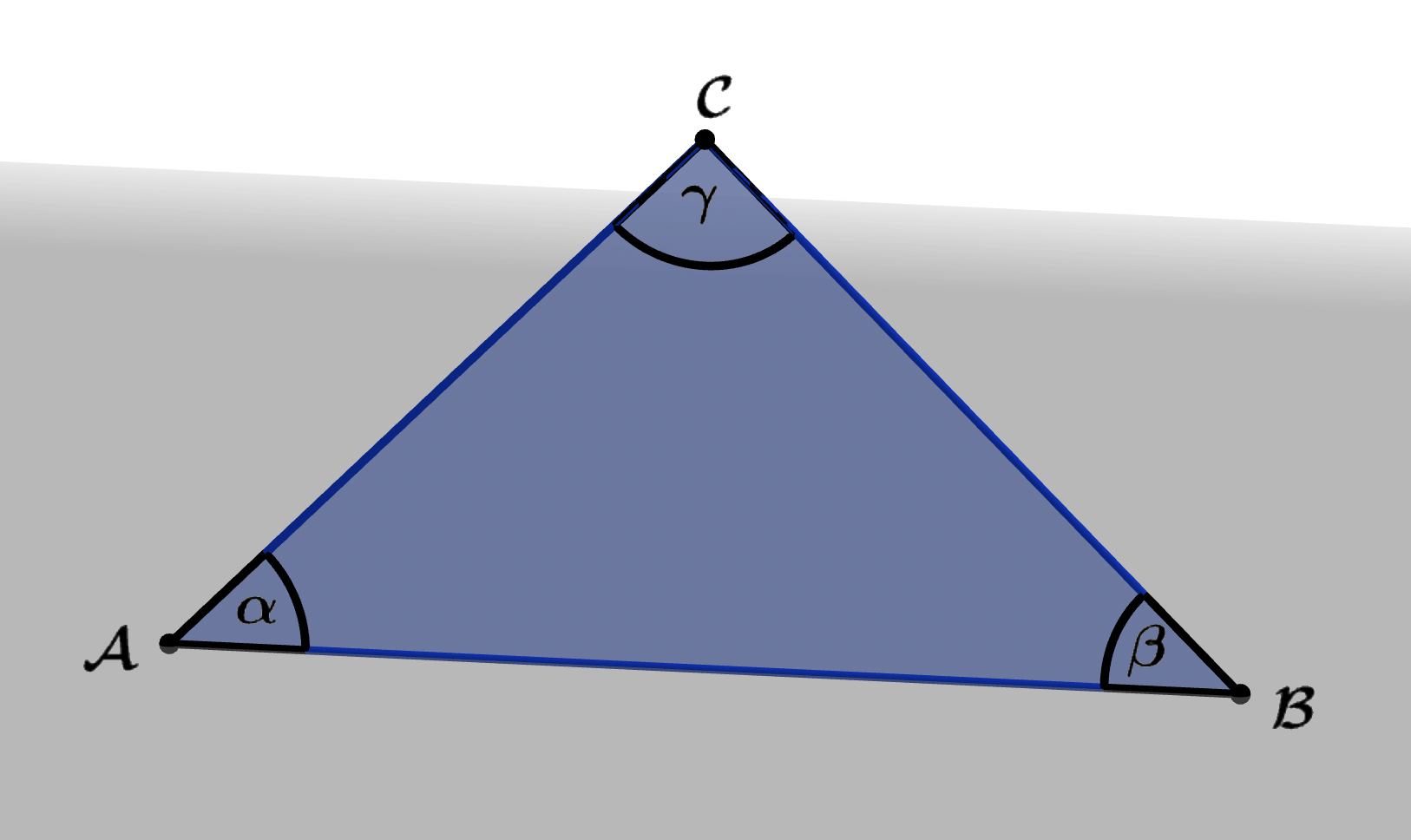
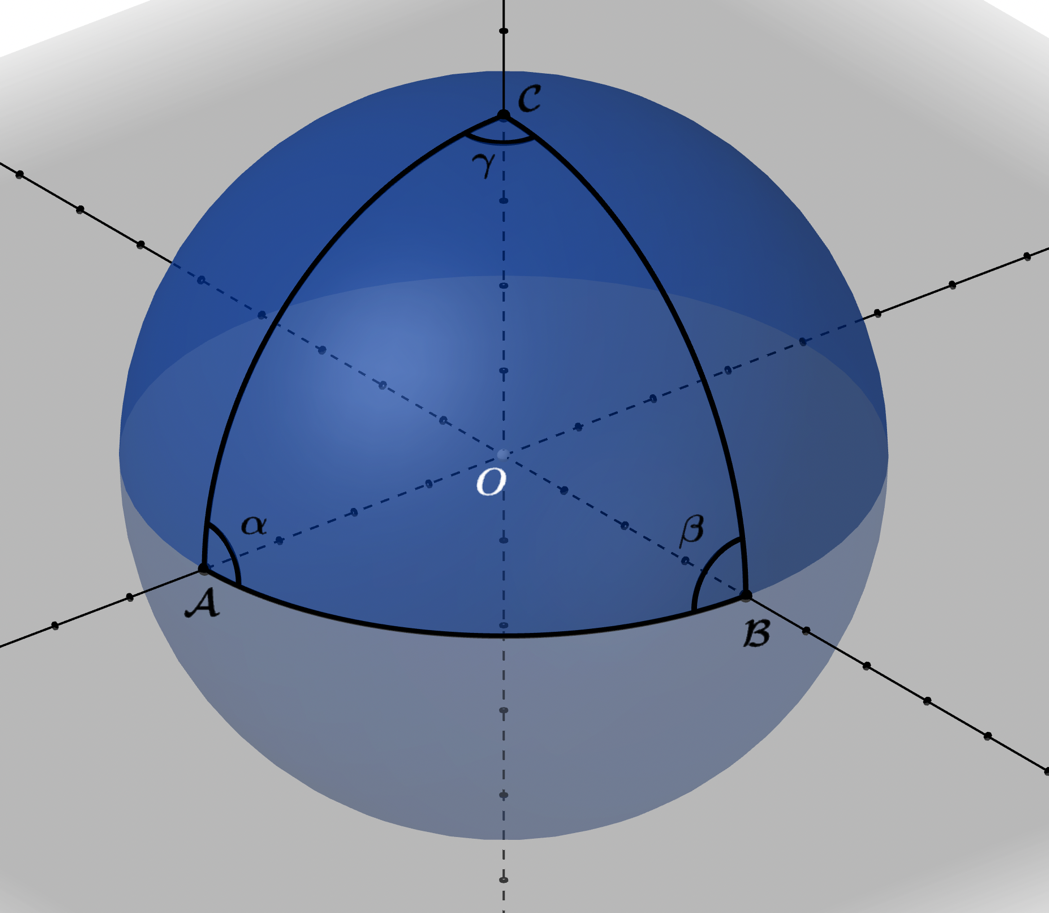
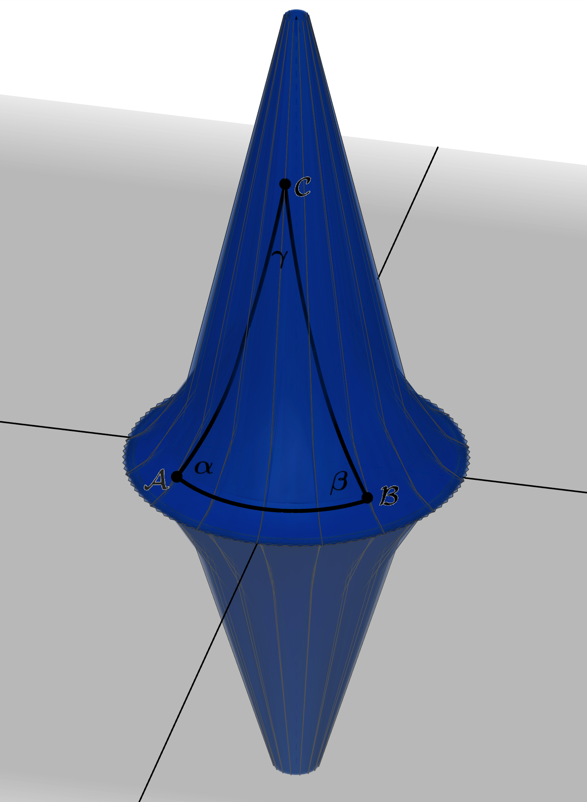
Figures 1.3.1-3 show triangles on surfaces with zero, positive, and negative curvatures, representing Euclidean space, the surface of the sphere, and the surface of the pseudosphere. An essential mathematical consideration is to ask how different geometries and curvatures are related? A metric is a term used by geometers, representing the mathematical means to measure things like distances in these various spaces. These metrics can take on trigonometric forms to define the invariance of a measured distance, where the familiar example of the circle is
and perhaps, the less familiar hyperbolic metric,
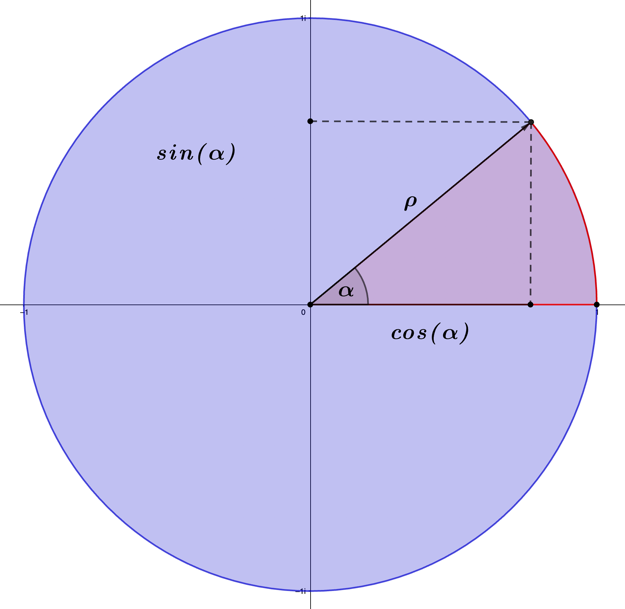
In Figure 1.3.4, the unit circle represents the distance metric solved for , resulting in the straightforward metric .
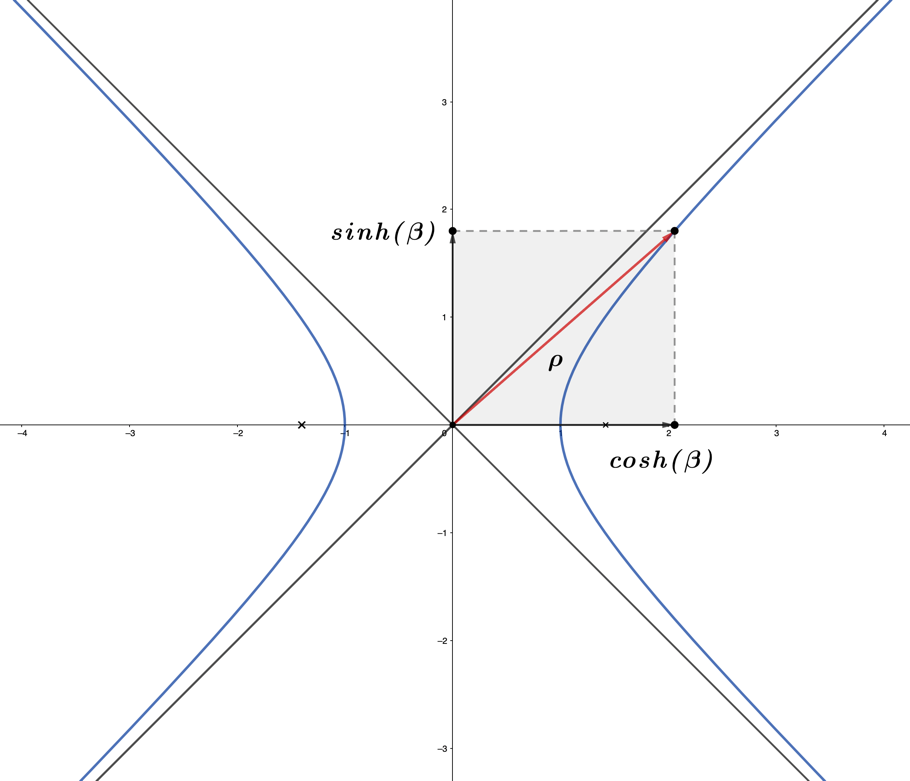
The invariant distance also defines the unit hyperbola, which, like the unit circle, has a trigonometric metric representation The horizontal axis of this hyperbolic triangle is the function, and the vertical axis is the function. The hyperbolic hypotenuse represents the metric's invariance, found by evaluating These distance metrics are well-established for both Euclidean and non-Euclidean geometries, but what is less established is the mathematical groundwork for what angles are in non-Euclidean spaces and how the varied geometries relate to one another by the angle argument space. Taking the approach that angle measurements should not be confined to real values , and instead take on complex values , reveals incredible topological insights about how geometric spaces relate. The interconnectedness of these geometric spaces with curvatures , represents a recurrent theme for the subject matter found in this book.