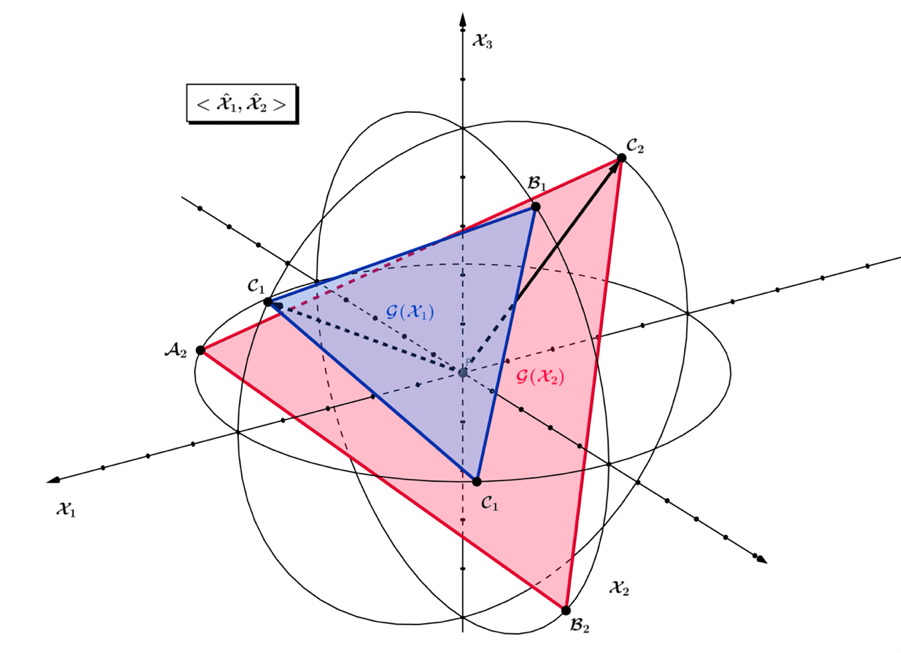
To visualize what an inner product of two matrices might look like, we use the examples for rotating the identity matrix , with entries along its diagonal, representing the vertices of the equilateral triangle. Setting the rotation angles , this yields the following
(1.1.168)
and
(1.1.169)
Taking the inner product
(1.1.170)
we find complex-valued vertex components and a real-valued component for the vertex. This is consistent with the effect of rotating in the -plane, for the vertices, having been on the complex axes of rotation for respectively, while the -plane did not act as a complex axis of rotation on the vertex. In Figure 1.1.15, we have plotted both rotations of the equilateral triangle identity matrix in the -plane.
Figure 1.1.15 – The inner product .
The equilateral triangle looks larger than , but from the standpoint of the Hilbert-Schmidt norms, they are the same. This can be seen by first considering
(1.1.171)
then for ,
(1.1.172)
recalling that , and that represent scalar magnitudes. Closer inspection also reveals that the inner product , is essentially the sum of the dot products of the matched column vectors from and , as
(1.1.173)
In this section, we have introduced the symmetry group as the interconnection of three complex unit circles which form a complex unit sphere. Rotations in are the result of group generators acting on the equilateral triangle as unitary linear transformations. Hilbert spaces and their inner-product mappings introduce complete vector spaces, a departure from the confines of Euclidean space.