On the way to finding the number of permutation elements , we made use of numbers that were described as cone numbers and axis numbers. Developing an intuition for these numbers comes by expanding beyond a simple algebraic description, to one that encompasses their geometry. Our spatial ability to consider higher-dimensional number forms may be hindered when trying to visualize them, but we can consider projecting our equilateral triangle onto a disc space. The considerations of arc length and areas on the complex unit circle, along with their spherical analogs, reveal that some numbers and their area/volumes are subsets of other ones. For the real integers and rational numbers, we are aware of the concept of even and odd numbers, for which, the following hold:
The example considered is a defined group , which represents the even natural numbers, with operations of addition and multiplication. The values of the natural numbers resulting from these operations will remain even and consistent with the even subgroup of the natural numbers . Adding an odd number to any element , in the subgroup, gives us an odd-valued natural number . If we choose the odd natural number , then apply the addition operation to every element , the result will be the whole group of natural numbers
(1.4.88)
If we were to choose an odd natural number such as we would be missing some of the odd natural numbers in the lower valued bound of the set, seen as follows
(1.4.89)
for , the set of even natural numbers. In the above expression, we are missing the odd natural numbers from to 5, given that the first odd natural number was chosen to be . As the number is required to complete the set of natural numbers, we define this to be the minimal element of the set, since there is no natural number in the set that is smaller than it. The definition of the minimal element can also be considered for the groups we have been studying. We can start by applying this concept to spheres, and we will eventually find the concept holds for the other discussed matrix group conic sections. This is elucidated by expanding from the simple natural numbers to the complex numbers and their representation as exponentials in higher dimensions.
To start, we consider the infinite set of complex numbers on the unit circle using raised to a variable power , as , for ,, where the number zero is included for and . For , the number is the arclength in radians from the positive real-axis, fitting the definition of the primary minimal element. The number is the total number of elements in the arclength partition set on the interval We define the number , as
(1.4.90)
for , signifying that the total number of elements in the partitioned set is zero, defining the non-partitioned interval. Expressing complex numbers on the unit circle up to a primary minimal element , comprises a set of minimal primary elements , for which the full sets are the following:
When considering the unit circle for odd-valued elements for the rational exponent and the sets above, the powers of these elements will land on every member in the set when successively iterated. An example: for modulo , the number lands on every element in the primary minimal element set , seen by expanding its sequence
(1.4.92)
For geometric spaces like the hyperbola, this would not hold as the hyperbola is open and successive elements in the set would continue to extend indefinitely out in the geometry, seen by using the analogous example in the hyperbolic sense
(1.4.93)
So, in the case of successive rotations on a complex sphere, where we want to track non-modulo powers, our primary minimal element is like the case of our natural numbers for , and is the only element that when multiplied by itself will yield every element in the set. This should sound consistent with a cyclic group, at least for the two-dimensional case on the complex unit circle. If our goal is to find a symmetric group, we need to think along the lines of taking advantage of minimal elements to arrive at all the elements in the group. Minimal elements, and any congruent modulo elements for the exponent equaling an odd rational, is analogous to the odd numbers from the case of the natural numbers with the defined multiplication operation, where exponents will add and the following hold,
(1.4.94)
To find all the generators encompassing the symmetric conic group in complex space, we remain mindful of the determinant results that occur when the defined operation is applied on odd and even permutations. For example, the operation of multiplication, with only even determinant permutations, will be bound to even determinants. A way to potentially describe the minimal elements of our matrices , is by projecting them onto a two-dimensional complex disc. We consider elements of the -type for hyperbolic forms and spherical forms, by using the examples
(1.4.95)
(1.4.96)
We can see the entries are not only the minimal elements, but they are also the axes of rotation. In the bottom-right submatrices are the radial endpoints of the minimal element modulus counterclockwise , and clockwise , from the minimal element. It should also be noted that the bottom-right submatrix is the imaginary hyperbolic analog and the real unit circle analog. Most are familiar with the real numbers representing the submatrix entries in the anti-diagonal for , but may not be aware that there is a similar analog for the split-complex numbers. For these generators alone, we can raise them to integer powers, letting the minimal element cycle through the subgroup elements. The case for is straightforward
(1.4.97)
for which, we are bound by the positive hyperbolic tangent space. For , the minimal element cycles the group through all four axes elements:
(1.4.98)
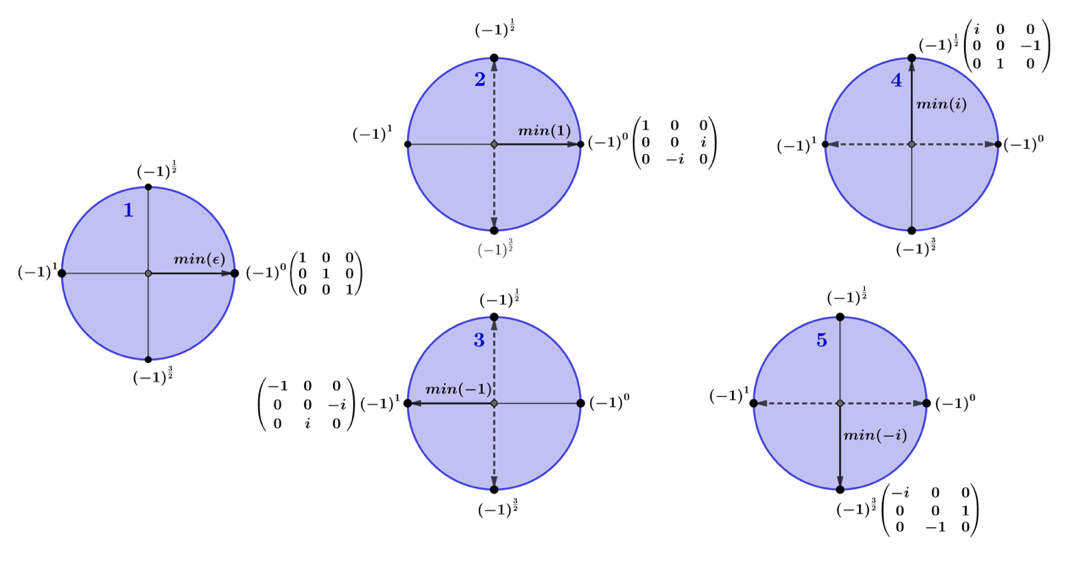
These elements, as two-dimensional projections, are shown graphically in Figure 1.4.13, for the identity element, the positive and negative hyperbolic tangent space, and the tangent spaces for the complex sphere -component. For all the elements above, the matrix determinants are even and bound to the axis numbers.
Turning to the cone number elements of the -form, we define the minimal element to be
(1.4.99)
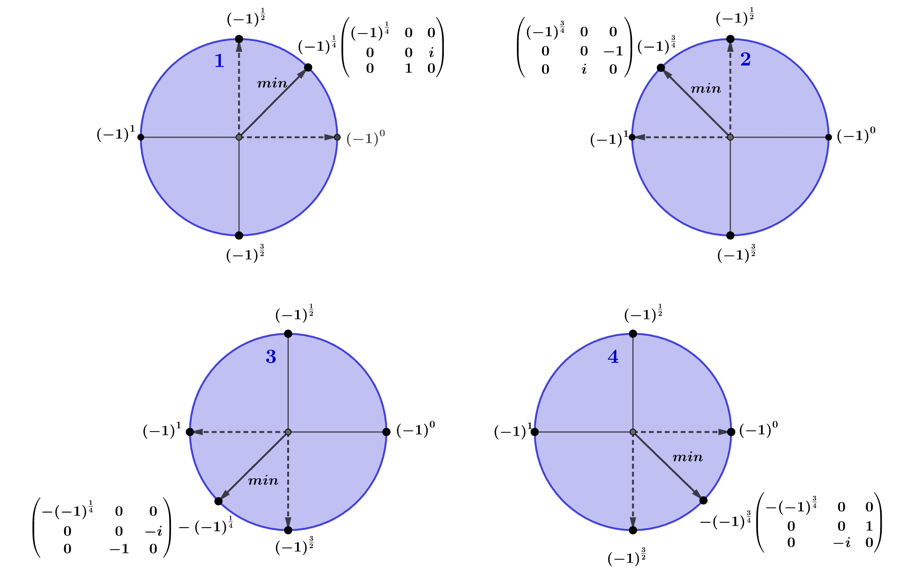
where once again the entry represents the minimal partition element and the axis of rotation. The minimal partition has an odd determinant, given it is a cone number, and cycles through the entire algebra set
Figure 1.4.14 shows a projective two-dimensional graphic representation for the -type cone numbers, as they cycle through the quadrants.
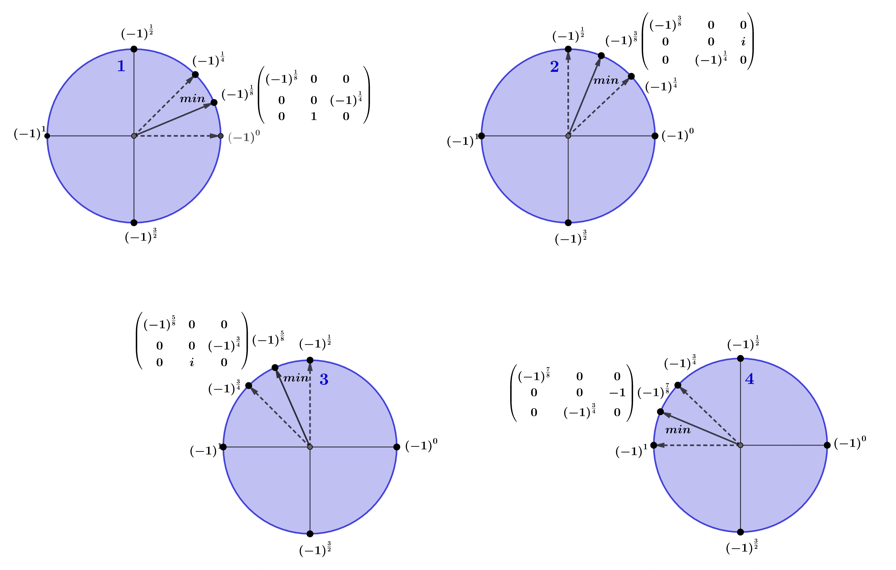
As a final example, we take the minimal element , which turns out to be like the example, having a total of 16 elements in the subgroup, having the minimal element matrix representation
(1.4.101)
In Figure 1.4.15, shown are four of the elements on the upper half of the complex circle for , raised to odd powers
As mentioned previously, having a better understanding of the minimal elements of our group and the concept of odd and even determinants give us better geometric clarity concerning the symmetric conic group. This clarity is by way of the fact that we will need to start with generators , which have odd value determinants and contain the minimal element for each.