
1.1.16 The Dihedral Groups
Before we proceed further, a clarification regarding the distinction between symmetric and dihedral groups is in order. Symmetric groups represent the entire combinatorial set of permutations possible for the order of that group. For example, the symmetric group , has permutations. The dihedral groups represent the group of symmetries of a regular polygon, including the form's specific rotations and reflections. Dihedral groups encompass the rigid motion of polygons, which means the bijection of a set of points onto itself, which leaves the distance between any two points on the polygon unchanged.
Definition (1.1.80) – The Dihedral Group is the group of symmetries of a regular polygon, it is a group under composition, with a set of permutation elements , that is bijective, representing the symmetries of a regular polygon with rotation elements and reflection elements
The group represents the rigid rotational and reflective symmetries of the equilateral triangle, and we will be working with this group within various geometric spaces throughout this book.
We choose to represent the permutation functions of as square matrices, which have one entry equal to 1 in each row and column, while the remaining entries are 0. These matrices are called permutation matrices, and we can rewrite the elements as
In Figure 1.1.3, we show the six permutations of the equilateral triangle representing the geometric reflections and rotations of the group. It is straightforward to see that we can permute the equilateral triangle with matrix-matrix multiplication or matrix-vector multiplication. For example, the composition , is
and in vector notation, the above can be represented as
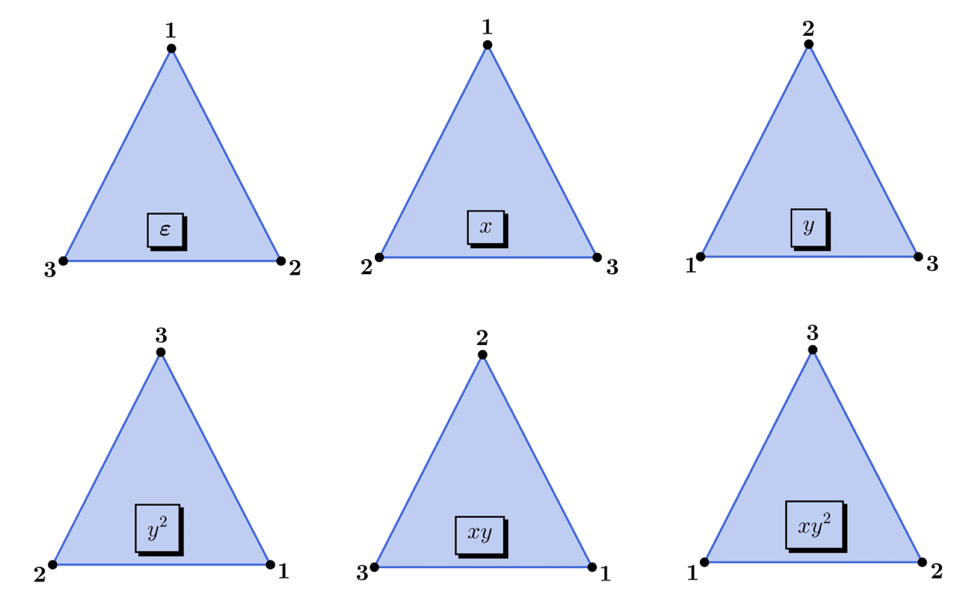
The composition of these six elements acts on the equilateral triangle, representing all the geometric reflections and rotations of the group. When first learning about the group, students are shown permutations of the equilateral triangle as depicted in Figure 1.1.3, but the geometric space in which this polygon sits is not properly conveyed. To rotate and reflect a form such as a polygon requires it to sit in the appropriate geometric space where these can occur. It turns out that the equilateral triangle in , sits in a higher-dimensional hyperbolic space, depicted in Figure 1.1.4, where the positive identity element of the group is oriented in the positive quadrant. The rotations and reflections of the equilateral triangle from the group will later be shown to represent the tangent space of the Lie group.
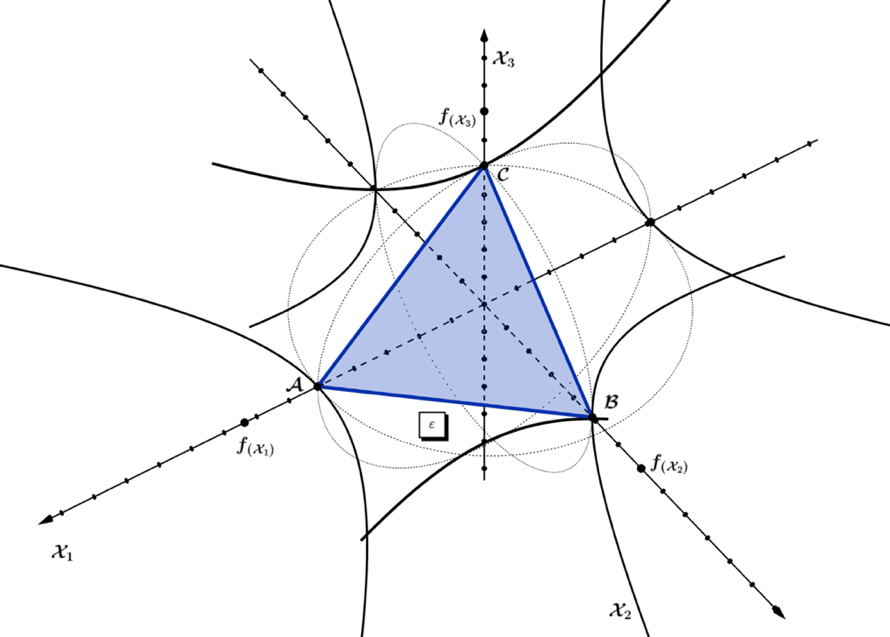
The geometric space in which the reflections and rotations of any form occur is an important aspect of group theory. For the identity element in Figure 1.1.4 above, with all its elements space, the vertices of the equilateral triangle sit on the only shared coordinates between orthogonal complex unit circles , and the hyperbolae space. This shared space is equivalent to setting , in the exponentials , which places the vertices at points a unit length from the origin on the real axes only. These geometric space considerations will become more apparent as we study their Lie group representations, where infinitesimal rotations will orient the vertices beyond the restrictions of the finite rotations and reflections of the group.