Definition (1.1.198) – We now define the Symmetric/Dihedral group, as a group under composition that sits in the complex geometric space, having a set of permutation elements
The set of permutation elements of have multi-valued entries for the permutations, and values for the cyclic subgroup , seen below.
(1.1.199)
(1.1.200)
(1.1.201)
(1.1.202)
(1.1.203)
(1.1.204)
Our defined group has elements, is non-abelian, and any permutation is both an injective and surjective (bijective) function from the set of three variables, representing the equilateral triangle symmetries onto itself. For our abelian cyclic group, we have elements that rotate to values on the axes of the complex unit circle.
Theorem (1.1.205) –The set of permutationsforms a group under composition
Proof – Verification of group axioms
Closure:All elementsare bijective, and the composition of any elementsis also bijective.
Associativity: Permutations are functions, and their compositions are associative.
Identity: The identity functionbijectively maps all elements of the setto themselves
Inverse:is a permutation and thus bijective, and a function existsthat is also bijective.
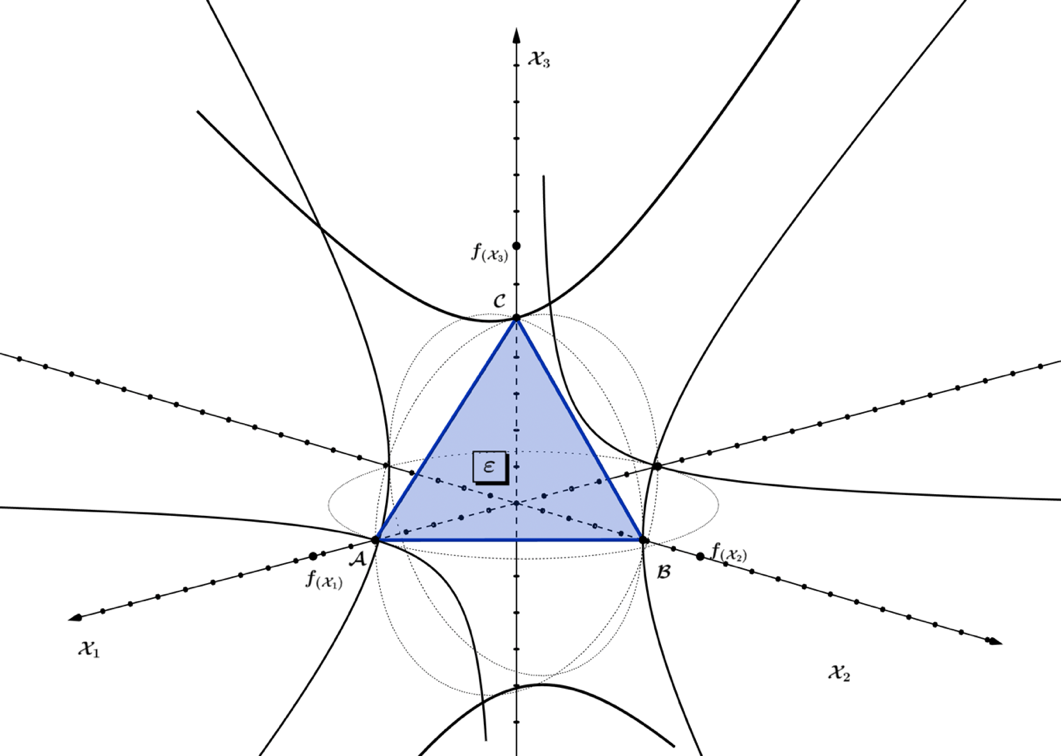
Much like the Figure 1.1.5 plot of the identity in hyperbolic space, the identity element has its vertices aligned along the real axes, shown in Figure 1.1.17.
Figure 1.1.17 –The identity element .
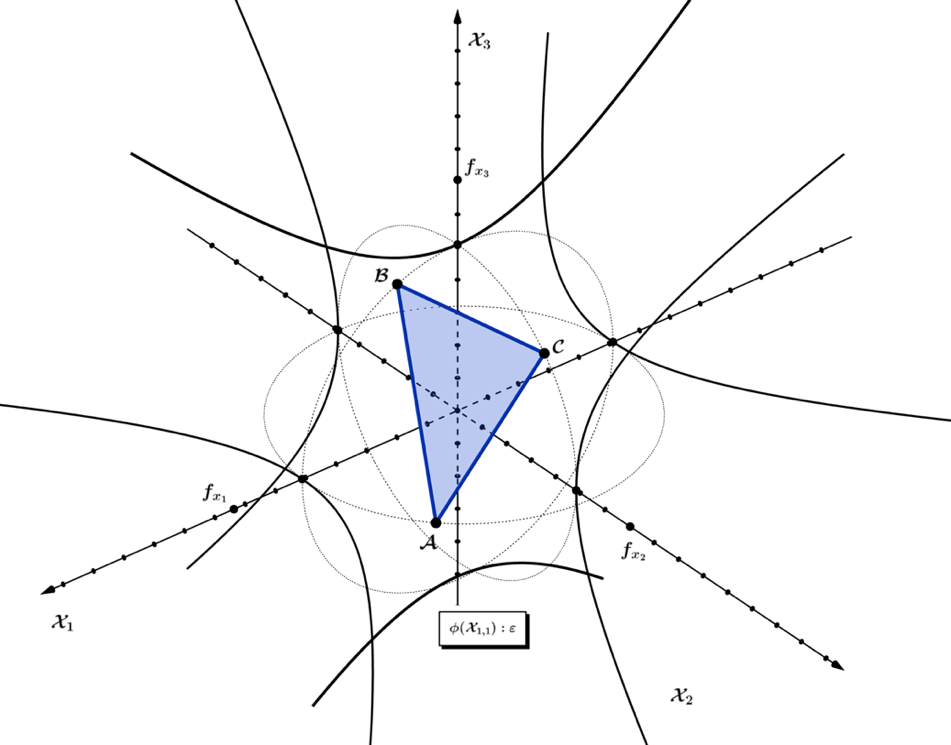
Figure 1.1.18 – The mapping.
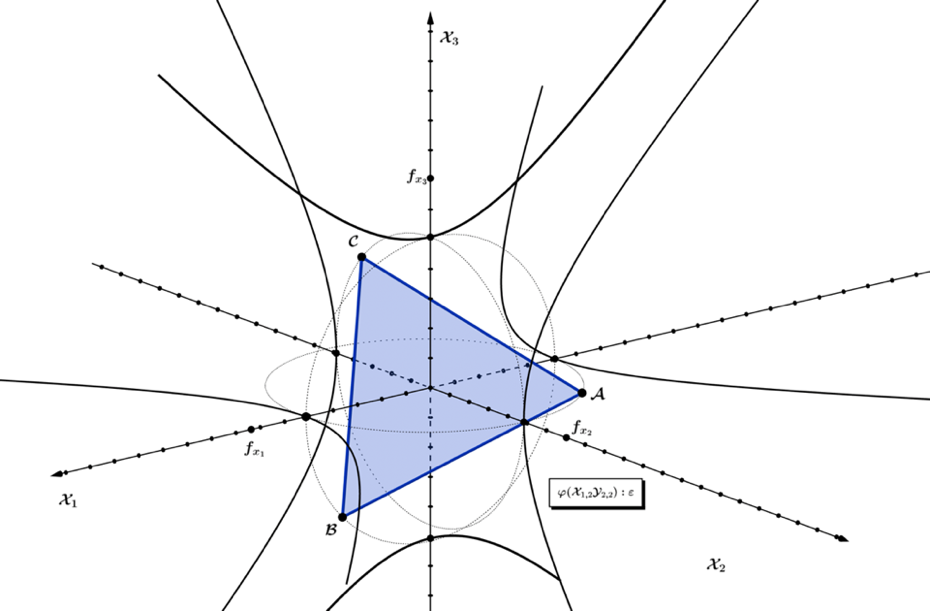
Taking the product with the identity element , yields the composite function , which reflects the vertices along the axis , and rotates the equilateral triangle in all three of the complex -planes to the coordinates (Figure 1.1.18). We can continue by taking the composite function from above and the permutation, to see a cyclic order shift occurs for the triangle, having rotated to the adjacent quadrant values , seen in Figure 1.1.19 below.
Figure 1.1.19 –The mapping.
In general, the composition of functions isolated to the subgroup will result in rotations and reflections of the equilateral triangle that lay along the imaginary and real axes of the space. Compare this to the composition of permutation functions from the subgroup, which will rotate and reflect the vertices of the equilateral triangle to values which are radians away from any real and imaginary-axis in the geometric space.
This section has expanded our dihedral group's definition to include complex-valued permutations with elements that perfectly balance real and imaginary values. The group has Lie algebra elements composed of an even balance of real and imaginary numbers, which will be central to the study of light in the upcoming physics volume.