Masteries · Jason GlowneyArithmoí Book 1

Masteries

1.1.24 The Cartan Subalgebra of U(3)

As is the case for the sym­met­ric group S3S_{3}, there is a cyclic sub­group in the 𝔤\mathfrak{g} al­ge­bra formed by its real-valued el­e­ments. By way of the fact that this is the Z3Z_{3} cyclic group, we know that it is abelian, and this sub­group is a Cartan sub­al­ge­bra of 𝔤\mathfrak{g}, which is de­fined as fol­lows.

De­f­i­n­i­tion (1.1.174) – If 𝔤\mathfrak{g} is a com­plex semi­sim­ple Lie al­ge­bra, then a Cartan sub­al­ge­bra of 𝔤\mathfrak{g} is a com­plex sub­space 𝔥\mathfrak{h} of 𝔤\mathfrak{g}, with the fol­low­ing prop­er­ties

∀ Hj,Hk∈𝔥, [Hj,Hk]=0,\forall{\ H}_{j},H_{k}\in \mathfrak{h},\ \left\lbrack H_{j},H_{k} \right\rbrack = 0,
if X∈𝔤 and [H,X]=0, for H∈ 𝔥, then X∈ 𝔥,if\ X \in \mathfrak{g}\ and\ \lbrack H,X\rbrack = 0,\ for\ H \in \ \mathfrak{h},\ then\ X \in \ \mathfrak{h},
∀ H∈ 𝔥, adH is diagonalizable.\forall\ H \in \ \mathfrak{h},\ ad_{H}\ is\ diagonalizable.

1

De­f­i­n­i­tion (1.1.175) – We define the com­plex sub­space 𝔥={Y1,Y2,Y3}\mathfrak{h = \{}Y_{1},Y_{2},Y_{3}\}, as the Cartan Sub­al­ge­bra of 𝔤\mathfrak{g} and the max­i­mal com­mut­ing sub­al­ge­bra of el­e­ments 𝔥\mathfrak{h}

𝔥={Y1,Y2,Y3}={(100010001),(010001100),(001100010)}.\begin{array}{r} \mathfrak{h} =\left\{ Y_{1},Y_{2},Y_{3} \right\} = \left\{ \begin{pmatrix} 1 & 0 & 0 \\ 0 & 1 & 0 \\ 0 & 0 & 1 \end{pmatrix},\begin{pmatrix} 0 & 1 & 0 \\ 0 & 0 & 1 \\ 1 & 0 & 0 \end{pmatrix},\begin{pmatrix} 0 & 0 & 1 \\ 1 & 0 & 0 \\ 0 & 1 & 0 \end{pmatrix} \right\}. \end{array}

The­o­rem (1.1.176) – For YjY_{j} as a set, the set of per­mu­ta­tions of 𝔤\mathfrak{g} forms a Cartan sub­al­ge­bra of 𝔤.\mathfrak{g}.

Proof –

∀ Yj,Yk∈ 𝔥, [Yj,Yk]=0,\forall{\ Y}_{j},Y_{k}\in \ \mathfrak{h},\ \left\lbrack Y_{j},Y_{k} \right\rbrack = 0,
if X∈𝔤 and [Y,X]=0 , for Y∈ 𝔥, then X∈ 𝔥,if\ X \in \mathfrak{g}\ and\ \lbrack Y,X\rbrack = 0\ ,\ for\ Y \in \ \mathfrak{h},\ then\ X \in \ \mathfrak{h},
∀ Y∈ 𝔥, adY is diagonalizable.\forall\ Y \in \ \mathfrak{h},\ ad_{Y}\ is\ diagonalizable.
 □\begin{array}{r} \ \square \end{array}

Note, as stated in De­f­i­n­i­tion (1.1.174), all the el­e­ments of 𝔥\mathfrak{h} com­mute, where for ex­am­ple Y2Y3=Y1Y_{2}Y_{3} = Y_{1}, Y3Y2=Y1,Y_{3}Y_{2} = Y_{1},and we have that

[Y2,Y3]=[(0y2000y2y200) ×(00y3y3000y30)−(00y3y3000y30)×(0y2000y2y200)]=\left\lbrack Y_{2},Y_{3} \right\rbrack = \left\lbrack \begin{pmatrix} 0 & y_{2} & 0 \\ 0 & 0 & y_{2} \\ y_{2} & 0 & 0 \end{pmatrix}\ \times \begin{pmatrix} 0 & 0 & y_{3} \\ y_{3} & 0 & 0 \\ 0 & y_{3} & 0 \end{pmatrix} - \begin{pmatrix} 0 & 0 & y_{3} \\ y_{3} & 0 & 0 \\ 0 & y_{3} & 0 \end{pmatrix} \times \begin{pmatrix} 0 & y_{2} & 0 \\ 0 & 0 & y_{2} \\ y_{2} & 0 & 0 \end{pmatrix} \right\rbrack =
[(Y2Y3000Y2Y3000Y2Y3)−(Y3Y2000Y3Y2000Y3Y2)]=(000000000).\begin{array}{r} \left\lbrack \begin{pmatrix} Y_{2}Y_{3} & 0 & 0 \\ 0 & Y_{2}Y_{3} & 0 \\ 0 & 0 & Y_{2}Y_{3} \end{pmatrix} - \begin{pmatrix} Y_{3}Y_{2} & 0 & 0 \\ 0 & Y_{3}Y_{2} & 0 \\ 0 & 0 & Y_{3}Y_{2} \end{pmatrix} \right\rbrack = \begin{pmatrix} 0 & 0 & 0 \\ 0 & 0 & 0 \\ 0 & 0 & 0 \end{pmatrix}. \end{array}
(1.1.177)

Triv­ial­ly, this holds for the iden­ti­ty el­e­ment as well. It is also easy to verify that Y2Y_{2} and Y3Y_{3} are the ad­joint ma­tri­ces of one an­oth­er, adY2=Y3,  adY3=Y2adY1ad_{Y_{2}} = Y_{3},\ \ a{d_{Y}}_{3} = Y_{2}a{d_{Y}}_{1}, and the iden­ti­ty el­e­ment Y1Y_{1} is its own ad­joint. Fur­ther, we have that all el­e­ments of Yj∈𝔥Y_{j}\in \mathfrak{h} are di­ag­o­nal­iz­able. The Y2Y_{2} and Y3Y_{3} mem­bers of the Cartan sub­al­ge­bra are like the λ3\lambda_{3} and λ8\lambda_{8} Gell-Mann ma­tri­ces of SU(3)SU(3), which belong to the Cartan sub­al­ge­bra of that group, and in ad­di­tion, λ3\lambda_{3} and λ8\lambda_{8} com­mute with each other.

We are ac­cus­tomed to matrix groups in physics with two-di­men­sion­al sub­groups and their re­spec­tive ro­ta­tions. In the U(3)U(3) group, we have two-di­men­sion­al ro­ta­tions for the XjX_{j} gen­er­a­tors, where the fa­mil­iar ex­am­ple of eiX1e^{{iX}_{1}} cal­cu­lates to

eiX1=(𝐞𝐢𝐱𝟏000cos⁡(x1)isin(x1)0isin(x1)cos⁡(x1)),\begin{array}{r} e^{{iX}_{1}} = \begin{pmatrix} \mathbf{e}^{\mathbf{i}\mathbf{x}_{\mathbf{1}}} & 0 & 0 \\ 0 & \cos\left( x_{1} \right) & isin\left( x_{1} \right) \\ 0 & isin\left( x_{1} \right) & \cos\left( x_{1} \right) \end{pmatrix}, \end{array}
(1.1.178)

noting the pres­ence of the ex­po­nen­tial func­tion 𝐞𝐢𝐱𝟏\mathbf{e}^{\mathbf{i}\mathbf{x}_{\mathbf{1}}} in the a1,1a_{1,1} row-column entry. We should also be aware of the re­flec­tion in the S3S_{3} group has become a ro­ta­tion in the com­plex X2/X3X_{2}/X_{3}-plane, with a sin­gu­lar X1X_{1}-plane ro­ta­tion for the x1x_{1} value el­e­ments. The matrix ex­po­nen­tial for the real-valued al­ge­bra yields the ex­po­nen­tial func­tion 𝐞𝐢𝐱𝟏\mathbf{e}^{\mathbf{i}\mathbf{x}_{\mathbf{1}}} in the a1,1a_{1,1} row-column entry and its co­in­cid­ing hy­per­bol­ic trigono­met­ric func­tions

eX1=(𝐞𝐗𝟏000cosh⁡(X1)sinh⁡(X1)0sinh⁡(X1)cosh⁡(X1)).\begin{array}{r} e^{X_{1}} = \begin{pmatrix} \mathbf{e}^{\mathbf{X}_{\mathbf{1}}} & 0 & 0 \\ 0 & \cosh\left( X_{1} \right) & \sinh\left( X_{1} \right) \\ 0 & \sinh\left( X_{1} \right) & \cosh\left( X_{1} \right) \end{pmatrix}. \end{array}
(1.1.179)

Some­thing unique hap­pens when we ex­po­nen­ti­ate the Y2Y_{2} and Y3Y_{3} al­ge­bra el­e­ments of the Cartan sub­al­ge­bra, a three-way split­ting of the ex­po­nen­tial func­tion occurs, rep­re­sent­ing new trigono­met­ric func­tions as de­scribed by Dennis Morris2. When we start to cal­cu­late the first sev­er­al terms of the matrix ex­po­nen­tial of the Y2Y_{2} and Y3Y_{3} al­ge­bra el­e­ments, we see a three-way split­ting pat­tern emerges, which is dis­tinct from the two-way split­ting the sine and cosine func­tions

eY2=∑n=0∞(0y2000y2y200)nn!=(1+y233!+y266!+…y2+y244!+y277!+…y222!+y255!+y288!+…y222!+y255!+y288!+…1+y233!+y266!+…y2+y244!+y277!+…y2+y244!+y277!+…y222!+y255!+y288!+…1+y233!+y266!+…),\begin{array}{r} e^{Y_{2}} = \sum_{n = 0}^{\infty}{\frac{\begin{pmatrix} 0 & y_{2} & 0 \\ 0 & 0 & y_{2} \\ y_{2} & 0 & 0 \end{pmatrix}^{n}}{n!} = \begin{pmatrix} 1 + \frac{y_{2}^{3}}{3!} + \frac{y_{2}^{6}}{6!} + \ldots & y_{2} + \frac{y_{2}^{4}}{4!} + \frac{y_{2}^{7}}{7!} + \ldots & \frac{y_{2}^{2}}{2!} + \frac{y_{2}^{5}}{5!} + \frac{y_{2}^{8}}{8!} + \ldots \\ \frac{y_{2}^{2}}{2!} + \frac{y_{2}^{5}}{5!} + \frac{y_{2}^{8}}{8!} + \ldots & 1 + \frac{y_{2}^{3}}{3!} + \frac{y_{2}^{6}}{6!} + \ldots & y_{2} + \frac{y_{2}^{4}}{4!} + \frac{y_{2}^{7}}{7!} + \ldots \\ y_{2} + \frac{y_{2}^{4}}{4!} + \frac{y_{2}^{7}}{7!} + \ldots & \frac{y_{2}^{2}}{2!} + \frac{y_{2}^{5}}{5!} + \frac{y_{2}^{8}}{8!} + \ldots & 1 + \frac{y_{2}^{3}}{3!} + \frac{y_{2}^{6}}{6!} + \ldots \end{pmatrix}}, \end{array}
(1.1.180)
eY3=∑n=0∞(00y3y3000y30)nn!=(1+y333!+y366!+…y322!+y355!+y388!+…y3+y344!+y377!+…y3+y344!+y377!+…1+y333!+y366!+…y322!+y355!+y388!+…y322!+y355!+y388!+…y3+y344!+y377!+…1+y333!+y366!+…).\begin{array}{r} e^{Y_{3}} = \sum_{n = 0}^{\infty}{\frac{\begin{pmatrix} 0 & 0 & y_{3} \\ y_{3} & 0 & 0 \\ 0 & y_{3} & 0 \end{pmatrix}^{n}}{n!} = \begin{pmatrix} 1 + \frac{y_{3}^{3}}{3!} + \frac{y_{3}^{6}}{6!} + \ldots & \frac{y_{3}^{2}}{2!} + \frac{y_{3}^{5}}{5!} + \frac{y_{3}^{8}}{8!} + \ldots & y_{3} + \frac{y_{3}^{4}}{4!} + \frac{y_{3}^{7}}{7!} + \ldots \\ y_{3} + \frac{y_{3}^{4}}{4!} + \frac{y_{3}^{7}}{7!} + \ldots & 1 + \frac{y_{3}^{3}}{3!} + \frac{y_{3}^{6}}{6!} + \ldots & \frac{y_{3}^{2}}{2!} + \frac{y_{3}^{5}}{5!} + \frac{y_{3}^{8}}{8!} + \ldots \\ \frac{y_{3}^{2}}{2!} + \frac{y_{3}^{5}}{5!} + \frac{y_{3}^{8}}{8!} + \ldots & y_{3} + \frac{y_{3}^{4}}{4!} + \frac{y_{3}^{7}}{7!} + \ldots & 1 + \frac{y_{3}^{3}}{3!} + \frac{y_{3}^{6}}{6!} + \ldots \end{pmatrix}}. \end{array}
(1.1.181)

Seeing the three-way split of the ex­po­nen­tial series in the eY2e^{Y_{2}} and eY3e^{Y_{3}} Lie groups leads to the pro­found con­clu­sion that three-di­men­sion­al ro­ta­tions exist in these groups. Given that a re­flec­tion has been changed to a two-plane ro­ta­tion ∈ℂ3\in \mathbb{C}^{3}, for the ex­po­nen­ti­at­ed XjX_{j} gen­er­a­tors, we can say that a cyclic ro­ta­tion be­comes a three-di­men­sion­al ro­ta­tion de­fined by the eY2e^{Y_{2}} and eY3e^{Y_{3}} gen­er­a­tors.

In the up­com­ing physics volume in the series, we will elab­o­rate on the math­e­mat­ics putting these func­tions at the heart of color ex­change in quan­tum chro­mo­dy­nam­ics (QCD), and the role they play with light. The Lie al­ge­bras of the SU(3)SU(3) group have short­com­ings and fail to form a group under com­po­si­tion. More suc­cinct­ly, the eigen­val­ues and eigen­vec­tors of the Cartan gen­er­a­tors Y2,Y3Y_{2},Y_{3} can be con­sid­ered the source of color ex­change and the strong force, and these are anal­o­gous to the T3T_{3} and T8T_{8} gen­er­a­tors of the Gell-Mann ma­tri­ces, where TA=(λA2).T_{A} = \left( \frac{\lambda_{A}}{2} \right).This treat­ment leads to a sound math­e­mat­i­cal ex­pla­na­tion of why gluons are not seen alone in space­time, given that two-di­men­sion­al ro­ta­tions/trigono­met­ric func­tions com­prise it. As stated in the in­tro­duc­tion, the SU(3)SU(3) group does not fit the above group cri­te­ria, but the U(3)U(3) group does.

We can ex­press the three-way ex­po­nen­tial func­tion splits in more fa­mil­iar trigono­met­ric terms as

1+Y333!+Y366!+…=∑n=0∞Y33n(3n)!=eY33+23e(− Y32)cos⁡(3Y32),\begin{array}{r} 1 + \frac{Y_{3}^{3}}{3!} + \frac{Y_{3}^{6}}{6!} + \ldots = \sum_{n = 0}^{\infty}\frac{Y_{3}^{3n}}{(3n)!} = \frac{e^{Y_{3}}}{3} + \frac{2}{3}e^{\left( - \ \frac{Y_{3}}{2} \right)}\cos\left( \frac{\sqrt{3}Y_{3}}{2} \right), \end{array}
(1.1.182)
Y3+Y344!+Y377!+…=∑n=0∞Y33n+1(3n+1)!=eY33−23e(− Y32)sin⁡(π6−3Y32),\begin{array}{r} Y_{3} + \frac{Y_{3}^{4}}{4!} + \frac{Y_{3}^{7}}{7!} + \ldots = \sum_{n = 0}^{\infty}\frac{Y_{3}^{3n + 1}}{(3n + 1)!} = \frac{e^{Y_{3}}}{3} - \frac{2}{3}e^{\left( - \ \frac{Y_{3}}{2} \right)}\sin\left( \frac{\pi}{6} - \frac{\sqrt{3}Y_{3}}{2} \right), \end{array}
(1.1.183)
Y322!+Y355!+Y388!+…=∑n=0∞Y33n+2(3n+2)!=eY33−23e(− Y32)sin⁡(π6+3Y32),\begin{array}{r} \frac{Y_{3}^{2}}{2!} + \frac{Y_{3}^{5}}{5!} + \frac{Y_{3}^{8}}{8!} + \ldots = \sum_{n = 0}^{\infty}\frac{Y_{3}^{3n + 2}}{(3n + 2)!} = \frac{e^{Y_{3}}}{3} - \frac{2}{3}e^{\left( - \ \frac{Y_{3}}{2} \right)}\sin\left( \frac{\pi}{6} + \frac{\sqrt{3}Y_{3}}{2} \right), \end{array}
(1.1.184)

and note that if the three series were added to­geth­er, the result would equal eY3e^{Y_{3}}. We look more close­ly at the Cartan sub­al­ge­bra set {λ3, λ8}\lambda_{3},\ \lambda_{8}\} of the Gell-Mann ma­tri­ces ∈SU(3)\in SU(3), by de­com­pos­ing them to their eigen­val­ues and eigen­vec­tors

λ3=(1000−10000),  λ3{D,V}={(−100000001),   (001100010)},\begin{array}{r} \lambda_{3} = \begin{pmatrix} 1 & 0 & 0 \\ 0 & - 1 & 0 \\ 0 & 0 & 0 \end{pmatrix},\ \ \lambda_{3}\left\{ D,V \right\} = \left\{ \begin{pmatrix} - 1 & 0 & 0 \\ 0 & 0 & 0 \\ 0 & 0 & 1 \end{pmatrix},\ \ \ \begin{pmatrix} 0 & 0 & 1 \\ 1 & 0 & 0 \\ 0 & 1 & 0 \end{pmatrix} \right\}, \end{array}
(1.1.185)
λ8=13(10001000−2),  λ8{D,V}=13{(−200010001),   (001010100)}.\begin{array}{r} \lambda_{8} = \frac{1}{\sqrt{3}}\begin{pmatrix} 1 & 0 & 0 \\ 0 & 1 & 0 \\ 0 & 0 & - 2 \end{pmatrix},\ \ \lambda_{8}\left\{ D,V \right\} = \frac{1}{\sqrt{3}}\left\{ \begin{pmatrix} - 2 & 0 & 0 \\ 0 & 1 & 0 \\ 0 & 0 & 1 \end{pmatrix},\ \ \ \begin{pmatrix} 0 & 0 & 1 \\ 0 & 1 & 0 \\ 1 & 0 & 0 \end{pmatrix} \right\}. \end{array}
(1.1.186)

Where we see only two eigen­val­ues for the λ3\lambda_{3} gen­er­a­tor, com­pared to three for the λ8\lambda_{8} gen­er­a­tor, eigen­val­ues are scaled by (1,−1)(1, - 1) for the x1,x2x_{1},x_{2} vari­ables ∈λ3{\in \lambda}_{3}, and by 13(1,1,−2)\frac{1}{\sqrt{3}}(1,1, - 2) for the x1,x2,x3x_{1},x_{2},x_{3} vari­ables ∈λ8.\in \lambda_{8}.The linear prod­uct of λ3\lambda_{3} with a three-vector will make the x3x_{3} vari­able equal to zero, main­tain­ing the order for the x1,x2x_{1},x_{2} vari­ables, while λ8\lambda_{8} will keep all the vari­ables intact

λ3vˆ=(1000−10000)(x1x2x3)=(x12−x220),  λ8vˆ=13(10001000−2)(x1x2x3)=(x13−2x23x33).\begin{array}{r} \lambda_{3}\widehat{v} = \begin{pmatrix} 1 & 0 & 0 \\ 0 & - 1 & 0 \\ 0 & 0 & 0 \end{pmatrix}\begin{pmatrix} x_{1} \\ x_{2} \\ x_{3} \end{pmatrix} = \begin{pmatrix} \frac{x_{1}}{2} \\ \frac{{- x}_{2}}{2} \\ 0 \end{pmatrix},\ \ \lambda_{8}\widehat{v} = \frac{1}{\sqrt{3}}\begin{pmatrix} 1 & 0 & 0 \\ 0 & 1 & 0 \\ 0 & 0 & - 2 \end{pmatrix}\begin{pmatrix} x_{1} \\ x_{2} \\ x_{3} \end{pmatrix} = \begin{pmatrix} \frac{x_{1}}{\sqrt{3}} \\ \frac{- 2x_{2}}{\sqrt{3}} \\ \frac{x_{3}}{\sqrt{3}} \end{pmatrix}. \end{array}
(1.1.187)

The re­sult­ing vec­tors from these λ3vˆ\lambda_{3}\widehat{v}, λ8vˆ\lambda_{8}\widehat{v} matrix-vector prod­ucts have equal two-norm values |λ3vˆ|=|λ3vˆ|,\left| \lambda_{3}\widehat{v} \right| = \left| \lambda_{3}\widehat{v} \right|,when as­sum­ing the mag­ni­tudes of three vector com­po­nents x1,x2,x3x_{1},x_{2},x_{3} are equiv­a­lent. Com­pare this to the same de­com­po­si­tions for the Y2,Y3Y_{2},Y_{3} el­e­ments of the Cartan sub­al­ge­bra ∈U(3),\in U(3),we see marked sym­me­tries in this form. A sim­i­lar de­com­po­si­tion of the Y2,Y3Y_{2},Y_{3} el­e­ments show the same eigen­val­ues for both, with two eigen­vec­tors that differ in the x2,x3x_{2},x_{3} com­po­nents by a sign in their imag­i­nary por­tions.

Y2=(010001100): Y2{D,V}={(−12+i32000−12−i320001),   (1313−13−123+i2−123−i2−13−123−i2−123+i2−13)},\begin{array}{r} Y_{2} = \begin{pmatrix} 0 & 1 & 0 \\ 0 & 0 & 1 \\ 1 & 0 & 0 \end{pmatrix}:\ Y_{2}\left\{ D,V \right\} = \left\{ \begin{pmatrix} - \frac{1}{2} + i\frac{\sqrt{3}}{2} & 0 & 0 \\ 0 & - \frac{1}{2} - i\frac{\sqrt{3}}{2} & 0 \\ 0 & 0 & 1 \end{pmatrix},\ \ \ \begin{pmatrix} \frac{1}{\sqrt{3}} & \frac{1}{\sqrt{3}} & - \frac{1}{\sqrt{3}} \\ - \frac{1}{2\sqrt{3}} + \frac{i}{2} & - \frac{1}{2\sqrt{3}} - \frac{i}{2} & - \frac{1}{\sqrt{3}} \\ - \frac{1}{2\sqrt{3}} - \frac{i}{2} & - \frac{1}{2\sqrt{3}} + \frac{i}{2} & - \frac{1}{\sqrt{3}} \end{pmatrix} \right\}, \end{array}
(1.1.188)
Y3=(001100010): Y3{D,V}={(−12+i32000−12−i320001),   (1313−13−123−i2−123+i2−13−123+i2−123−i2−13)}.\begin{array}{r} Y_{3} = \begin{pmatrix} 0 & 0 & 1 \\ 1 & 0 & 0 \\ 0 & 1 & 0 \end{pmatrix}:\ Y_{3}\left\{ D,V \right\} = \left\{ \begin{pmatrix} - \frac{1}{2} + i\frac{\sqrt{3}}{2} & 0 & 0 \\ 0 & - \frac{1}{2} - i\frac{\sqrt{3}}{2} & 0 \\ 0 & 0 & 1 \end{pmatrix},\ \ \ \begin{pmatrix} \frac{1}{\sqrt{3}} & \frac{1}{\sqrt{3}} & - \frac{1}{\sqrt{3}} \\ - \frac{1}{2\sqrt{3}} - \frac{i}{2} & - \frac{1}{2\sqrt{3}} + \frac{i}{2} & - \frac{1}{\sqrt{3}} \\ - \frac{1}{2\sqrt{3}} + \frac{i}{2} & - \frac{1}{2\sqrt{3}} - \frac{i}{2} & - \frac{1}{\sqrt{3}} \end{pmatrix} \right\}. \end{array}
(1.1.189)

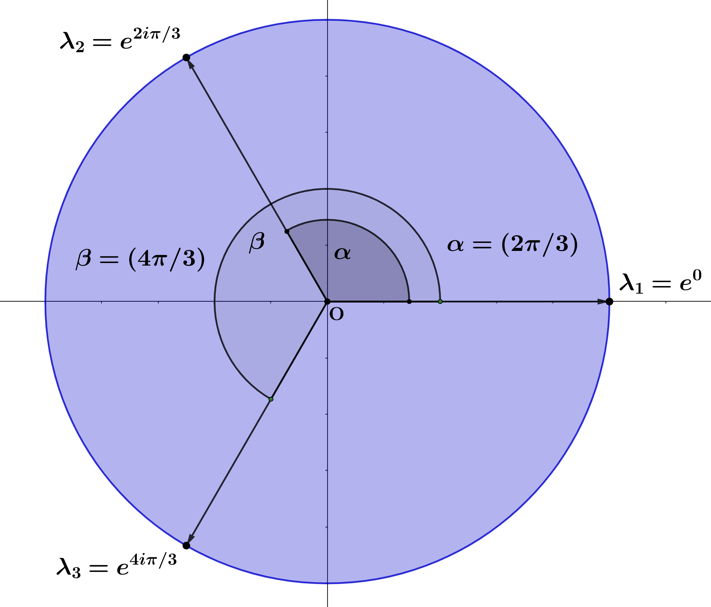
Plot­ting the set of eigen­val­ues {λ1,λ2,λ3}\left\{ \lambda_{1},\lambda_{2},\lambda_{3} \right\} for the Y2,Y3Y_{2},Y_{3} gen­er­a­tors, re­veals the reg­u­lar polyg­o­nal sym­me­try of the S3/D3S_{3}/D_{3} group's equi­lat­er­al tri­an­gle (Figure 1.1.16).

Figure
Figure 1.1.16 – Plot­ted Eigen­val­ues (λj)\ \left( \lambda_{j} \right) on the Unit Circle, for Y2Y_{2} and Y2=Y3\overline{Y_{2}} = Y_{3}.

A sim­i­lar linear prod­uct of the Y2,Y3Y_{2},Y_{3} el­e­ments with a three-vector shows cyclic trans­for­ma­tion­al shifts in both pos­i­tive and neg­a­tive di­rec­tions, having a sim­i­lar order of vari­ables in the Y2Y_{2} trans­form, com­pared to the λ8\lambda_{8} trans­form in the Gell-Mann case, except for dif­fer­ent scale fac­tors and the neg­a­tive sign for the x2x_{2} vari­ables.

Y2vˆ=(010001100)(x1x2x3)=(x2x3x1),  Y3vˆ=(001100010)(x1x2x3)=(x3x1x2).\begin{array}{r} Y_{2}\widehat{v} = \begin{pmatrix} 0 & 1 & 0 \\ 0 & 0 & 1 \\ 1 & 0 & 0 \end{pmatrix}\begin{pmatrix} x_{1} \\ x_{2} \\ x_{3} \end{pmatrix} = \begin{pmatrix} x_{2} \\ x_{3} \\ x_{1} \end{pmatrix},\ \ Y_{3}\widehat{v} = \begin{pmatrix} 0 & 0 & 1 \\ 1 & 0 & 0 \\ 0 & 1 & 0 \end{pmatrix}\begin{pmatrix} x_{1} \\ x_{2} \\ x_{3} \end{pmatrix} = \begin{pmatrix} x_{3} \\ x_{1} \\ x_{2} \end{pmatrix}. \end{array}
(1.1.190)

The notion of causal­i­ty in matrix groups seems to exist, and for the U(3)U(3) group as de­scribed, the Cartan sub­al­ge­bra YjY_{j} is caused by the pri­ma­ry XjX_{j} group el­e­ments, where the YjY_{j} el­e­ments alone cannot yield any el­e­ment of the XjX_{j} group. But the YjY_{j} are nec­es­sary for the XjX_{j} group el­e­ments to ex­change with one an­oth­er in terms of the al­ge­bras, as demon­strat­ed below

X1Y2=(i0000i0i0)(010001100)=(0i0i0000i)=X3,\begin{array}{r} X_{1}Y_{2} = \begin{pmatrix} i & 0 & 0 \\ 0 & 0 & i \\ 0 & i & 0 \end{pmatrix}\begin{pmatrix} 0 & 1 & 0 \\ 0 & 0 & 1 \\ 1 & 0 & 0 \end{pmatrix} = \begin{pmatrix} 0 & i & 0 \\ i & 0 & 0 \\ 0 & 0 & i \end{pmatrix} = X_{3}, \end{array}
(1.1.191)
Y2X1=(010001100)(i0000i0i0)=(00i0i0i00)=X2.\begin{array}{r} Y_{2}X_{1} = \begin{pmatrix} 0 & 1 & 0 \\ 0 & 0 & 1 \\ 1 & 0 & 0 \end{pmatrix}\begin{pmatrix} i & 0 & 0 \\ 0 & 0 & i \\ 0 & i & 0 \end{pmatrix} = \begin{pmatrix} 0 & 0 & i \\ 0 & i & 0 \\ i & 0 & 0 \end{pmatrix} = X_{2}. \end{array}
(1.1.192)
  1. Hall, Brian C., "Lie Groups, Lie Al­ge­bras, and Rep­re­sen­ta­tions", Grad­u­ate Texts in Math­e­mat­ics, Springer, 2015
  2. Morris, Dennis, "Com­plex Num­bers the Higher Di­men­sion­al Forms - 2nd Edi­tion", Abane & Right, 2015