
1.1.8 The Singular Value Decomposition
We now consider the singular value decomposition of a matrix to increase our conceptual understanding of the geometry involved in the linear transformation process. All matrices have a singular value decomposition, and the image of the unit sphere for any size, , takes on the form of a hyperellipse. The hyperellipse can be defined , to be the obtained surface that results from stretching the unit sphere , by the scaling factors , in orthogonal directions . When taken together, the set of vectors , are the principle semiaxes of the hyperellipse, which are scaled by , equating to the length of these semiaxes. The rank of the matrix being considered for the singular value decomposition determines the number of non-zero scaling elements present in the decomposition. In what follows, we use a similar SVD definition to that described by Trefethen and Bau.1
The SVD is one of the more important means to understand how a matrix will act on a mathematical object like a vector or another matrix. It also yields one of the most important insights into the complex conjugate transpose of a matrix The SVD decomposition for a matrix , is defined
for unitary
We note that , or in some texts, , means the (complex) conjugate transpose of the matrix and that the complex conjugate transpose of a unitary matrix equals the inverse of that matrix. For the matrix , we have diagonal entries that are the real number scaling factors , arranged in descending order along the diagonal. The mapping , will rotate or reflect the sphere, while preserving its shape, the matrix stretches the sphere by singular values and the final matrix , will then rotate or reflect the hyperellipse. Figure 1.1.2 graphically depicts the SVD of a matrix , for the actions of , , and , which, when taken together, accomplish the linear transformation .
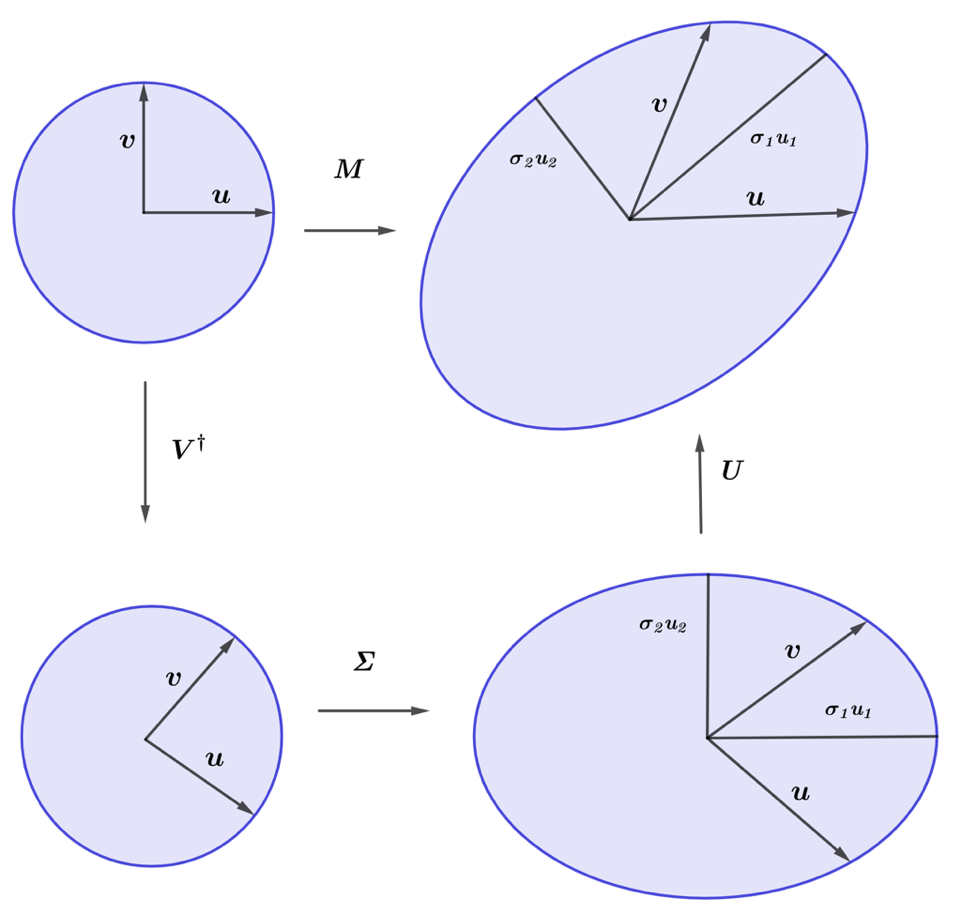
- Trefethen & Bau, "Numerical Linear Algebra", 1997