Masteries · Jason GlowneyArithmoí Book 1

Masteries

1.1.19 The DihedralGroup and Symmetry Transformations ∈3ℂ\in 3\mathbb{C}

We can con­sid­er the form of the S3/D3S_{3}/D_{3} sym­met­ric group from the last sec­tion and allow the per­mu­ta­tion ma­tri­ces to be ∈ℂ.\in \mathbb{C}.By doing this, the values for the cor­ners of the equi­lat­er­al tri­an­gle are not only ∈ℝ+\in \mathbb{R}^{+}, they take on the pos­si­bil­i­ty of being imag­i­nary valued. We define this higher-di­men­sion­al spa­tial free­dom by the fol­low­ing per­mu­ta­tion ma­tri­ces

ϵ=(100010001) ,   x=(i0000i0i0),   y=(010001100),\epsilon = \begin{pmatrix} 1 & 0 & 0 \\ 0 & 1 & 0 \\ 0 & 0 & 1 \end{pmatrix}\ ,\ \ \ x = \begin{pmatrix} i & 0 & 0 \\ 0 & 0 & i \\ 0 & i & 0 \end{pmatrix},\ \ \ y = \begin{pmatrix} 0 & 1 & 0 \\ 0 & 0 & 1 \\ 1 & 0 & 0 \end{pmatrix},
y2=(001100010),   xy=(0i0i0000i),   xy2=(00i0i0i00),\begin{array}{r} y^{2} = \begin{pmatrix} 0 & 0 & 1 \\ 1 & 0 & 0 \\ 0 & 1 & 0 \end{pmatrix},\ \ \ xy = \begin{pmatrix} 0 & i & 0 \\ i & 0 & 0 \\ 0 & 0 & i \end{pmatrix},\ \ \ xy^{2} = \begin{pmatrix} 0 & 0 & i \\ 0 & i & 0 \\ i & 0 & 0 \end{pmatrix}, \end{array}
(1.1.90)

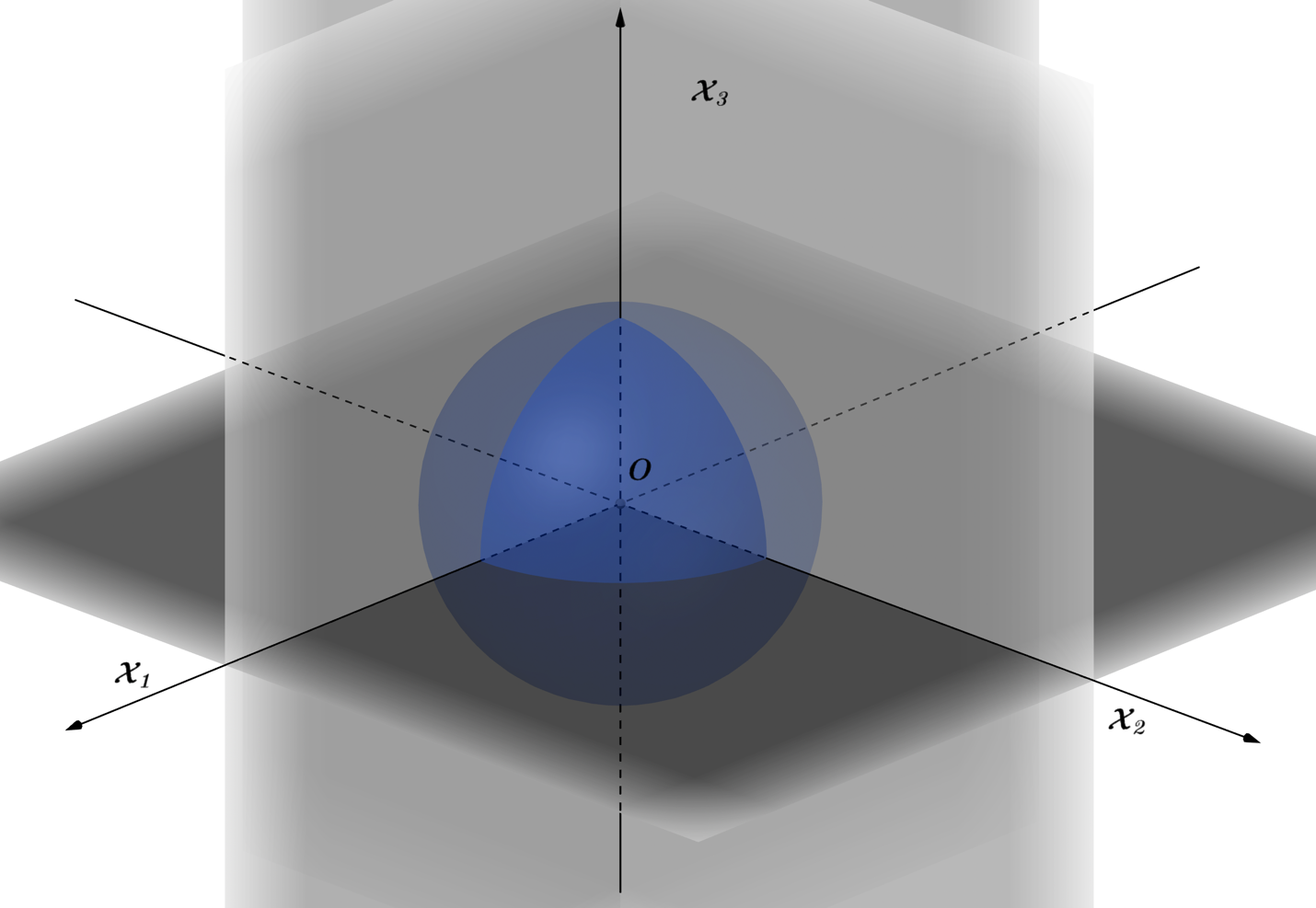
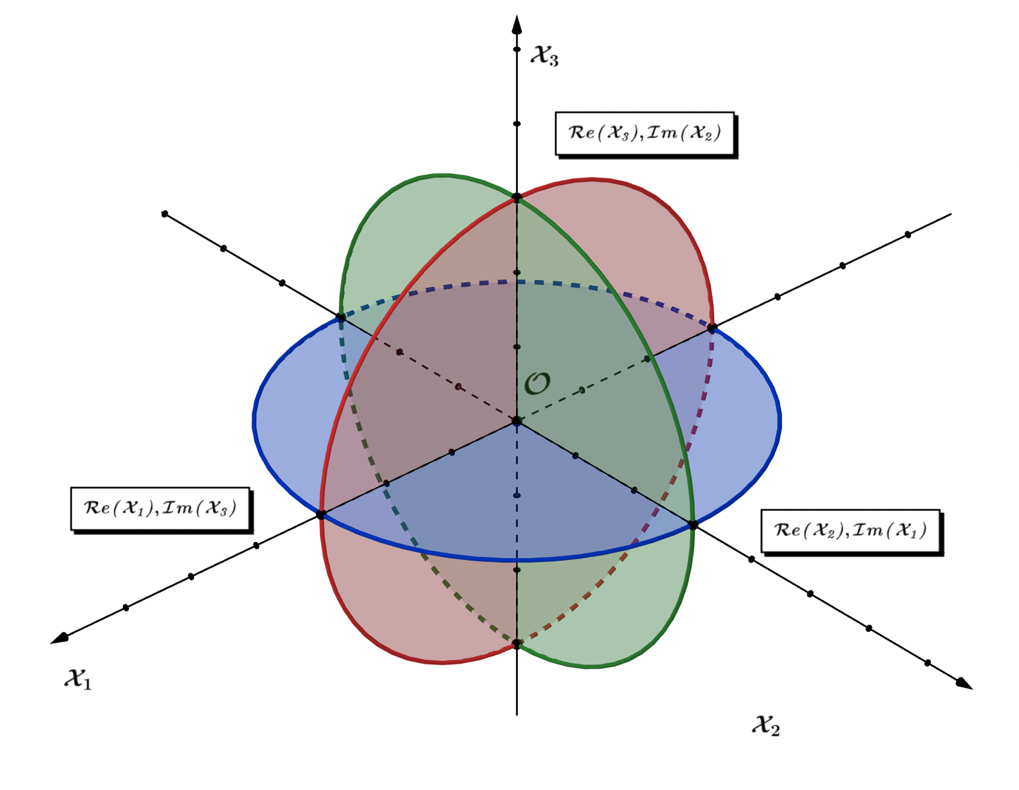
for which, the com­po­si­tion of its func­tions is ∈ℂ±.\in \mathbb{C}^{\pm}.By set­ting the equi­lat­er­al tri­an­gle into a higher-di­men­sion­al geom­e­try ∈ℂ3\in \mathbb{C}^{3}, means it not only ro­tates and re­flects ∈ℝ3 like S3\in \mathbb{R}^{3}\ like\ S_{3}, but is now free to move in the three or­thog­o­nal planes ∈ℂ3\in \mathbb{C}^{3}. These planes are in an or­thog­o­nal ori­en­ta­tion with one an­oth­er, form­ing com­pos­ite axes with values in ∈ℂ\in \mathbb{C} (Fig­ures 1.1.5-6).

Figure
Figure 1.1.5 – Or­thog­o­nal planes in re­la­tion to the sphere, with 𝒪\mathcal{O}, the origin.
Figure
Figure 1.1.6 – Or­thog­o­nal com­plex unit cir­cles in­ter­sect­ing at points Re(Xj),Im(Xk)Re\left( X_{j} \right),Im\left( X_{k} \right), with 𝒪\mathcal{O}, the origin.

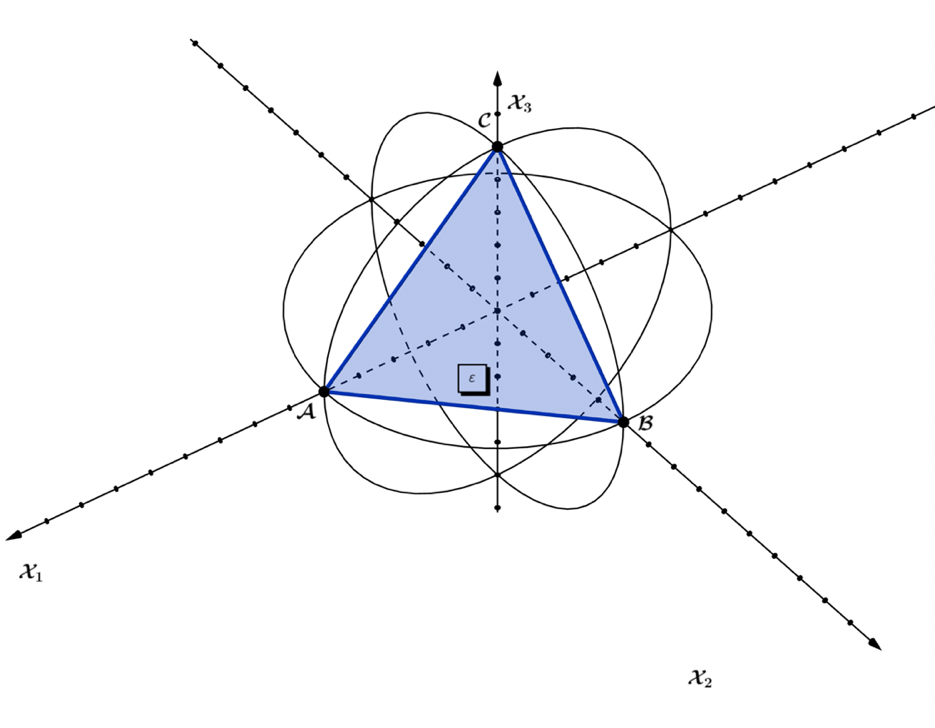
To avoid con­fu­sion, we rep­re­sent the ver­tices of the equi­lat­er­al tri­an­gle by using the set {A,B,C}∈ℂ\left\{ A,B,C \right\}\in \mathbb{C}, in­stead of using num­bers for its values. To present the iden­ti­ty el­e­ment ϵ\epsilon in its geo­met­ric ori­en­ta­tion, the angles A,B,CA,B,C are ori­ent­ed along the re­spec­tive X1,X2,X3X_{1},X_{2},X_{3} real-valued axes, as seen in Figure 1.1.7 below.

Figure
Figure 1.1.7 – The iden­ti­ty el­e­ment ϵ\epsilon ori­ent­ed along the real-axes ∈ℂ3\in \mathbb{C}^{3}

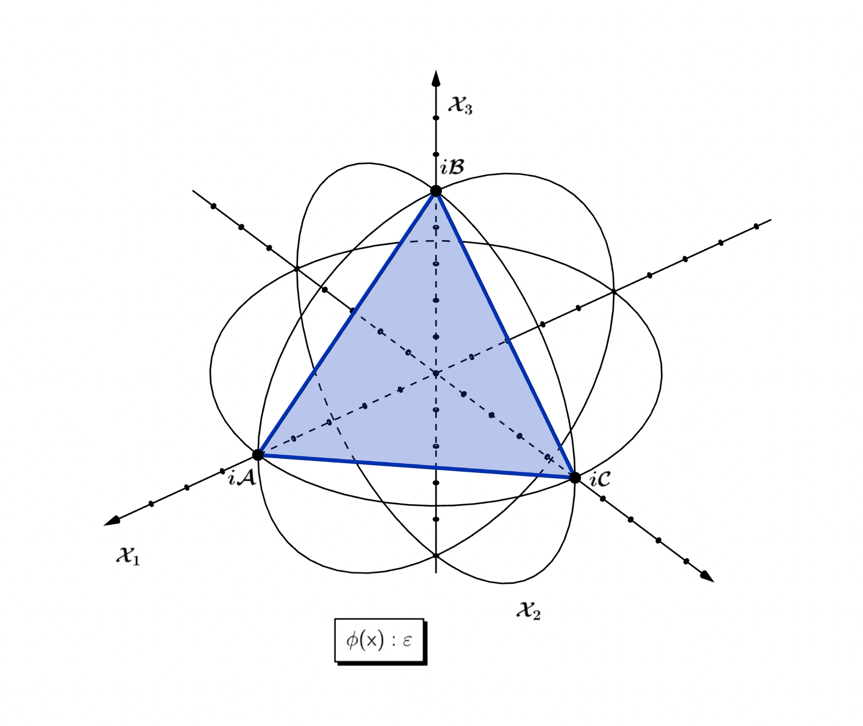
In the S3S_{3} sym­me­try group, we had clock­wise and coun­ter­clock­wise ro­ta­tions, and re­flec­tions of the equi­lat­er­al tri­an­gle. This changes in ℂ3\mathbb{C}^{3} to an extent where the pre­vi­ous­ly seen re­flec­tion be­comes a tri­an­gle ro­ta­tion in com­plex space about an axis. To demon­strate this, we use the com­po­si­tion of the "x""x"per­mu­ta­tion func­tion on the iden­ti­ty ϵ\epsilon, ϕ(x):ϵ\phi(x):\epsilon, acting on the vector ABCABC, with the de­fined mul­ti­pli­ca­tion op­er­a­tion

ϕ(x):ϵ→(i0000i0i0)(ABC)=(iAiCiB).\begin{array}{r} \phi(x):\epsilon \rightarrow \begin{pmatrix} i & 0 & 0 \\ 0 & 0 & i \\ 0 & i & 0 \end{pmatrix}\begin{pmatrix} A \\ B \\ C \end{pmatrix} = \begin{pmatrix} iA \\ iC \\ iB \end{pmatrix}. \end{array}
(1.1.91)

De­pict­ed in the figure below, we see that all vertex values are now imag­i­nary (ro­tat­ed), and iB,iCiB,iC have been re­flect­ed.

Figure
Figure 1.1.8 – The ro­ta­tions and re­flec­tion of ϕ(x):ϵ\ \phi(x):\epsilon ∈ℂ3\in \mathbb{C}^{3}.

Con­tin­u­ing to ex­plore com­plex sym­me­tries, we take the com­pos­ite of per­mu­ta­tion func­tions

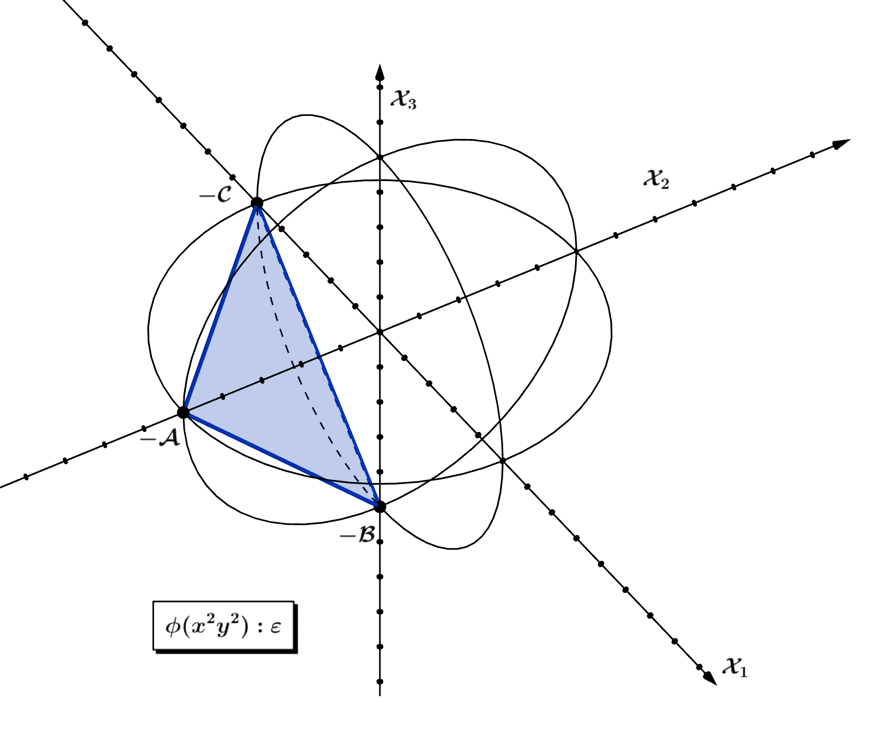
ϕ(x)∘ϕ(xy2):ϵ→ϕ(x2y2):ϵ→(i0000i0i0)(00i0i0i00)(ABC)→(00−1−1000−10)(ABC)=(−C−A−B),\begin{array}{r} \phi(x) \circ \phi\left( {xy}^{2} \right):\epsilon \rightarrow \phi\left( x^{2}y^{2} \right):\epsilon \rightarrow \begin{pmatrix} i & 0 & 0 \\ 0 & 0 & i \\ 0 & i & 0 \end{pmatrix}\begin{pmatrix} 0 & 0 & i \\ 0 & i & 0 \\ i & 0 & 0 \end{pmatrix}\begin{pmatrix} A \\ B \\ C \end{pmatrix} \rightarrow \begin{pmatrix} 0 & 0 & - 1 \\ - 1 & 0 & 0 \\ 0 & - 1 & 0 \end{pmatrix}\begin{pmatrix} A \\ B \\ C \end{pmatrix} = \begin{pmatrix} - C \\ - A \\ - B \end{pmatrix}, \end{array}
(1.1.92)

find­ing vertex co­or­di­nate values ∈ℝ−\in \mathbb{R}^{-}, de­pict­ed below in Figure 1.1.9.

Figure
Figure 1.1.9 –The com­pos­ite func­tion map­ping ϕ(x2y2):ϵ\phi\left( x^{2}y^{2} \right):\epsilon.

It should be noted that the per­mu­ta­tions leave the cor­ners of the equi­lat­er­al tri­an­gle ori­ent­ed on the bound­aries of the com­plex cir­cles, rep­re­sent­ing the planes of the geo­met­ric group. The tri­an­gle stays intact as a reg­u­lar poly­gon for the per­mu­ta­tions of the group, lead­ing to the de­f­i­n­i­tion:

De­f­i­n­i­tion (1.1.93) – The Di­he­dral Group 𝐃𝟑ℂ\mathbf{D}_{\mathbf{3}\mathbb{C}} is a group under com­po­si­tion, sit­ting in the com­plex geo­met­ric space ℂ3×3\mathbb{C}^{3 \times 3}, with a set of per­mu­ta­tion el­e­ments AℂA^{\mathbb{C}}

D3ℂ ={Aℂ∈U(3,ℂ)|Aℂ∙(Aℂ)∗=I }.\begin{array}{r} D_{3\mathbb{C}}\ = \left\{ A^{\mathbb{C}} \in U\left( 3,\mathbb{C} \right)|A^{\mathbb{C}} \bullet \left( A^{\mathbb{C}} \right)^{*} = I\ \right\}. \end{array}

The set of per­mu­ta­tion el­e­ments Aℂ∈D3ℂA^{\mathbb{C}} \in D_{3\mathbb{C}} have values ∈ℂ±\in \mathbb{C}^{\pm}, many of which can be cal­cu­lat­ed with com­pos­ite func­tion arrange­ments of the two gen­er­a­tor el­e­ments, X,YX,Y,

X=(i0000i0i0),  Y=(010001100),X = \begin{pmatrix} i & 0 & 0 \\ 0 & 0 & i \\ 0 & i & 0 \end{pmatrix},\ \ Y = \begin{pmatrix} 0 & 1 & 0 \\ 0 & 0 & 1 \\ 1 & 0 & 0 \end{pmatrix},
Y2=(001100010),  Y3=(100010001),\begin{array}{r} Y^{2} = \begin{pmatrix} 0 & 0 & 1 \\ 1 & 0 & 0 \\ 0 & 1 & 0 \end{pmatrix},\ \ Y^{3} = \begin{pmatrix} 1 & 0 & 0 \\ 0 & 1 & 0 \\ 0 & 0 & 1 \end{pmatrix}, \end{array}
X2=(−1000−1000−1),  X3=(−i0000−i0−i0),X^{2} = \begin{pmatrix} - 1 & 0 & 0 \\ 0 & - 1 & 0 \\ 0 & 0 & - 1 \end{pmatrix},\ \ X^{3} = \begin{pmatrix} - i & 0 & 0 \\ 0 & 0 & - i \\ 0 & - i & 0 \end{pmatrix},
XY=(0i0i0000i),  XY2=(00i0i0i00),  X2Y=(0−1000−1−100),XY = \begin{pmatrix} 0 & i & 0 \\ i & 0 & 0 \\ 0 & 0 & i \end{pmatrix},\ \ XY^{2} = \begin{pmatrix} 0 & 0 & i \\ 0 & i & 0 \\ i & 0 & 0 \end{pmatrix},\ \ X^{2}Y = \begin{pmatrix} 0 & - 1 & 0 \\ 0 & 0 & - 1 \\ - 1 & 0 & 0 \end{pmatrix},
X2Y2=(00−1−1000−10),  (XY)3=(0−i0−i0000−i),  X3Y2=(00−i0−i0−i00).\begin{array}{r} X^{2}Y^{2} = \begin{pmatrix} 0 & 0 & - 1 \\ - 1 & 0 & 0 \\ 0 & - 1 & 0 \end{pmatrix},\ \ (XY)^{3} = \begin{pmatrix} 0 & - i & 0 \\ - i & 0 & 0 \\ 0 & 0 & - i \end{pmatrix},\ \ X^{3}Y^{2} = \begin{pmatrix} 0 & 0 & - i \\ 0 & - i & 0 \\ - i & 0 & 0 \end{pmatrix}. \end{array}
(1.1.94)

Our de­fined group D3ℂD_{3\mathbb{C}} has 12 elements12\ elements, is non-abelian, and any per­mu­ta­tion ϕ\phi is both an in­jec­tive and sur­jec­tive func­tion, there­fore bi­jec­tive, from the set of three vari­ables rep­re­sent­ing the sym­me­tries of the equi­lat­er­al tri­an­gle {A,B,C}∈ℂ3\{ A,B,C\} \in \mathbb{C}^{3}, onto itself.

The­o­rem (1.1.95) – The set of per­mu­ta­tions Aℂ∈D3ℂ{\ A}^{\mathbb{C}} \in D_{3\mathbb{C}} forms a group under com­po­si­tion

Proof – Ver­i­fi­ca­tion of group axioms

  • Clo­sure: All AℝA^{\mathbb{R}} el­e­ments are bi­jec­tive, and the com­po­si­tion of any el­e­ments ϕ∘ψ ∈Aℝ\phi \circ \psi\ \in A^{\mathbb{R}} is also bi­jec­tive.
  • As­so­cia­tiv­i­ty: Per­mu­ta­tions are func­tions, and their com­po­si­tions are as­so­cia­tive.
  • Iden­ti­ty: The iden­ti­ty func­tion ϵAℂ\epsilon_{A^{\mathbb{C}}} bi­jec­tive­ly maps all set el­e­ments Aℂ{\ A}^{\mathbb{C}} to them­selves (ϵAℂ:Aℂ→Aℂ)\left( \epsilon_{A^{\mathbb{C}}}:A^{\mathbb{C}} \rightarrow A^{\mathbb{C}} \right).
  • In­verse: ϕ\phi is a per­mu­ta­tion and thus bi­jec­tive, and a func­tion exists ϕ−1\phi^{- 1} that is also bi­jec­tive.
□\square

The reader may have no­ticed that do not refer to the D3ℂD_{3\mathbb{C}} group as being iso­mor­phic to S3ℂS_{3\mathbb{C}} at this point. The reason is that D3ℂD_{3\mathbb{C}} exists as a sub­group of S3ℂS_{3\mathbb{C}}, having only twelve el­e­ments, Yj∈ℝ±Y_{j} \in \mathbb{R}^{\pm} and Xj∈ℂ±X_{j} \in \mathbb{C}^{\pm}, where­as S3ℂS_{3\mathbb{C}} would have all the pos­si­ble el­e­ments for A∈ℝ± and ℂ±.A \in \mathbb{R}^{\pm}\ and\ \mathbb{C}^{\pm}.This sec­tion has taken the di­he­dral/sym­me­try group, D3/S3D_{3}/S_{3}, and ex­tend­ed its tri­an­gu­lar ro­ta­tions into the imag­i­nary-num­bered space. We have dou­bled the number of group per­mu­ta­tions by this geo­met­ric ex­ten­sion, while ad­her­ing to our group axioms. We see that the per­mu­ta­tions, X∈A𝕔X \in A^{\mathbb{c}}, are per­mu­ta­tions ∈Im±\in Im^{\pm}, and that, Y∈A𝕔Y \in A^{\mathbb{c}}, are per­mu­ta­tions ∈ℝ±\in \mathbb{R}^{\pm}. The con­cept presents itself that some per­mu­ta­tions exist on the imag­i­nary axes while others may exist on the real axes.