In this section, we apply the tangent space from Lie theory to our defined groups, and to the coinciding group derivatives . For , we find that the skew-symmetry conditions hold , for their tangent vectors . Previously, we have shown the existence of derivatives for the groups, and given this, we can define the tangent space through the smooth paths these groups have passing by the identity.
Definition (1.2.146) – The Tangent Spaceis defined as the tangent vectors of smooth paths in, where they pass through the identity, which represents
where,, designates the group with the set of algebras,, andrepresents the variables,, of the Lie algebras
From the previous sections, we know that the matrix-by-scalar derivative of the group will be equivalent to
(1.2.147)
meaning that all derivatives will be equal to the group being differentiated, multiplied by the product of its scalar factor with the algebra. The algebras are the symmetries of the equilateral triangle, representing the core characteristics of these higher-dimensional numbers. Their role should not be understated and leads us to define , as the primordial algebras of the equilateral triangle.
Definition (1.2.148) – A primordial algebrais the finite set of permutation elements, representing the symmetries of its respective regular-gon.exists in the coincidingspace, with strictly finite and positive unitary values, which correspond to the identity values of each of thecomplex unit discs comprising its- dimensional space of planes.
To be clear, the set represents the primordial algebras that form the foundations of the group dynamics. is the set of permutations , composed of the following matrix permutations
(1.2.149)
So, in the expression , the primordial algebras represent the symmetries of the equilateral triangle acting on the group . These primordial symmetries are extended into the other degrees of freedom by the variable. In the following expression, we consider the tangent space in terms of the action of its primordial algebra
(1.2.150)
where for the case
(1.2.151)
the group portion evaluated at , will be equal to the identity for all . The proof for this comes from the diagonalization decomposition for each
(1.2.152)
for which, we already found that the diagonal matrices for , have the form
(1.2.153)
for the eigenvalues from the primordial algebras. When , will be equal to the identity matrix
(1.2.154)
and therefore, all evaluated at , will also be equal to the identity
(1.2.155)
This leads to the result that the tangent space, for any group is equal to
(1.2.156)
defining the primordial algebras and their given degrees of freedom in the space, and is based upon the scalar multiple, . To present an example, we evaluate the following group derivative
(1.2.157)
for which, , represents its derivative Lie algebra
(1.2.158)
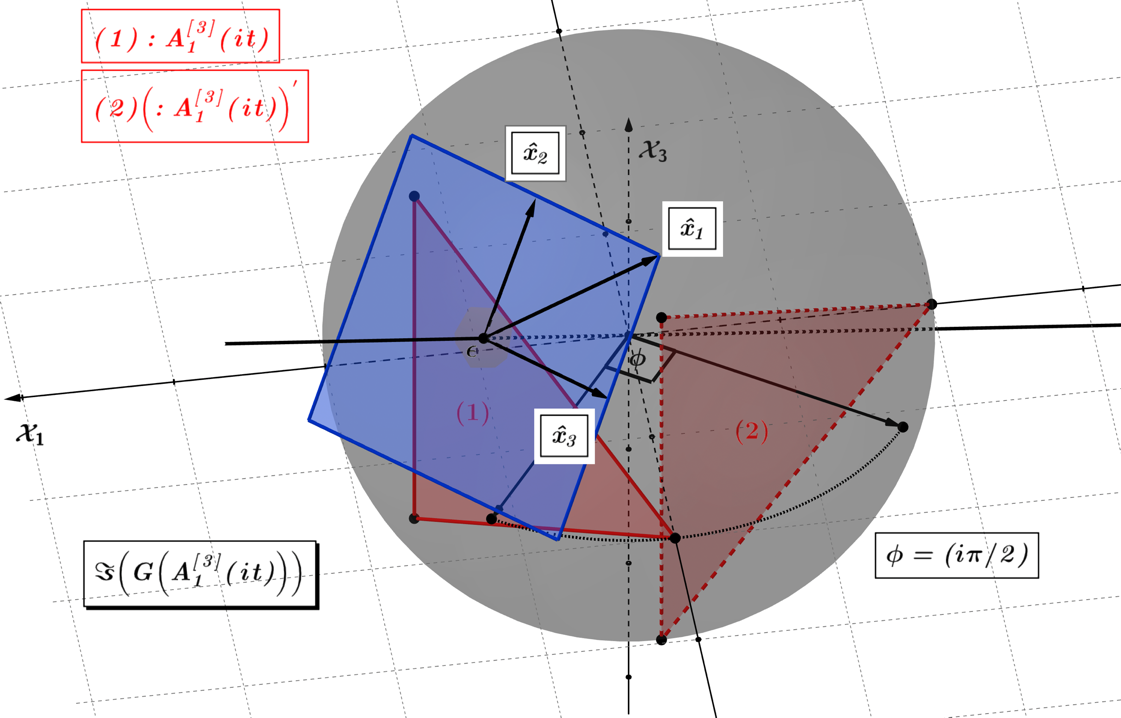
In Figure 1.2.6, we present the tangent space, , as the three eigenvectors that form it when passing through the identity at . Triangle-1 represents the Lie algebra , and the derivative algebra is represented by triangle-, which is rotated by in the phase space from . The blue-plane section is tangent to the sphere in the neighborhood of the identity , for weighted vectors representing the path the triangle's vertices take passing through . The Euclidean flatness of the tangent space in the figure above can be readily appreciated, capturing the Lie algebra giving rise to the curved geometry of the group.
Figure 1.2.6 – The tangent space for , where is the Lie algebra, is
the derivative Lie algebra,is the identity, andare the tangent space vectors.
The Lie algebra representations in the figure differ from previous images in the book, which were renderings of the generator's column vectors. The Lie algebras in Figure 1.2.6 are plots of the resulting row vectors in the tangent space from the products
(1.2.159)
(1.2.160)
where the eigenvectors matrices are equivalent for the and algebras. The resulting , vector matrices represent eigenvector matrices that solve the eigenvalue/eigenvector decomposition
(1.2.161)
For example, the eigenvector matrix forms the following product with the diagonal eigenvalue matrix
(1.2.162)
which equals We have not yet explicitly stated that
(1.2.163)
but this does hold for the Lie groups with and -type Lie algebras, which is very similar to the non-matrix derivatives. This implies that the group derivative is equivalent to the group being acted on by its Lie algebra via matrix multiplication. This makes intuitive sense since a derivative defines how the group changes with respect to a calculative time. Given that a matrix group commutes with itself, it holds that
(1.2.164)
where multiplication on either side by the Lie algebra is equivalent. The group derivative above is equal to the eigendecomposition technique that we have been utilizing, where holds as a result of the following theorem.
Theorem (1.2.165) – For a diagonalizable group, with a Lie algebra, the following identity holds for the group derivative
Proof –For a diagonalizable Lie algebra, the following eigendecompositionholds
whereis a diagonalized matrix of eigenvalues, for, and the matrixis the set of eigenvectors of the matrixThe exponential mapping ofyields the Lie group,, which has the eigendecomposition
Finding the group's derivativeusing the decomposition technique yields
which, after factoring out the eigenvalues, becomes
Given the identity
whereis the group's identity,is equivalent to
Setting thevariable to one, we find thatis equal to
and given that
it holds that
The Lie algebra of a group seen in the context of the tangent space allows one to visualize a matrix group's defining algebra geometrically. The following section contemplates the dependent connections a Lie group has with its Lie algebra and subalgebras beyond the tangent space.