Now that we have described the symmetric conic group, the cone subgroup and the axis subgroup, we can turn our attention to further exploring the subgroups that lay within. It should be obvious that all the dihedral groups explored in previous chapters are subgroups of the symmetric conic group, including . The reader should be thinking about Cayley's Theorem, discussed in Chapter 3, and its implication that every group is a subgroup of some symmetric group. What might not be obvious, while at the same time, remarkable is the group can be seen as a subgroup of the symmetric conic group . To remind the reader, the group's Lie algebra is represented by
(1.4.135)
generated by the following matrices,
(1.4.136)
We define two matrices, using the notation
(1.4.137)
which are two permutations , with determinants equal to . These matrices form the subgroup by having similar products relations studied for the tangent spaces of the cone. The relations are stated by the products
(1.4.138)
Although the matrices are , the entries are fixed for , remaining the same value for all products in the subgroup. Like the Lie algebra matrices described using matrices, the forms above also have determinants of . We could have also just created each matrix of the Lie algebra individually but seeing how the products of create the subgroup , this lends itself to a better geometric perspective about how the cone numbers and axis numbers relate. By associating the variables to the matrices, as well as defining to be a scalar constant, we rewrite the matrices as the set :
(1.4.139)
and define as the group
(1.4.140)
with determinants
(1.4.141)
where these matrices have a Euclidean distance metric, scaled by the constant . By setting , the determinant reduces to , and is the familiar determinant of the group with its matrices. As seen in Section 1.4.2, the chord-related tangent spaces of the cone yielded the group, and these chords can be envisioned as the entries in our matrices, highlighted in bold, in the following
(1.4.142)
and as permutation elements of the symmetric conic group, they are responsible for these chord relationships. Taking the matrix exponentials of the matrices, we find
(1.4.143)
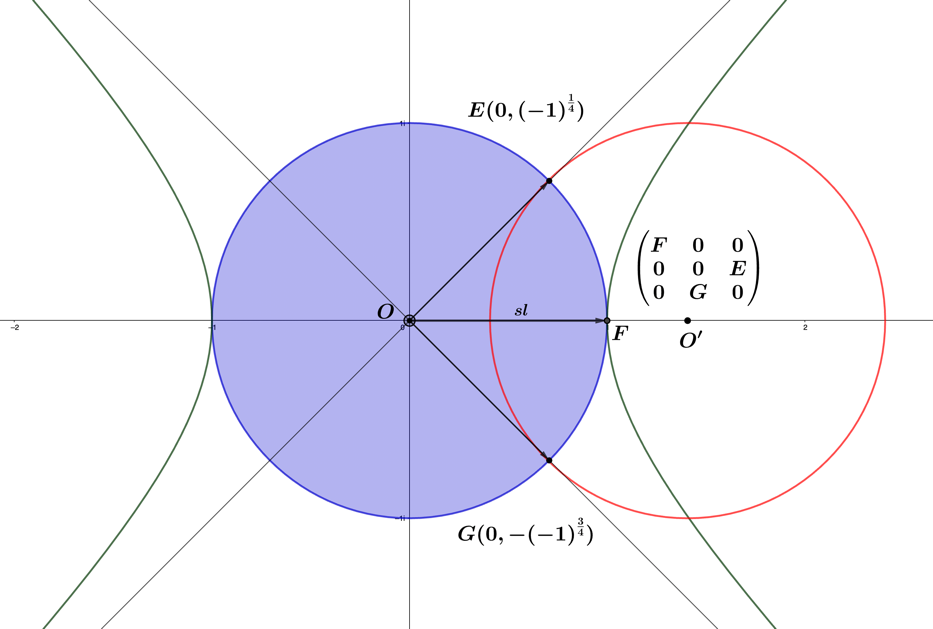
which all have determinants equal to , representing a symmetric scaling by way of the rotational axes. In Figure 1.4.18, we represent the example of the -element in relation to the circle, representing a slice of the inscribed sphere group, for the axis of rotation of the-element, representing the minimal slice vector pointing toward
(1.4.144)
Figure 1.4.18 – The -element for and, represents the axis of rotation for , a slice of the sphere, as a disc through the -plane of radius , is the origin of the sphere.
As we saw with the inscribed spheres of the tangent cone, the other iterations of the group are found the same way. The group with opposite chirality can be derived from the following elements of the symmetric conic group
(1.4.145)
for the matrix , taking the diagonal form of a -type matrix, denoting the element with a bar to show its subgroup relationship. The matrix products , are found to represent the following matrix elements,
(1.4.146)
The above matrices differ from the prior matrices for , by having the bottom-right submatrices flip signs for each entry. The elements all square to -1, in terms of their bottom-right elements, which is consistent with being imaginary number forms. The products of the matrices are reversed compared to the previous, where
(1.4.147)
The reversal of the chirality occurs because we have swapped the elements , from their positions . In essence, this entails going from a counterclockwise orientation in the sequence of elements to a clockwise one.
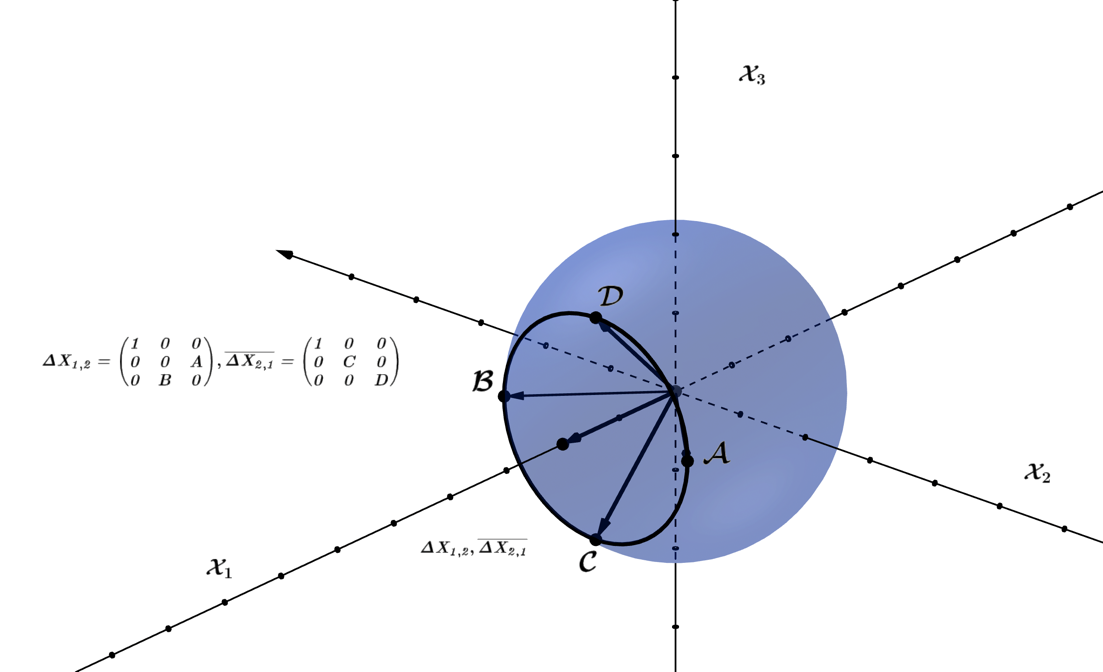
In Figure 1.4.19, a graphic depicts this chirality change for the group, where the elements of the matrix are in the -plane, for . The element is counterclockwise from the center point, while the matrix for , the element is counterclockwise from the center point in the -plane. To make this clearer the matrices are presented below with the same values for and
(1.4.148)
Figure 1.4.19 – Chirality change by switching elements , in matrix,
A comparison of the Lie algebras of the two subgroups , shows
(1.4.149)
(1.4.150)
where the change in sign for the elements on the main diagonal become apparent as the difference between the two,
(1.4.25)
Generalizing the matrices that produce the subgroup representations, depends on using a common axis of rotation for both the main diagonal matrices and the forms. These can be represented by elements of the symmetric conic group , as
(1.4.151)
where the matrices on the left represent the familiar form of the -type matrices, for , the center of rotation in each. The matrices on the right represent the respective cone numbers of the orthogonal plane, with the identity entries denoted by the number , coinciding with the centers of rotation for the matrices. Taking the examples , they form matrix products representing an subgroup with its tangent space positioned at the intersection of the imaginary -plane, and the orthogonal representation of the -plane
(1.4.152)
We can see the products have the familiar subgroup form, differing in the position for the axis of rotation for the matrices. From the Lie algebra standpoint, this subgroup can be defined as
(1.4.153)
These arrangements have a nice geometric intuition, which underscores that we can rotate the elements to arrive at the other chiral forms of , which is what was occurring for the example. To demonstrate, using ,, we rotate both matrices by raising them to the odd power of three
(1.4.154)
(1.4.155)
seeing that has rotated to its antipodal point on the sphere of tangent spaces, and has mapped to its negative complex conjugate, . The matrices of the resulting group become
(1.4.156)
showing that the product now maps to the matrix. Further, now maps to , instead of the previous . The overall effect is to reverse the subgroup's chirality, leading to the chiral Lie algebra
(1.4.157)
The essence of the transformation maps to its negative and antipodal position, where becomes its negative complex conjugate, and therefore, we can represent the transformation as
(1.4.158)
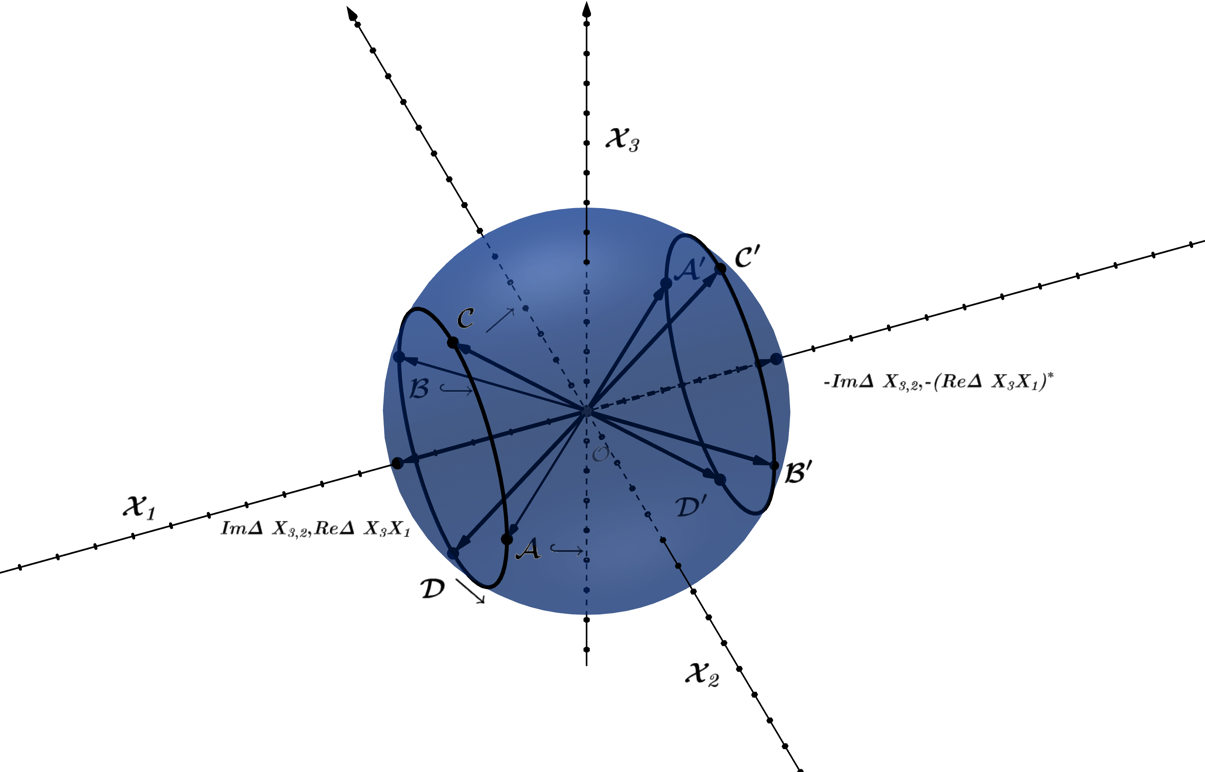
In Figure 1.4.20, we show a geometric rendering of this transformation, where the matrices transform for coinciding points , as follows:
(1.4.159)
(1.4.160)
The point to not overlook, is that rotates in the -plane, while transforms in the -plane.
The final thing we consider, are the exponential mappings of the subgroup algebras as forms based . It turns out that since the axis properties of the Euclidean distance metric remains intact, the finite group relationship remains intact, seen by using denoting the Lie algebra, as
(1.4.161)
then proceeding to find the matrix exponential , resulting in the Lie group representation
(1.4.162)
The group above shares the same result for its bottom-right sub-matrix, with the matrix exponentiation of the Lie algebra . In addition, the function located in the entry acts to scale the axis of rotation for the group.
Figure 1.4.20 – Chirality change by mapping: .